Nam In-soon, Democratic Party Lawmaker
Violation of National Health Promotion Act
Convenience Store Violations Increasing Since Last Year
As convenience stores have emerged as a key channel for alcohol distribution, they have recorded the highest number of violations of alcohol advertising regulations. It appears that the number of violations has surged as these stores put all their efforts into online marketing for alcohol sales.
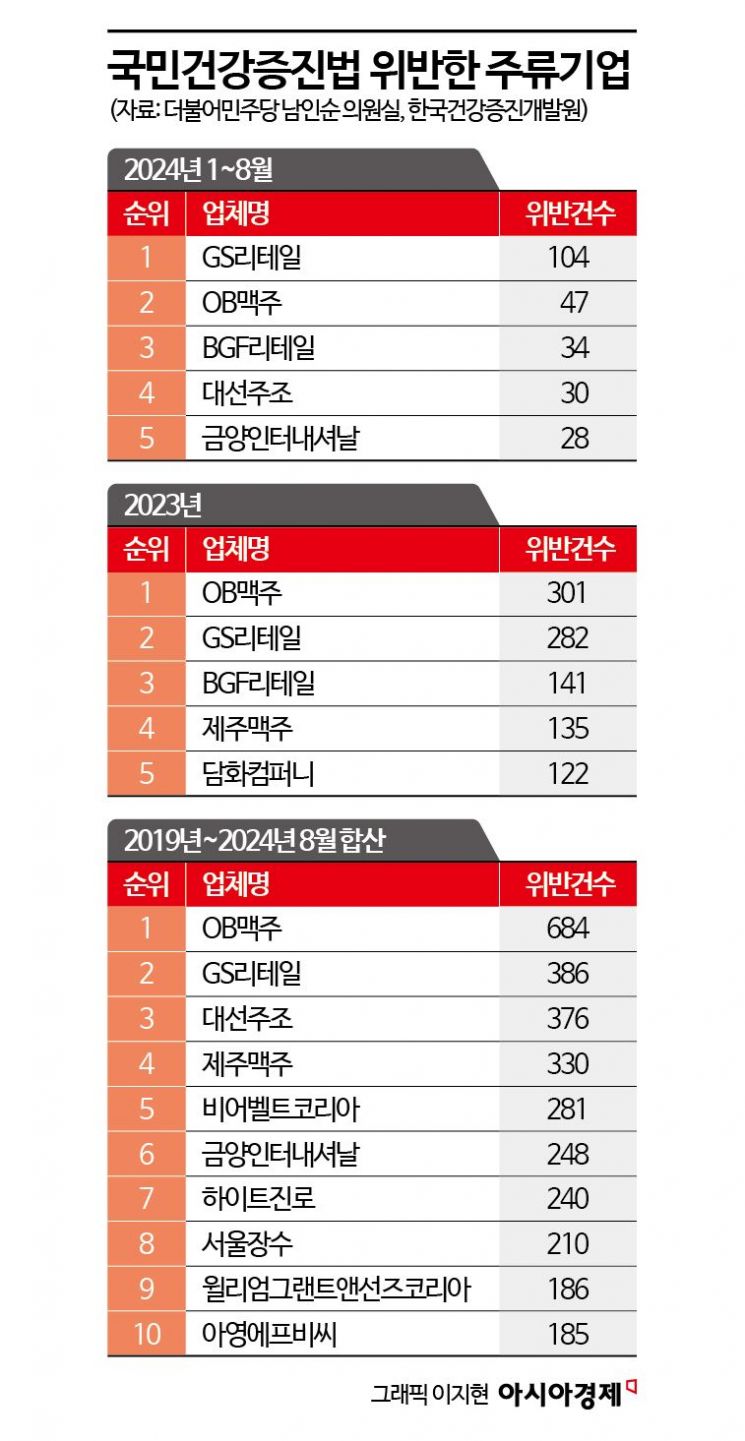
According to data submitted by the Korea Health Promotion Institute to Nam In-soon, a member of the National Assembly’s Health and Welfare Committee from the Democratic Party of Korea, the company with the most violations of the National Health Promotion Act from January to August this year was GS Retail. BGF Retail also ranked third in the number of violations. GS Retail and BGF Retail operate the convenience stores GS25 and CU, respectively.
GS Retail recorded 104 violations of the National Health Promotion Act through August this year, exceeding those of alcohol manufacturers such as OB Beer (47 violations) and Daesun Brewery (30 violations). BGF Retail also had 34 violations. Violations by convenience store companies have surged since last year. In 2022, GS Retail (282 violations) and BGF Retail (141 violations) ranked second and third, respectively, in the number of violations.
According to the National Health Promotion Act, alcohol advertisements must not include content offering prizes to promote sales beyond informing about the product name, type, and characteristics. The advertisement content must not directly or indirectly encourage drinking, nor show drinking while driving or working.
However, these companies advertised alcoholic products online through social networking services (SNS) and YouTube, offering prizes to customers who shared posts or including phrases encouraging drinking in SNS posts. Some companies held offline events themed around beer and other alcoholic beverages, and as they actively promoted related marketing mainly online, the number of violations reportedly surged.
The number of violations of online alcohol advertising regulations was also evident in violations by media type. The Korea Health Promotion Institute monitored all alcohol advertisements and issued corrective actions through July this year. Of the total 649 violations across all media, 96% (625 violations) were through communication media such as SNS. Considering that alcohol advertisements via communication media accounted for only 1.2% (4,134 cases) of the total 344,678 alcohol advertisements during this period, the violation rate is interpreted as high. This contrasts sharply with broadcast media such as TV and radio, where only 15 violations were found among 340,200 alcohol advertisements.
The recent surge in violations of the Health Promotion Act is also attributed to the convenience store industry’s active marketing aligned with new alcohol product launches. As the number of 'home drinking' consumers who make alcohol at home increases, convenience stores are competitively releasing new products. In addition to traditionally popular beers and soju, more stores are handling wine and whiskey, and unique alcoholic beverages such as highballs reflecting the 'mixology' trend (mixing alcohol and beverages) are being actively launched.
The convenience store industry acknowledges the issues and intends to improve. A representative from the convenience store sector said, "There were shortcomings in the process of strengthening promotions and customer benefits for differentiated alcoholic beverages recently, and we are actively working to improve these. Going forward, we will prioritize public health and strictly comply with relevant laws."
© The Asia Business Daily(www.asiae.co.kr). All rights reserved.


















