10,062 Greenwashing Cases Disposed Over 5 Years
Among Them, 10,013 Are Non-Compulsory 'Administrative Guidance'
Only 6 Cases Received Fines
"Strong Sanctions Needed Against Deceptive Eco-Friendly Consumer Practices"

It has been revealed that 99% of companies that engaged in greenwashing over the past five years received only mild disciplinary actions. These companies deceived consumers by promoting themselves as eco-friendly but were only subject to administrative guidance, which carries no enforcement power. Only a very small number of companies were fined or ordered to cease their activities. As the number of greenwashing cases detected increases every year, there are calls to strengthen related regulations.
According to the "Greenwashing Investigation Status" submitted by the Ministry of Environment to the office of Kang Deuk-gu, a member of the National Assembly’s Environment and Labor Committee, from 2019 to August of this year, a total of 10,062 greenwashing sanctions were issued. Among these, 10,013 cases (99.5%) received administrative guidance. Administrative guidance is a type of recommendation without any enforcement power, and companies are not obligated to comply, making it the mildest form of disciplinary action.
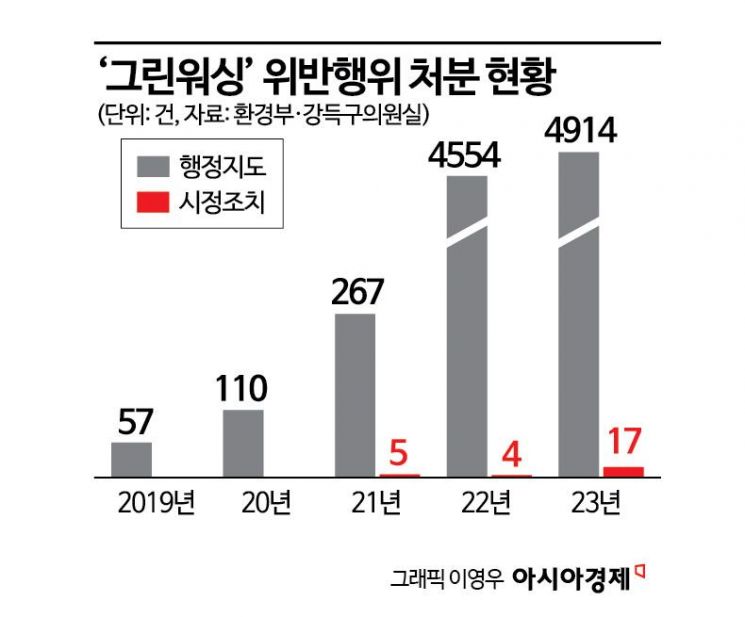
According to the Environmental Technology Industry Act, companies are prohibited from advertising in a way that deceives or misleads consumers regarding the environmental performance of their products. Violations are subject to sanctions by the Ministry of Environment. Sanctions are divided into corrective actions and administrative guidance. Corrective actions require immediate cessation of the advertisement and submission of a compliance report within one month from the date of the order. Corrective actions accounted for only 42 cases (0.4%) during the same period.
There were only six cases where fines were imposed. All were penalties for failing to submit empirical data. Although the law allows for additional penalties such as surcharges or imprisonment of up to two years if violations are found during greenwashing investigations, no such cases have been actually sanctioned.
The industry with the highest prevalence of greenwashing is non-store retailing (telemarketing), with 8,331 sanctions issued. This is attributed to the increase in non-face-to-face sales conducted online without physical stores. The second highest was cultural, entertainment, and leisure goods retailing with 563 cases, followed by general retailing (478 cases), other household goods retailing (167 cases), and other specialized goods retailing (166 cases).
The number of greenwashing companies is gradually increasing. Last year, 1,822 companies were caught greenwashing. While there were only 45 companies in 2019, the number rapidly increased to 110 in 2020, 244 in 2021, and 1,498 in 2022. Notably, greenwashing among large corporations has increased. Until 2020, all detected greenwashing companies were small and medium-sized enterprises. In 2021, one large corporation was caught for the first time, and last year the number rose to 26.
According to violation cases disclosed by the Korea Environmental Industry & Technology Institute last year, many companies advertised their cookware as eco-friendly simply because it did not deform under high heat or was made of pure cotton or paper. Some companies claimed "non-toxic" status by meeting legal standards such as KC certification or children's product safety standards. There were also cases of exaggerated advertising where companies claimed "non-toxic" status under the pretext of having received environmental label certification despite only slightly reducing harmful substances.
The Ministry of Environment has expressed its intention to actively utilize corrective actions with enforcement power. A Ministry official explained, "While administrative guidance was frequently used in the past, we have been trying to use corrective actions more actively since this year," adding, "We are also sending warnings that failure to comply with corrective actions may lead to prosecution, striving to suppress greenwashing by companies as much as possible."
In the National Assembly, there are voices calling for more active measures such as imposing fines to fundamentally reduce greenwashing. The Ministry of Environment also proposed a bill early last year to impose a fine of 3 million won to reduce greenwashing. The bill was discarded as the National Assembly session ended, but discussions are underway to reintroduce related legislation. Assemblyman Kang stated, "We need to impose stronger sanctions so that acts of deceiving consumers with lies such as eco-friendly, non-toxic, and pollution-free are recognized as crimes."
© The Asia Business Daily(www.asiae.co.kr). All rights reserved.


















