Jeonju Unemployment Benefit Claims 225,000 'Exceed Expectations'
Labor Ministry's September Employment Report on 4th in Focus
Oil Prices Rise Over 2% Amid Middle East Tensions
The three major indices of the U.S. New York stock market are falling in early trading on the 3rd (local time). Amid heightened tensions in the Middle East due to the clash between Israel and Iran, investors are taking a wait-and-see approach to the market as they await the September employment report, which will show the current state of the U.S. labor market.
As of 9:31 a.m. in the New York stock market, the Dow Jones Industrial Average, centered on blue-chip stocks, is down 0.3% from the previous trading day, standing at 42,069.43. The S&P 500, focused on large-cap stocks, is down 0.26% at 5,694.98, and the Nasdaq, centered on tech stocks, is trading down 0.42% at 17,850.22.
The number of new U.S. unemployment claims exceeded market expectations. According to the Department of Labor, new unemployment claims for the week of September 22?28 rose by 6,000 from the previous week's 219,000 to 225,000, surpassing experts' forecast of 222,000 by 3,000. Although not a large increase, this is interpreted as a sign that the labor market is gradually easing. Continuing claims, which count those claiming unemployment benefits for at least two weeks, were 1,826,000 for the week of September 15?21, down by 1,000 from the revised figure of 1,827,000 the previous week.
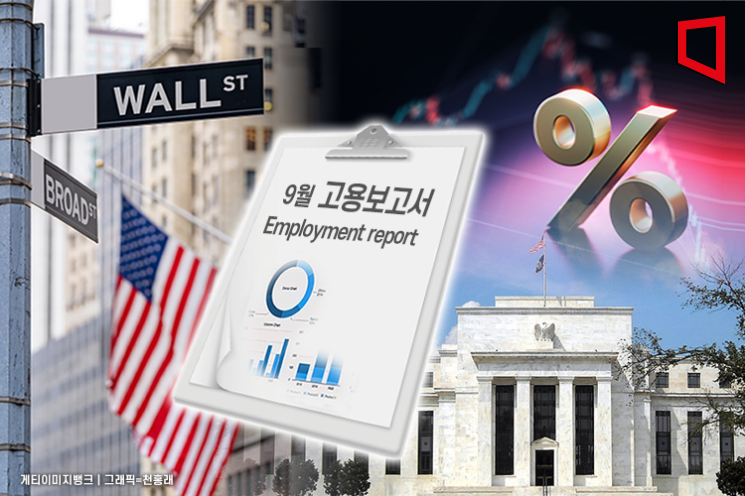
Wall Street's attention is focused on the September employment report to be released the next day. According to a Bloomberg survey, nonfarm payrolls are expected to have increased by 146,000 in September, up 4,000 from August's 142,000. The unemployment rate for September is expected to have remained steady at 4.2%. The market is likely to use the employment report to assess the current labor market and economy and to gauge the Federal Reserve's next rate cut.
Phil Hunt, chief economist at Column Pickering, said, "Tensions are rising ahead of the jobs report the next day," adding, "If the unemployment rate rises, the market will likely shift back to expecting a 50 basis point (bp = 0.01 percentage point) rate cut, and the Fed's response to this will be crucial."
Expectations for a big cut (a 0.5 percentage point rate cut) have receded. According to the Chicago Mercantile Exchange (CME) FedWatch, the federal funds futures market currently reflects a 63.5% chance that the Fed will cut rates by 0.25 percentage points in November, up from 50.7% a week ago. Meanwhile, the probability of a 0.5 percentage point cut has dropped from 49.3% to 36.5% during the same period.
The escalation of Middle East conflicts is also suppressing investor sentiment. On the 1st, Iran launched a large-scale missile attack on Israel, raising concerns that a full-scale war could expand in the Middle East. Although Iran declared the missile attacks over and drew a line against further provocations, Israel has warned of retaliation. Additionally, simultaneous strikes by port workers in the southeastern U.S. are increasing uncertainty.
On Wall Street, there is analysis that although volatility will prevail, there is still room for stock market gains.
Mary Ann Bartels, chief investment strategist at Sanctuary Wealth, said, "The stock market is grappling with various concerns such as heightened Middle East tensions, port strikes, and election uncertainties," adding, "With the Fed beginning to cut rates, liquidity has increased, which means the market can continue to rise." She further advised, "Accept the volatility in October," and added, "There is still plenty of fuel left in this bull market."
By individual stocks, Levi's is down 10.93% after lowering its annual sales forecast and announcing it is considering selling the clothing brand Dockers. U.S. power semiconductor company Wolfspeed is down 6.99% after Mizuho downgraded its investment rating from 'underperform' to 'neutral.' Tesla is down 0.22% after posting third-quarter vehicle delivery results below market expectations the previous day.
Government bond yields are rising. The U.S. 10-year Treasury yield, a global bond yield benchmark, is up 3 basis points from the previous trading day to 3.82%, while the 2-year Treasury yield, sensitive to monetary policy, is trading at 3.67%, up 4 basis points from the previous day.
International oil prices have surged more than 2% amid rising Middle East tensions. West Texas Intermediate (WTI) crude oil is up $1.81 (2.58%) from the previous trading day to $71.91 per barrel, and Brent crude, the global oil price benchmark, is up $1.74 (2.35%) to $75.64 per barrel.
© The Asia Business Daily(www.asiae.co.kr). All rights reserved.

















