Government Announces 'Measures to Stabilize Construction Costs'
Industry: "Quality Control and Realistic Adjustment Take Long Time"
Concerns Raised Over 'Union Inspections and User Effectiveness'
Skilled Workforce and Public Construction Cost Measures Seen Positively
"Plans such as importing cement or robotizing construction machinery are encouraging. However, it is expected that the process of realizing these plans will take a considerable amount of time, including issues related to quality control."
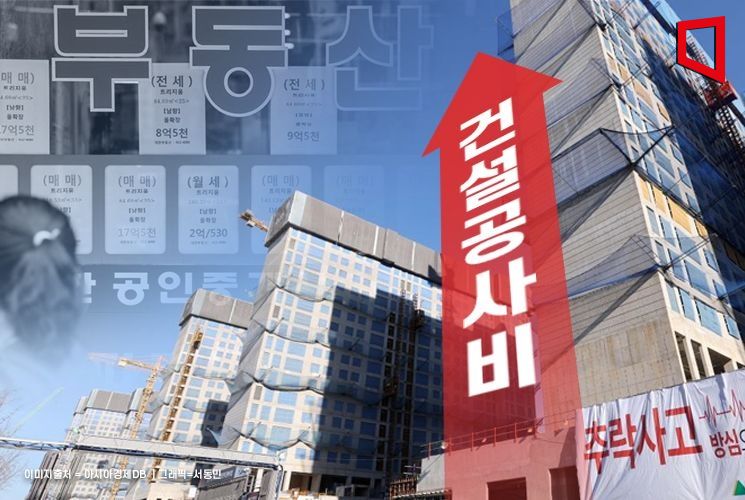
The construction industry welcomed the government's 'Construction Cost Stabilization Plan' announced on the 2nd but judged that its effectiveness would be limited. Some even commented, "Above all, it is too late to control construction costs that have already risen significantly."
Regarding the government's measure to stabilize supply by importing cement, which has seen soaring prices, it was viewed as potentially only sending a downward price signal. Despite the decline in the price of bituminous coal, a raw material, cement prices rose from 75,000 KRW per ton in July 2020 to 92,400 KRW in July 2022, and further to 112,000 KRW in July this year.
A representative from Construction Company A said, "It is desirable to verify the quality of imported cement through 'KS certification,'" but expressed concerns that "due to the wide variety of cement types and the difficulty of checking even private construction projects, this may not be practical." He added, "Although the quality of Chinese cement is not inferior, people's perception is the problem," and explained, "Even in maintenance projects, the associations look for 'domestic' products rather than 'imported' ones."
A representative from Construction Company B also pointed out, "Imported cement could be used for government projects, but unless the government actively manages quality certification stages, widespread adoption may be difficult." While unit price competitiveness is important, quality must also be guaranteed.
Regarding the plan to increase skilled foreign workers to alleviate labor shortages and to prepare a plan to reflect public construction costs by the end of the year, the response was generally positive. A representative from Construction Company C said, "Public construction projects are also frequently failing to attract bids," and added, "Since the funding comes from taxes, the government must be cautious, but because these projects affect hundreds of thousands of people, quick decision-making through cost reflection is necessary."
Some opinions noted that only monitoring and restrictions were presented without incentives for construction companies, and that inspections of labor unions are also needed. A representative from Construction Company D advised, "Realistic inspections of various union issues, such as 'cargo unions in the material distribution process' and 'union disagreements over the use of foreign workers,' which are frequent causes of construction stoppages, are necessary."
From the demand side, it was pointed out that the actual sale prices do not significantly decrease according to construction costs, reducing effectiveness. A representative from Construction Company E said, "It is not easy to lower construction costs once they have risen. It literally means reducing the rate of increase in construction costs," and added, "For buyers who feel burdened by apartments in Seoul with exclusive areas of 59㎡ priced over 1 billion KRW, this will not resonate."
© The Asia Business Daily(www.asiae.co.kr). All rights reserved.
![User Who Sold Erroneously Deposited Bitcoins to Repay Debt and Fund Entertainment... What Did the Supreme Court Decide in 2021? [Legal Issue Check]](https://cwcontent.asiae.co.kr/asiaresize/183/2026020910431234020_1770601391.png)















