New Provocation Mentioned Targeting the US... Possible ICBM Launch
South Korea Specified as Primary Adversary with Potential Frontline Provocation
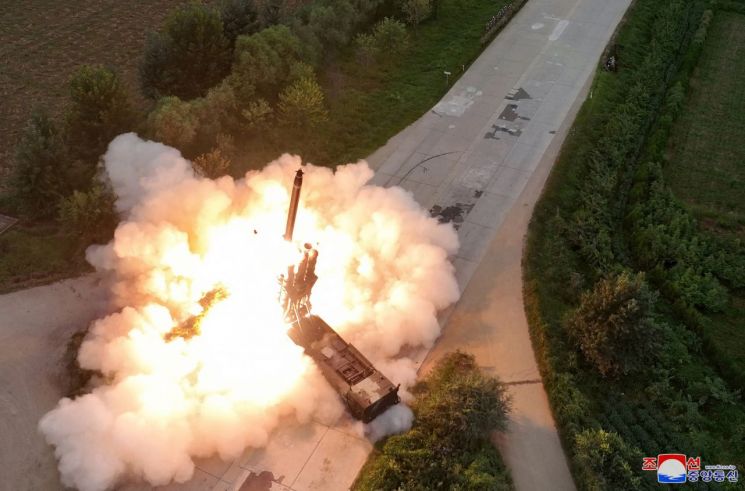
North Korea has announced that it will begin full-scale military provocations targeting South Korea and the United States starting this month. It is expected to specify the Republic of Korea as its 'primary adversary,' as well as conduct launches of solid-fuel intercontinental ballistic missiles (ICBMs) aimed at the U.S. mainland.
On the 2nd, the Joint Chiefs of Staff reported that North Korea is floating suspected balloons carrying trash intended for South Korea. Considering the wind direction, there is a high possibility that they will move toward northern Gyeonggi Province or the Seoul metropolitan area. This is the first time North Korea has floated balloons in ten days since the 22nd of last month.
Provocations in the frontline areas are also anticipated. At the Supreme People's Assembly scheduled for the 7th (equivalent to our National Assembly), North Korea is expected to amend its constitution to designate South Korea as its 'primary adversary' and establish a new 'maritime border line.' It is unlikely to recognize the Northern Limit Line (NLL) in the West Sea and may draw a new line near Yeonpyeong Island and Baengnyeong Island, further south than the 'guard line' it claimed in 2007. Observers expect that North Korea will deliberately send naval vessels to provoke disputes.
There is also mention of the possibility of new provocations targeting the United States, 35 days ahead of the U.S. presidential election. On the 1st, North Korea threatened, stating, "New methods that add serious concerns to the safety of the U.S. mainland should rightfully emerge." This is interpreted as hinting at a test launch of the solid-fuel ICBM 'Hwasong-18' aimed at the U.S. mainland.
Until now, North Korea has launched ICBMs at high angles, but there is a strong possibility they will launch at normal angles. This would maximize the threat effect and demonstrate technical capabilities that allow the warhead to withstand high heat and friction and enter the atmosphere stably. Some speculate that North Korea may have received partial transfer of ICBM reentry technology from Russia, with which it has elevated military alliance-level relations.
In this way, North Korea is sequentially showcasing its strike capabilities against South Korea and the U.S., raising the level of threat, and after the U.S. election, it may carry out a seventh nuclear test to demand recognition as a nuclear power from the new U.S. administration and enter nuclear negotiations. The National Intelligence Service also reported at last month's National Assembly Intelligence Committee plenary session that the nuclear test is "more likely to occur after the U.S. election than before."
North Korea's announcement of provocations against South Korea and the U.S. on the 1st appears to be a reaction to the deployment of the U.S. Air Force strategic bomber B-1B to the Korean Peninsula and the first public unveiling of the 'Hyeonmu-5' ballistic missile, known as the 'monster missile,' on the occasion of Armed Forces Day. On the same day, our military also revealed the Korean supersonic fighter KF-21 and the long-range surface-to-air missile (L-SAM), dubbed the 'Korean version of THAAD.'
A military official said, "In preparation for North Korea's provocations, South Korea and the U.S. are maintaining 24-hour surveillance without letting up."
© The Asia Business Daily(www.asiae.co.kr). All rights reserved.

















