Improving Housing Instability Due to Construction Cost Surge
Joint Inspection Team of Relevant Ministries Operated to Address Unfair Practices
Securing Aggregate Sources by Improving Regulation Application Methods
The government has decided to stabilize construction material and labor costs to manage the construction cost increase rate at around 2% until 2026. To this end, a joint inspection team composed of related ministries will be operated to improve unfair practices in the construction industry while supporting the overseas import of key materials such as cement. Additionally, various systems will be established to expand the input of young and foreign workers.
On the 2nd, the government held an Economic Ministers' Meeting and announced the "Construction Cost Stabilization Plan" with these details. Since construction costs surged by about 30% due to rising material and labor costs after 2020, causing intensified conflicts in maintenance projects and a decrease in mid- to long-term housing supply, leading to housing supply instability issues, this plan includes measures to improve these problems.
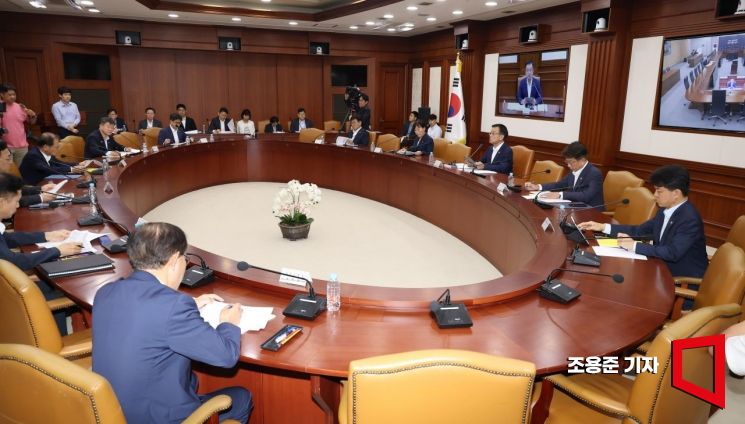 The Economic Ministers' Meeting held on the 28th of last month at the Government Seoul Office in Jongno-gu, Seoul. Photo by Jo Yongjun jun21@
Through this, the government set a goal to manage the construction cost increase rate from next year until 2026 at around 2%, which is lower than the recent three-year average of 8.5%. It also plans to support construction contract amounts exceeding 200 trillion won next year. Kang Gi-ryong, Director of Policy Coordination at the Ministry of Economy and Finance, said, "(The 2% target) is based on the inflation rate, considering the stabilization of materials such as thermal coal and steel, and the 1.4% increase in construction wages," adding, "We will strive to achieve this as much as possible."
Focused Inspection on Key Materials... Expansion of Aggregate Extraction Sources
To stabilize material costs, the government will operate a cross-ministerial inspection team for illegal and unfair practices in the construction sector for six months starting next month. Despite the price drop in thermal coal, which was a cause of price increases for representative items like cement, the supply price has risen, and the construction industry has maintained inelastic material supply prices, continuing unfair practices. The government decided to improve this. While focusing on inspecting key materials, the inspection team’s operation may be extended if necessary. During this process, a supply-demand stabilization consultative body for voluntary dialogue among industries will also be promoted simultaneously.
Additionally, the government will support overseas cement imports. Since it is difficult for new businesses to enter the market for key materials such as cement and steel, prices fluctuate sharply during supply instability. The government will resolve difficulties such as obtaining permits for port cement storage facilities (silos) and securing inland distribution bases when the private sector attempts to import overseas cement. In this process, quality and safety will be verified through KS certification, and quality control will be strengthened by regularly inspecting the distribution process.
The government will improve the regulatory application method to expand aggregate extraction sources. This is to address the difficulty in responding to increased aggregate demand due to reduced supply of natural aggregate sources from the sea, forests, and land caused by strengthened environmental regulations. Accordingly, sea aggregates will be allocated based on actual extraction volume (5% of total aggregates) and managed accordingly. Forest aggregates will expand quarrying areas to include restricted soil and rock extraction zones if necessary, and land aggregates will ease urban planning review requirements.
Consideration of Hiring Incentives and Introduction of E-7 Visa
To stabilize workforce supply caused by aging in the construction industry, incentives will be provided to encourage youth entry. Vocational education will be strengthened for young people, and incentives will be given for hiring skilled workers to ensure they are properly treated. This includes awarding additional points in construction company capability evaluations and relaxing registration standards for specialized construction businesses (such as reducing capital requirements).
Existing regulations on foreign workers will be eased, and a skilled worker visa system will also be considered. The reasons for movement between construction sites for foreign workers with E-9 visas will be specified, and in the mid- to long-term, the introduction of the E-7 skilled worker visa will be considered only for domestic unpopular industries. The government has consulted with the Ministry of Justice on this and, since there is broad consensus, plans to quickly proceed with a pilot project.
Efforts will also be made to eradicate unfair practices related to construction machinery such as tower cranes and to promote modular construction methods. Amid widespread slowdowns and illegal activities related to construction machinery, rental fees for construction equipment have recently risen rapidly. The government will conduct intensive inspections of construction machinery sites for six months in connection with the joint construction sector inspection team and expand the application of electronic payment systems to ensure transparency in rental fees and labor costs. In supporting robotization and modular construction methods, the government plans to expand modular public housing orders to 3,000 units annually by 2030.
Allowing Direct Purchase of Government-Supplied Materials by Public Institutions
To improve the public procurement purchasing system, the government will change the system for purchasing government-supplied materials. For major public construction projects of national importance, such as the 3rd New Towns, public institutions as ordering parties will be allowed to directly purchase government-supplied materials without going through the Public Procurement Service, reducing purchasing procedures. Separately, the Ministry of SMEs and Startups will prepare supplementary measures for the direct purchase system of construction materials through research services in the first half of next year.
The government will also promote the realization of public construction costs. To improve cases where major large-scale public construction projects are canceled or delayed due to insufficient reflection of cost increases during the surge period, the government plans to finalize and announce institutional improvement measures within the year. These measures include adjusting general administrative expense rates, rationalizing the application method of the total project cost price index, and evaluating the appropriateness of bid rates.
© The Asia Business Daily(www.asiae.co.kr). All rights reserved.

![Clutching a Stolen Dior Bag, Saying "I Hate Being Poor but Real"... The Grotesque Con of a "Human Knockoff" [Slate]](https://cwcontent.asiae.co.kr/asiaresize/183/2026021902243444107_1771435474.jpg)
















