Recognition of Technological Excellence from 'Manufacturing Powerhouse' Czech Republic
Will Serve as a Catalyst for Expanding Nuclear Power Plant Exports in Europe
Need for Vertical Integration of Dual-Track Nuclear Power Plant Exports
Raised Necessity for Korea Hydro & Nuclear Power's Construction Management
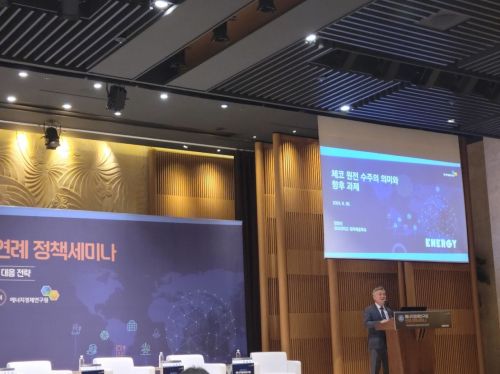
It has been assessed that if South Korea successfully constructs the Czech nuclear power plant, it will serve as a foothold for further expansion into other European countries. Since the Czech Republic is a manufacturing powerhouse located in the heart of Europe, this project holds a different significance compared to the previously constructed Arab Emirates (UAE) nuclear power plant. However, there are also suggestions that the current dual system managed by Korea Electric Power Corporation (KEPCO) and Korea Hydro & Nuclear Power (KHNP) should be improved for future nuclear power plant exports.
At the annual policy seminar held on the 30th of last month at the Korea Advertising Culture Center by the Korea Energy Economics Institute, Professor Jeong Beom-jin of Kyung Hee University's Department of Nuclear Engineering explained the significance in his presentation titled "The Meaning of the Czech Nuclear Power Plant Contract and Future Tasks." He stated, "The Czech Republic is already a nuclear power country operating six reactors including Dukovany Units 1-4 and Temelin Units 1 and 2, and is a manufacturing powerhouse in Europe," adding, "This has a greater impact than winning a contract from a country like the UAE, which has no prior experience with nuclear power plants."
Recently, in Europe, following the Russia-Ukraine war, there has been an increased sense of crisis regarding energy security, leading to expanded demands for nuclear power plant construction. Countries such as the United Kingdom, France, Finland, Sweden, Poland, the Netherlands, and Switzerland are all promoting nuclear power expansion. Amid this, with Russia, a former dominant player in the European nuclear market, being excluded, opportunities are opening up for South Korea. Professor Jeong explained, "Since the Czech Republic is a country possessing independent nuclear technology and is a manufacturing powerhouse in steel and automobiles, being recognized for its technological capabilities by the Czech Republic can serve as a foothold to enter the advanced European market."
If the final contract with the Czech Republic is signed in March next year, the effects are expected to first appear in the construction sector. As the Czech Republic is a landlocked country, materials and components for nuclear power plant construction will first be transported by ship to the port of Hamburg, Germany, and then moved approximately 800 km inland. Road and bridge maintenance for this transportation is also expected to be contracted to Korean construction companies.
However, Professor Jeong emphasized the need to improve the current dual system for nuclear power plant exports, which is divided between KEPCO and KHNP. He said, "KHNP is a 100% subsidiary of KEPCO, and Korea Electric Power Technology Co., Ltd. and Korea Nuclear Fuel Co., Ltd. are also subsidiaries of KEPCO," adding, "It is difficult for KHNP to secure leadership in nuclear power plant exports," and stressed, "Vertical integration is necessary." He also mentioned, "For financing overseas nuclear power plant construction, it is necessary to corporatize KHNP." Furthermore, Professor Jeong pointed out, "Currently, there are many discretionary regulations in nuclear safety regulation, which weaken the competitiveness of domestic nuclear power plants," and called for "improvements in the regulatory system."
Park Woo-young, head of the Power Policy Research Division at the Korea Energy Economics Institute, who participated as a discussant that day, said, "European countries, which have not been prominent in the global nuclear power market, are emerging as the largest demand countries," expressing expectations that the Czech Republic will play a role as a catalyst for European nuclear power exports. Park also explained that building partnerships with local Czech companies, which have a strong manufacturing base, could strengthen competitiveness when entering neighboring European countries.
Park emphasized, "In the next 10 years, there will be a higher preference for new nuclear power plants such as Small Modular Reactors (SMRs) or non-light water reactors rather than large nuclear power plants," and stressed, "Government policy support is important to continuously maintain the competitiveness of South Korea's nuclear power industry."
Lim Chae-young, head of the Nuclear Promotion Strategy Division at the Korea Atomic Energy Research Institute, emphasized that to compete with China and Russia in the nuclear power market, South Korea must strategically form a nuclear alliance with the United States. Lim explained, "According to the 'Advanced Act' passed bipartisanship by the Republican and Democratic parties in July to promote the development of the U.S. nuclear industry, foreign capital is allowed to enter the U.S. nuclear market," adding, "Various ways have opened for South Korean companies to invest in U.S. companies and enter the nuclear power industry." Lim said, "If cooperation with the U.S. develops into an alliance, it will be much more advantageous when entering the three countries other than the U.S."
Lim also emphasized, "Solar and wind power are expanding at an incredible speed," and highlighted, "When designing next-generation nuclear power such as SMRs, it is important to secure flexibility to coexist with renewable energy."
No Baek-sik, vice chairman of the Korea Nuclear Industry Association, reminded, "South Korea cannot unilaterally reap benefits from exporting nuclear power plants," emphasizing, "There must be a win-win relationship with the counterpart." Kim Jun-han, head of the Gumi CIS Team at KOTRA, diagnosed, "The Czech Republic, like South Korea, is a small country with developed trade and manufacturing industries and many technologically capable companies," and said, "There will be many business opportunities in engineering, future mobility, advanced technology, and energy."
© The Asia Business Daily(www.asiae.co.kr). All rights reserved.











