Overall Weakness in Semiconductor, Secondary Battery, and Financial Stocks
The Korea Exchange's 'Korea Value-Up Index,' which was publicly released last week, fell nearly 3% on its official calculation day, the 30th, underperforming compared to the KOSPI.
On that day, the Korea Value-Up Index closed at 992.13, down 2.80%. The opening price was 1023.16, and it turned downward during the session, widening its losses in the latter part of the trading day.
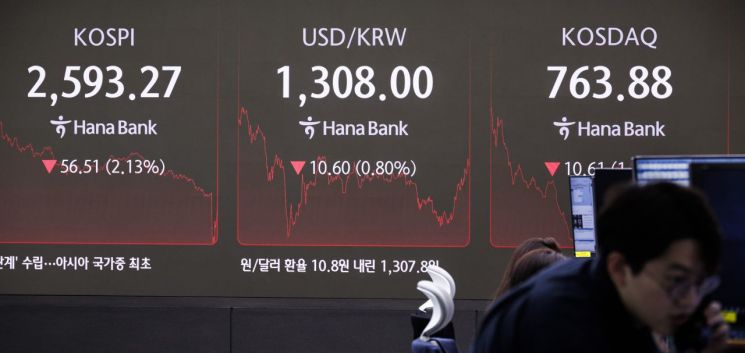
Based on the closing price, the decline was more pronounced compared to the KOSPI (-2.13%), KOSPI 200 (-2.59%), and KOSDAQ (-1.37%).
Major stocks included in the Value-Up Index such as Samsung Electronics (-4.21%), SK Hynix (-5.01%), Hyundai Motor (-4.13%), Kia (-4.68%), and Shinhan Financial Group (-1.25%) all fell together.
Out of the 100 constituent stocks that day, 81 stocks declined.
Hanjin KAL (-6.78%) had the largest drop, followed by Hanwha Aerospace (-6.31%), Rino Industrial (-5.03%), and SK Hynix (-5.01%).
On that day, the market capitalization of the Value-Up Index was KRW 970.749 trillion.
Earlier, on the 24th, the Korea Exchange announced the 100 constituent stocks and selection criteria for the Korea Value-Up Index as part of the government's corporate value-up support plan.
Lee Kyung-min, a researcher at Daishin Securities, analyzed, "Today, as the market broadly declined in sectors such as semiconductors and secondary batteries, even sectors like finance, which had been relatively strong, fell, leading to a larger drop in the Value-Up Index."
Experts believe that for the time being, the Value-Up Index is likely to show a return trend similar to indices containing large-cap blue-chip stocks from the KOSPI and KOSDAQ, such as the KRX100 Index.
Lee Jin-woo, a researcher at Meritz Securities, explained, "The Value-Up Index prioritizes companies with large market capitalizations rather than those that pay high dividends, and the industry weights are almost evenly distributed. It is essentially close to the KRX100 Index, so it can experience a larger decline than the KOSPI." He added, "With the regular revision scheduled for June next year, it will take about a year for the index's characteristics to change."
© The Asia Business Daily(www.asiae.co.kr). All rights reserved.

![Clutching a Stolen Dior Bag, Saying "I Hate Being Poor but Real"... The Grotesque Con of a "Human Knockoff" [Slate]](https://cwcontent.asiae.co.kr/asiaresize/183/2026021902243444107_1771435474.jpg)















