Sales Retreat Centered on EU and US
Bloomberg News reported that the electric vehicle (EV) transition is faltering as EV sales stagnate this year and major manufacturers scale back their EV investment plans.
According to BloombergNEF, sales of battery electric vehicles (BEVs) and plug-in hybrid electric vehicles (PHEVs) more than doubled in 2021 compared to the previous year, and grew by 62% in 2022. However, last year sales increased by only 31%, indicating a slowdown in growth.
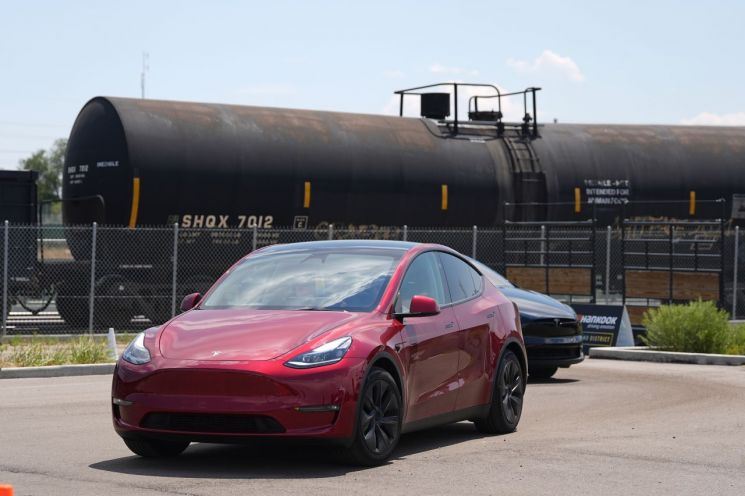
In particular, the EV transition is retreating mainly in Europe and the United States. In August this year, the market share of battery-powered vehicles in Europe was 14%, down 1 percentage point from the same month last year. According to the European Automobile Manufacturers Association, new EV registrations in August fell by 16.5% year-on-year. Especially in Germany, Europe’s largest car market, EV sales plunged by 69%. Automotive research firm JD Power predicted that battery electric vehicles would account for 9% of total vehicle sales in the U.S. market this year, a decline from the previous forecast of 12.4%. Currently, the main driver of EV market growth is China, which accounted for 59% of global sales excluding commercial vehicles.
Bloomberg analyzed that in the early EV market, there was an appeal as early adopters, and the introduction of various new technologies in vehicles made them popular. However, the consumers to be targeted for market expansion afterward were more cost-sensitive than early adopters. In Europe and the U.S., BEVs are respectively 30% and 27% more expensive than internal combustion engine vehicles. Bloomberg also noted that these consumers tend to be skeptical of the technology and cautious about purchasing EVs without confidence in charging infrastructure.
Additionally, Europe has faced the elimination of government subsidies. Without subsidies, EVs are more expensive than comparable internal combustion vehicles. Although Chinese-made EVs are affordable, Europe and the U.S. protect domestic manufacturers and counter Chinese companies such as BYD through tariffs and other trade barriers.
With weak consumer demand and reduced subsidies, major manufacturers have also scaled back their EV investment plans. These include GM, Ford, Mercedes-Benz, Volvo, and Toyota. According to BloombergNEF, traditional automakers aim to sell 23.7 million EVs by 2030, which is over 3 million fewer than last year’s forecast.
Even Tesla, the industry leader in pure electric vehicles, has recently stopped mentioning its previous goal of selling 20 million vehicles annually by 2030. Ford has completely halted plans to produce three-row electric SUVs and delayed the launch of its next-generation electric pickup truck. It plans to reduce EV investment from 40% to 30% of its annual capital expenditure. Volkswagen, Europe’s largest automaker, is negotiating with unions over the closure of a factory in Germany.
The EV retreat has also impacted battery manufacturers. Northvolt, Europe’s largest battery company, announced layoffs amounting to 20% of its global workforce.
In this situation, Western governments face a dilemma. Expanding imports and manufacturing of Chinese-made EVs and EV components could lower prices and stimulate demand in European and North American markets. However, this would weaken domestic manufacturers and strengthen China’s dominance in key emerging industries.
Bloomberg reported that some countries shocked by the recent drop in EV demand are considering reinstating purchase subsidies. Manufacturers are also expanding affordable models. According to the Transport & Environment (T&E) group, seven new EV models priced below 25,000 euros (approximately 36.56 million KRW) are scheduled to launch in the European market next year.
Accordingly, there is a forecast that the EV market will enter a recovery phase next year. T&E projected that under an optimistic scenario, EV market share in Europe could reach 24% next year. This is a significant increase compared to the 12.5% EV market share in the European Union (EU) reported by the European Automobile Manufacturers Association for January to July this year.
© The Asia Business Daily(www.asiae.co.kr). All rights reserved.

















