KISDI "User-Centered Discussion on the Mobile Subsidy Law is Essential"
Advantages Such as Mitigating User Discrimination Must Also Be Considered
Even if the Device Distribution Act is abolished, an analysis suggests that positive policies that have enhanced user welfare since the implementation of the Act, such as the selection discount, require supplementary legislation and further discussion. Evidence was also presented showing that the discount benefits have alleviated discrimination among users.
On the 3rd, the Korea Information Society Development Institute (KISDI) stated in its report titled "Device Distribution Act and Changes in the Mobile Communication Market" that "the principle of abolishing the Device Distribution Act is considered irreversible," but added, "however, even after the abolition of the law, it is necessary to focus on 'user-centered discussions based on data' to preserve the legacies of the Device Distribution Act."
A representative example of the Device Distribution Act's legacy is the selection discount. This allows users who do not receive device subsidies to receive additional discounts on their fees, which was initially 12% in October 2014 and increased to 25% in September 2017.
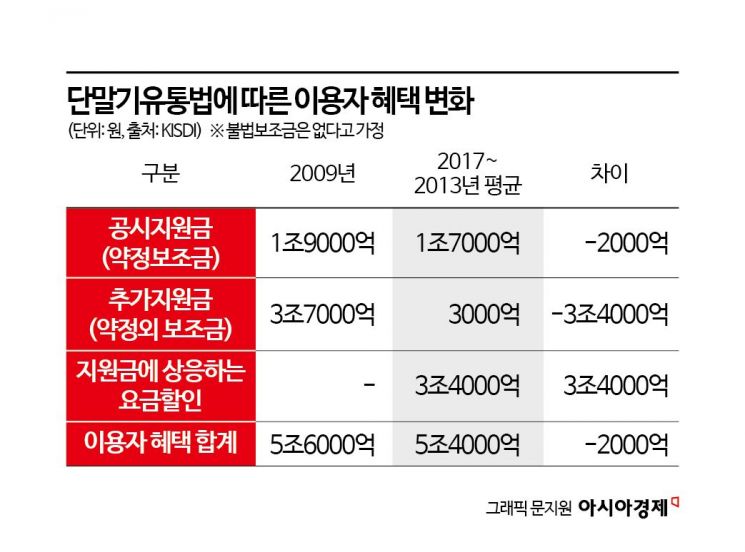
KISDI analyzed that the selection discount system offset the reduction in subsidy benefits after the implementation of the Device Distribution Act. Since the Act's enforcement, the official subsidies from mobile carriers decreased by 200 billion KRW, and additional subsidies provided by retailers and others decreased by 3.4 trillion KRW. However, fee discount benefits equivalent to the subsidies increased by 3.4 trillion KRW, resulting in an overall user benefit decrease of 200 billion KRW compared to before the Act's implementation.
Regarding this, KISDI explained, "Considering that illegal subsidies still exist before and after the enforcement of the Device Distribution Act, the actual decrease in user benefits may be smaller than 200 billion KRW or there may even be an increase in benefits."
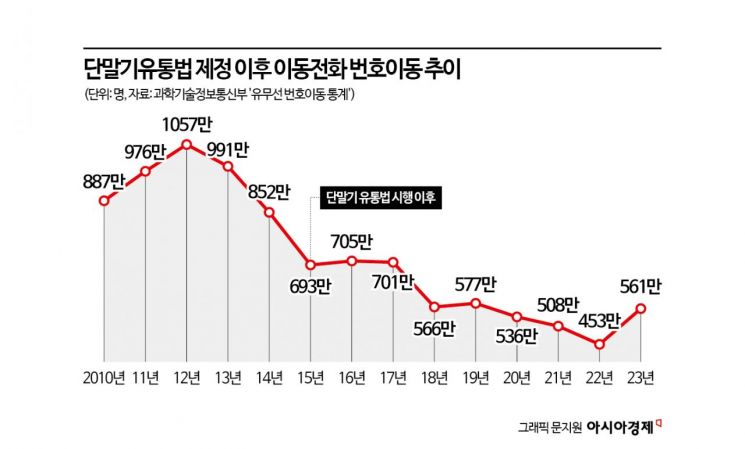
It was also pointed out that since the Device Distribution Act alleviated user discrimination based on mobile subscription types, supplementary legislation is necessary in future lawmaking. Before the Act's enforcement in 2012, the subsidy gap between new subscriptions and device changes was at an unprecedented level. As of September that year, new mobile subscriptions (number portability and new 010 numbers) received subsidies of 517,304 KRW, while device changes received 239,196 KRW. Since the Act prohibits unfair differential subsidy payments, KISDI stated that the extreme forms of user discrimination prior to the Act have been resolved.
Kang In-gyu, a senior researcher at KISDI who authored the report, explained, "Even if the Device Distribution Act is abolished, fee discounts corresponding to subsidies must be included in (supplementary legislation) to prevent a decrease in user welfare," and added, "It is necessary to compare the positive and negative effects of each provision of the (Device Distribution Act) and discuss which provisions should be included in the bill."
© The Asia Business Daily(www.asiae.co.kr). All rights reserved.


















