Yuhan Corporation announced on the 30th that it conducted biodiversity enhancement activities on the 28th at Yeouiseatgang Ecological Park in Yeouido, Seoul, and Palgyeol Wetlands of Miho River in Ochang, Chungbuk.
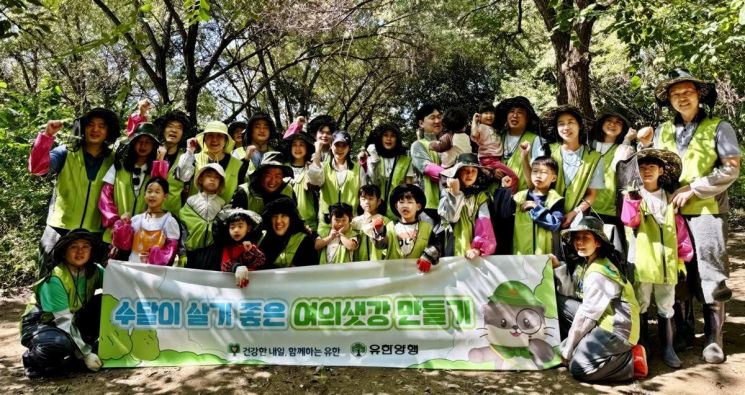
First, at Yeouiseatgang Ecological Park near Yuhan Corporation’s headquarters, about 50 employees and their families gathered to carry out the activity “Making Yeouiseatgang a Good Habitat for Otters,” aimed at protecting the habitat of otters, which are designated as a natural monument and a first-class endangered wild species.
On that day, employees and their families repaired the wooden fence protecting the otter habitat, which was installed last year, and created biotopes?artificial habitats for wildlife?within the ecological park. Since otters live in areas with little human presence, it is necessary to separate walking trails used by people from otter habitats. The fence serves to protect the otters’ habitat. Yuhan Corporation has formed an employee volunteer group to continuously carry out ecological guardian activities at Yeouiseatgang, conducting various ecological activities 4 to 5 times annually.
On the same day in Ochang, Chungbuk, about 30 children from Neulpureun Children’s Home and Yuhan Corporation employees jointly carried out biodiversity enhancement activities at the Palgyeol Wetlands of Miho River. Neulpureun Children’s Home is a childcare center located in Cheongju that has maintained a relationship with the employee volunteer group since 2018. Participants received explanations about the ecological value of the Palgyeol Wetlands and the seriousness of biodiversity decline, observed insects living in the wetlands, and engaged in forest and nature experience play activities to foster awareness of the importance of the environment.
Starting this year, Yuhan Corporation, together with the Community Chest of Korea and the environmental organization Social Cooperative Hangang, began a biodiversity enhancement project to preserve the Miho River ecosystem. They conduct seasonal monitoring four times a year in four fields: vegetation, birds, fish, and mammals, investigating key species, tracking and observing changes, and managing invasive species to improve habitat conditions. Additionally, they carry out natural vegetation management and plant scenic trees to cultivate river forests, and operate ecological programs involving employees and citizens to raise awareness of biodiversity. The Miho River biodiversity project plans to establish an ecological monitoring system by 2028 and aims to collaborate with the local community to improve habitats and designate the area as an Other Effective area-based Conservation Measure (OECM), continuing the project sustainably.
© The Asia Business Daily(www.asiae.co.kr). All rights reserved.

















