First Goal: Launch of Active Control Satellite in 2027... Research on Asteroid Exploration
Recruitment of Asteroid Expert Vice President Shueares
President Lee Kwang-hyung "Active Support for Space Sector"
"KAIST Space Research Institute will present a new paradigm for space research and education, nurture creative talents, and establish itself as a space research hub leading national space development."
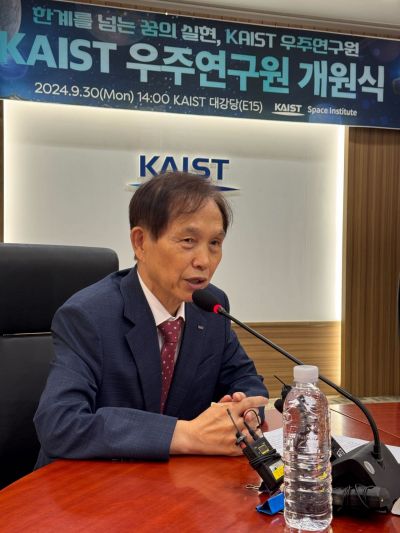 KAIST President Kwang-Hyung Lee is speaking at a press conference commemorating the opening of the Space Research Institute on the 30th. Photo by Jong-Min Baek
Lee Kwang-hyung, President of KAIST, expressed his strong will to develop the space sector, which possesses world-class technology, as a strategic field for KAIST in the 'New Space era.'
At the press conference marking the launch of the Space Research Institute held on the 30th at the KAIST headquarters in Daejeon, President Lee said, "KAIST has made significant contributions in the space sector, starting with the satellite 'UriByul.' Now, to create a new paradigm in the New Space era, we have established a new organization." He added, "No university in the world has succeeded in developing satellites as KAIST has," promising, "We will actively support space, one of the five world-class fields at the university level."
The Space Research Institute was born by integrating existing space-related research organizations within KAIST. Centered on the existing Satellite Research Center, the Space Technology Innovation Talent Training Center, Space Core Technology Research Center, and Space Convergence Technology Research Center will be established. The Hanwha Space Hub-KAIST Space Research Center, Perigee-KAIST Rocket Research Center, and Future Space Education Center, which KAIST collaborates with companies on, also belong to the Space Research Institute.
The Space Research Institute aims to conduct space missions and research on convergence and core technologies that can lead the 'New Space' era, which is led by the private sector rather than the government. It was officially opened two years after establishing a promotion team in September 2022 and has recruited a strong supporter. The key figure is Professor Daniel J. Scheeres, appointed as the deputy director of the Space Research Institute and a distinguished chair professor.
KAIST, which had strengths in the satellite field, is taking on a new challenge in asteroid exploration through Deputy Director Scheeres. Scheeres is a renowned scholar in space engineering and celestial mechanics, well known as a key researcher leading asteroid studies such as NASA's 'DART' mission, which tested whether a spacecraft could alter an asteroid's orbit by collision.
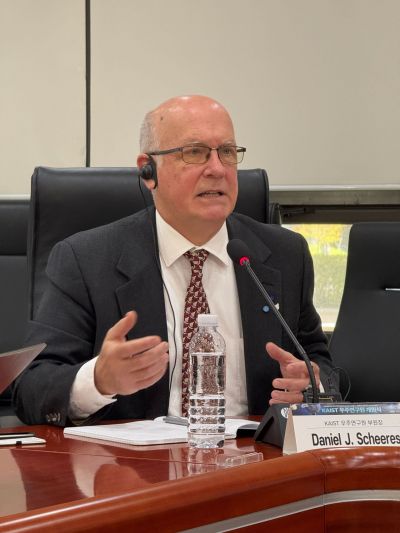 Daniel J. Shueres, Deputy Director of KAIST Space Research Institute, is speaking at a press conference on the 30th. Photo by Baek Jongmin
Han Jae-hong, director of the Space Research Institute, said, "Those who want to explore asteroids recognize the necessity of consulting Professor Scheeres due to his acknowledged expertise." Professor Scheeres also stated, "I will continue to collaborate with international organizations at KAIST and conduct further exploration missions or research supported by NASA," expressing his desire to contribute to enhancing KAIST's asteroid exploration capabilities.
Director Han said, "The Space Research Institute aims to launch a satellite in 2027 to demonstrate active control technology for space objects, which can be used for purposes such as retrieving the UriByul satellite developed by KAIST and currently in space." He also emphasized, "Currently, the institute has about 50 members, but it plans to expand to 400 personnel and a budget of 60 billion KRW, contributing to talent development as part of the Daejeon Space Industry Cluster."
Director Han stated, "Although we have role models like the Jet Propulsion Laboratory under the California Institute of Technology, due to the significant difference in scale, the Space Research Institute will approach the concept of a university-based center like the University of Colorado, where Deputy Director Scheeres is employed," adding, "We will actively support companies." Regarding relationships with existing space-related government-funded research institutes such as the Korea Aerospace Research Institute and Korea Astronomy and Space Science Institute, he mentioned, "We are already cooperating and will continue to play roles in each other's fields."
© The Asia Business Daily(www.asiae.co.kr). All rights reserved.
![From Bar Hostess to Organ Seller to High Society... The Grotesque Con of a "Human Counterfeit" [Slate]](https://cwcontent.asiae.co.kr/asiaresize/183/2026021902243444107_1771435474.jpg)

















