Jinju K-Entrepreneurship International Forum
Confucian Philosophy Emphasizing Human Respect and Community
Connected with K-Entrepreneurship Spirit
Former Prime Minister Han Seung-soo emphasized that companies must fulfill their social responsibilities in an era of complex crises such as climate change and digital transformation at an international forum regarded as the 'Korean version of the Davos Forum.' He stated that there are intersections between Jinju and Korea's unique Confucian philosophy, which is based on a culture that respects humanity and values community, and entrepreneurial spirit, through which innovative DNA to overcome complex crises can be found.
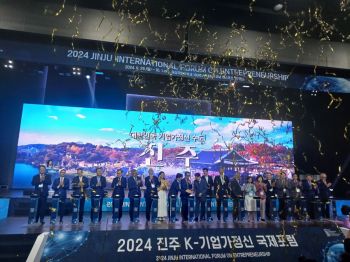 On the 30th, attendees of the '2024 Jinju K-Entrepreneurship International Forum' held at the 100th Anniversary Hall of Gyeongsang National University in Jinju, Gyeongnam, are performing a commemorative event.
 Lee Jeong-il, Senior Advisor at Samsung Global Research (far left), Han Seung-soo, former Prime Minister (12th from the far right), Cho Gyu-il, Mayor of Jinju (to the right of former Prime Minister Han), Ayman Tarabishi, President of the International Council for Small Business (ICSB) (10th from the right), and Kim Jae-moon, Head of LG Management Research Institute (4th from the right) are applauding.
[Photo by Moon Chae-seok]
Former Prime Minister Han made these remarks in his keynote speech at the 'Jinju K-Entrepreneurship International Forum' held on the 30th at the 100th Anniversary Hall of Gyeongsang National University in Jinju, Gyeongnam. The forum was co-hosted by Jinju City and the Jinju K-Entrepreneurship Foundation and organized by the Jinju K-Entrepreneurship International Forum Organizing Committee.
In his keynote speech titled 'Entrepreneurship and a Sustainable Future,' Former Prime Minister Han said, "Entrepreneurs must fully embrace their social responsibility to promote eco-friendly technologies and sustainable business models to lead future markets." He emphasized, "Companies can no longer operate in traditional ways and must consider how their management activities align with the sustainable development of society as a whole."
He continued, "We must overcome the uncertainties and fears brought by digital transformation, stimulate creativity and innovation, and maximize new possibilities. Entrepreneurs should stand at the center of positive movements and lead the creation of new values." He added, "In particular, the role of companies is essential to ensure that innovative technologies such as artificial intelligence (AI) contribute to sustainability and human welfare."
?
Forum speakers unanimously agreed that Korea has the potential to overcome complex crises, and the key lies in entrepreneurship. Jinju Mayor Cho Gyu-il said in his welcoming remarks, "The four major companies with ties to Jinju?Samsung, LG, GS, and Hyosung?have created South Korea's economic miracle based on corporate cultures that respect humanity, value community, and emphasize social responsibility."
Oh Jun, Chair of the Jinju K-Entrepreneurship International Forum Organizing Committee and former Chair of the UN Economic and Social Council, stated in his opening remarks, "The principle adopted by the UN in 2015 with the Sustainable Development Goals (SDGs) is to leave no one behind." He added, "Strengthening entrepreneurship can greatly contribute to inclusive and sustainable social development."
Ayman Tarabishy, President of the International Council for Small Business (ICSB) and professor at George Washington University, argued that Nammyung Jo Sik is the root of Korean entrepreneurship. Jo Sik, who was born in Hapcheon County near Jinju in Gyeongnam, was a 16th-century figure who founded and emphasized practical Confucianism. President Tarabishy cited four aspects of Korean entrepreneurship emphasized by Jo Sik: rationality, patriotism and love for the people, critical thinking, and talent development.
President Tarabishy said, "In the past, I thought Western leadership led companies, but through studying Jo Sik, I learned how Eastern philosophy drives global development." He added, "Ethical leadership, sustainable development, international education and human resource development, and international cultural exchange will be key themes guiding future dialogues between the Jinju K-Entrepreneurship International Forum and companies."
Kim Dong-hoon, Director of the Korean Corporate Management Convergence Research Institute at Yonsei University and Vice President for Administration and External Affairs at Yonsei University, explained that the characteristic of Korean brands is that they are Korean yet not entirely Korean. For example, high-quality home appliances from LG Electronics and Samsung Electronics have little to do with uniquely Korean values but have established themselves as representative Korean products. Director Kim said, "Internationalization is not about Korean culture alone or Western culture alone but about fusing Eastern and Western cultures to create something new." He added, "Korean companies are well-positioned to achieve internationalization."
Francis Shotgen, Associate Dean of the Asia Campus at the University of Utah, emphasized that companies should utilize the global networks provided by universities. Associate Dean Shotgen said, "To realize entrepreneurship, one must be able to connect excellent ideas with the right people such as mentors, investors, and collaborators." He added, "The University of Utah Asia Campus offers networks through University of Utah alumni that provide insights necessary for management, including partnerships with Korean companies, understanding consumer behavior, and navigating regulatory environments."
In the 'Four Major Global Corporations Session' held in the afternoon, speakers such as Lee Jung-il, Senior Advisor at Samsung Global Research, Kim Jae-moon, Division Head at LG Management Research Institute, Choi Nuri, Executive Director at GS, and Yoo Young-hwan, Vice President at Hyosung, will share cases of entrepreneurship where the four major companies turned crises into opportunities. In the 'Cox Round Table' session, experts will discuss the role of entrepreneurship in moral capitalism and sustainable growth.
© The Asia Business Daily(www.asiae.co.kr). All rights reserved.
![Clutching a Stolen Dior Bag, Saying "I Hate Being Poor but Real"... The Grotesque Con of a "Human Knockoff" [Slate]](https://cwcontent.asiae.co.kr/asiaresize/183/2026021902243444107_1771435474.jpg)
















