Employment Growth Prominent Among Youth and High-Growth Regions (Gyeonggi-do, Chungcheong-do, etc.)
Bank of Korea Analysis Report
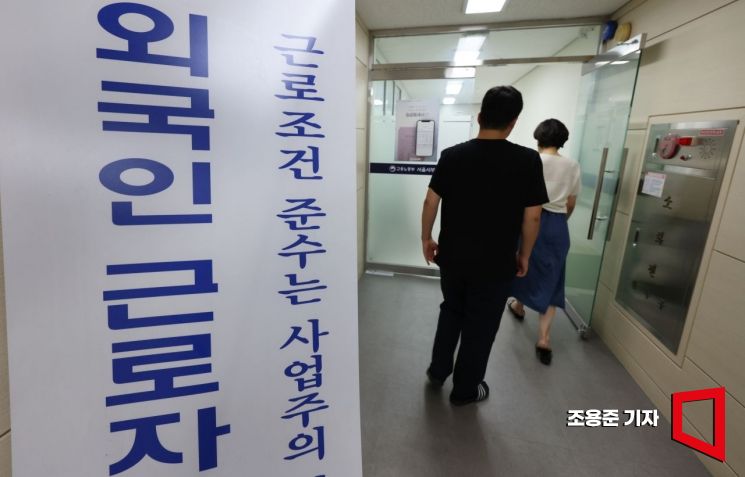 On the 11th, a notice related to the employment of foreign workers was posted at the Western Branch of the Ministry of Employment and Labor in Mapo-gu, Seoul. Photo by Jo Yongjun
A study has found that the influx of foreign workers contributes to business expansion and improved worker productivity, which in the long term positively affects employment for native workers.
According to the "Impact of Foreign Worker Influx on Regional Labor Markets" section of the regional economic report released by the Bank of Korea on the 30th, South Korea is expected to face a worsening labor shortage in the future due to rapid demographic changes such as low birth rates and aging population.
The report states that foreign nationals are entering South Korea at a rapid pace. From 2006 to 2022, the number of foreigners increased 4.2 times, from about 500,000 to approximately 2.3 million. As of 2022, foreigners accounted for 4.4% of the total population, with higher proportions in the Seoul metropolitan area and Chungcheong region.
Examining the characteristics of foreign workers, 42% have a high school education level, and 32% have a college degree or higher (as of 2023), but most are employed in low-skilled jobs with low job levels.
By industry, they mainly work in manufacturing, wholesale and retail trade, food and accommodation services, and construction. By job type, they primarily perform functions such as skilled work, machine operation, assembly, and simple labor.
Long-term Effect of Foreign Influx on Increasing Native Employment
The study estimated the effect on employment and wages of native workers in a region when labor supply increased by 1% due to the influx of foreign workers at the regional level.
The analysis showed that the short-term effect of foreign influx on the employment of all native workers nationwide was not significant, but in the long term, it actually increased employment.
Looking at long-term effects by sector, employment growth was notable among the youth and in high-growth regions (such as Gyeonggi-do and Chungcheong-do). It was suggested that the influx of foreigners may have led to business expansion and improved worker productivity.
However, employment among middle-aged and older workers decreased. It is presumed that they had a strong substitution relationship with foreign workers.
The effect of foreign worker influx on the short- and long-term wages of all native workers in the region was not significant. Regionally, long-term effects varied: wages for natives increased in high-growth regions but decreased in low-growth regions. The report estimated that natives in high-growth regions had more opportunities to shift to more specialized jobs in response to the influx of foreign workers.
Co-authors of the report, Professor Oh Tae-hee and Professor Lee Jang-yeon of Incheon National University, and Lee Young-ho, Director of the Bank of Korea’s Research Department, concluded that overall, foreign influx does not have a significant impact on native wages but has a long-term positive effect on employment.
They assessed that long-term effects varied by region and age group, with positive effects mainly among youth and in high-growth regions, and negative effects among middle-aged and older workers and in low-growth regions.
They emphasized the importance of carefully designing policies to promote the influx of foreign labor that aligns with corporate labor demand and complements native workers.
Meanwhile, the regional economy slightly improved in the third quarter compared to the previous quarter. Among manufacturing sectors, automobile and steel production decreased, but semiconductor and display production increased. In wholesale and retail trade, financial and insurance sectors maintained previous quarter levels, while real estate and transportation sectors showed growth. By region, the Seoul metropolitan area, Chungcheong region, and Daegu-Gyeongbuk region slightly improved, while the Honam region slightly deteriorated.
The Bank of Korea expects the regional economy to slightly improve compared to the third quarter, with modest increases in both manufacturing and service sector production.
© The Asia Business Daily(www.asiae.co.kr). All rights reserved.

















