Few Restaurants Allowing Pets
Only 141 Cases Under Regulatory Sandbox Exemption
Food Sanitation Act Legislative Notice Expected in First Half
Park Ji-yeon (pseudonym), a woman in her 40s who owns a pet dog, visited a restaurant in Seoul that allowed pets last month for lunch with her family. However, she had to leave shortly after. Dining was only permitted on the outdoor terrace. Since the daytime temperature soared past 30 degrees Celsius, she could not stay long with her elderly dog. Finding a nearby indoor restaurant that allowed pets was difficult, so she ultimately had no choice but to return home.
Although one in four Koreans now owns a pet, dining out with them remains a significant challenge. According to the Food Sanitation Act, pets are not allowed inside restaurants or cafes. While some outdoor spaces permit pets, it is difficult to stay outside during midsummer or winter, making even that option challenging. Despite the government’s repeated calls for regulatory innovation, the public continues to feel the burden of these restrictions. The government plans to address this issue through a legislative notice on the enforcement regulations of the Food Sanitation Act in the first half of next year.
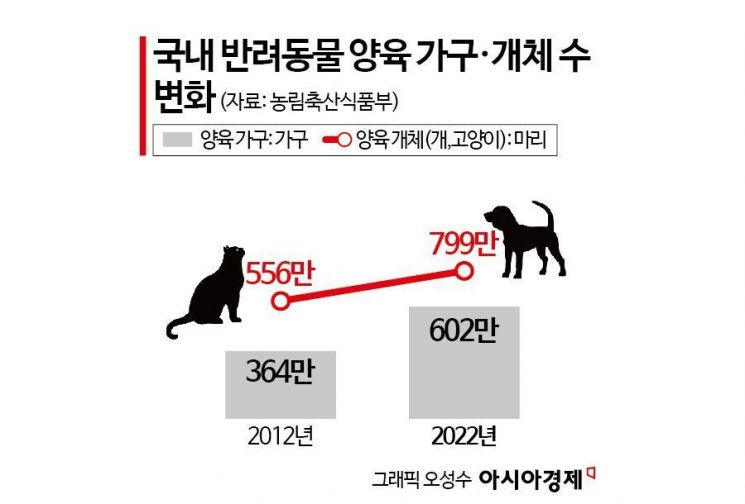
According to the Ministry of Agriculture, Food and Rural Affairs and the Korea Rural Economic Institute (KREI) on the 3rd, the number of households raising pets (dogs and cats) was 6.02 million in 2022, accounting for 25.4% of all households in South Korea. This proportion is expected to increase further. In an April report on pets, KREI explained, "Among households not currently raising pets, those with a high intention to raise pets in the future are people in their 20s, residents of detached houses, unmarried individuals, and respondents with past pet-raising experience."
As the number of pet-owning households increases, more people are trying to operate businesses that allow pet access, but the system does not support this. According to Article 36 of the Food Sanitation Act and its enforcement regulations, pets are prohibited from entering cafes or restaurants. Many establishments that advertise pet access are technically operating illegally. As a result, some places that allowed pets have faced complaints, been forced to ban pets, or paid fines.
The government is granting permission for "pet-friendly restaurants" to some businesses that meet necessary requirements through a regulatory sandbox demonstration exemption that temporarily suspends the application of the law. However, the Ministry of Food and Drug Safety, which oversees the Food Sanitation Act, reported that only 38 brands (141 stores) have received this exemption. This is a small number despite the data being cumulative from December 2022 to July this year.
In the field, it is pointed out that the complicated paperwork and the quarterly review process make it difficult for small business owners to apply for the demonstration exemption. This has led self-employed individuals to pay substantial consulting fees to companies that have received the exemption or share information through various online communities.
Even after obtaining permission, the two-year limit on the demonstration exemption period adds to business difficulties. Although the government has allowed an additional two-year extension, stable business operations remain constrained. Another limitation is that multiple ministries are involved in the demonstration exemption process, including the Ministry of Food and Drug Safety, the Ministry of Trade, Industry and Energy (which implements the regulatory sandbox), and the Ministry of Agriculture, Food and Rural Affairs (which oversees the Feed Control Act).
The government plans to revise the law by April next year, coinciding with the end of the regulatory sandbox pilot project. A Ministry of Food and Drug Safety official said, "Based on the pilot project results, we plan to sufficiently gather expert opinions from academia, consumer groups, and others to revise the law. After confirming safety, we will issue a legislative notice on the enforcement regulations of the Food Sanitation Act in the first half of next year."
Cho Dong-geun, emeritus professor of economics at Myongji University, emphasized, "As national income rises, demand related to pets inevitably increases, and if the freedom of occupational choice for business owners is recognized, there is no need to strictly prohibit store operations by law." He added, "It is desirable to selectively address factors that harm public hygiene but avoid excessive regulation beyond what is necessary."
© The Asia Business Daily(www.asiae.co.kr). All rights reserved.

















