Mandatory Police Reporting for Unnatural Withdrawals
Issues with Elderly Identification Personnel...Effectiveness in Question
Osaka Prefecture in Japan is promoting an ordinance that prohibits elderly people from making phone calls in front of financial institutions' automated teller machines (ATMs) as a measure to reduce voice phishing damage.
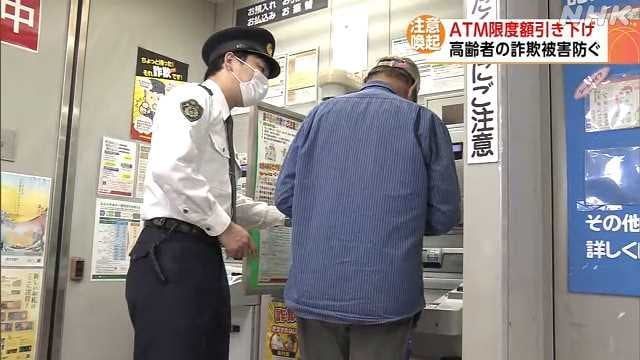 A police officer in Japan is explaining remittance precautions to an elderly person using an ATM machine. [Image source=NHK broadcast capture]
On the 29th, the Mainichi Shimbun reported that Hirofumi Yoshimura, Governor of Osaka, plans to submit a revision of the ordinance with this content by February next year to prevent special fraud damages such as voice phishing.
Governor Yoshimura recently stated at a crime prevention agency meeting, "The average daily damage from voice phishing in Osaka reaches 10 million yen (approximately 92 million KRW)," adding, "There may be pros and cons, but this is a necessary measure to prevent the despicable crime of defrauding hard-earned retirement funds." Osaka Prefecture plans to finalize the details after expert review. In addition to the call prohibition, Osaka Prefecture also plans to implement measures such as mandatory police reporting by local financial institutions when unnatural withdrawal confirmations occur, restrictions on large remittances by elderly people, and mandatory purpose verification for customers purchasing high-value prepaid cards at convenience stores.
Kumamoto and Okayama Prefectures in Japan have already enacted ordinances encouraging restraint in using mobile phones in front of ATMs. However, these are advisory ordinances and not mandatory. Whether Osaka Prefecture's ordinance will pass remains uncertain. Although local police have already launched campaigns urging people not to make calls in front of ATMs, some elderly users complain of inconvenience, calling it "excessive oppression." Furthermore, issues have arisen regarding the practical difficulty of distinguishing elderly individuals without dispatching separate personnel from local governments or police to verify identities, and questions about who would enforce the call prohibition at unmanned ATMs.
Meanwhile, the Japanese National Police Agency announced that voice phishing cases reported in Osaka Prefecture last year reached 2,656, the highest ever recorded. This is the second highest nationwide after Tokyo Metropolis, which recorded 2,918 cases. Additionally, 85% of the victims were aged 65 or older, indicating a higher incidence among the elderly. In particular, cases have increased where scammers exploit elderly people's unfamiliarity with ATM operations by deceiving them with messages such as "We will help you receive a medical insurance refund, so please take your mobile phone and move to the ATM."
© The Asia Business Daily(www.asiae.co.kr). All rights reserved.

















