Drank 1 Glass of Somaek and 7 Glasses of Beer Totaling 1800ml
Court: "No Evidence That All Alcohol Was Consumed"
A man in his 50s who caused an accident while driving after drinking alcohol was brought to trial but was acquitted. The court ruled that it was difficult to accurately measure the amount of alcohol consumed.
According to Yonhap News on the 29th, the Incheon District Court Criminal Division 11 (Judge Kim Saetbyeol) acquitted Mr. A (51), who was charged with drunk driving and failure to take measures after an accident under the Road Traffic Act. Mr. A was prosecuted for driving a passenger car about 3 meters while intoxicated on a road in Bupyeong-gu, Incheon, around 10 p.m. on May 2 last year. He was also charged with leaving the scene after hitting a parked van while driving the passenger car.
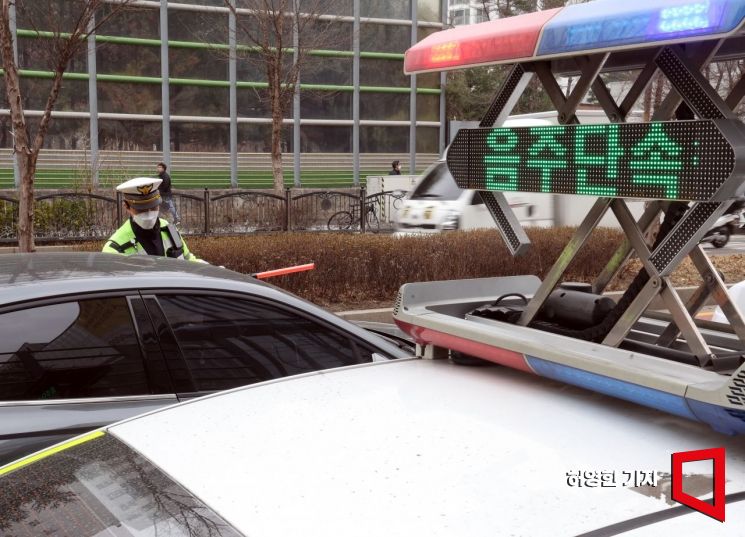 The photo is not related to the specific content of the article. Police are conducting a drunk driving checkpoint near an elementary school in Sangam-dong, Seoul. Photo by Heo Younghan younghan@
After the accident, the police investigated and calculated Mr. A's blood alcohol concentration at the time of driving using the 'Widmark' formula based on CCTV footage inside the pub where he drank and his body weight. The Widmark formula is an investigative technique that estimates blood alcohol concentration over time by considering the alcohol concentration of the drink, amount consumed, body weight, gender, and other factors.
The pub's CCTV showed Mr. A drinking a total of eight drinks: one glass of somaek (soju + beer) poured by an acquaintance and seven glasses of beer. The prosecution and police estimated that Mr. A consumed 50 ml of soju with an alcohol concentration of 16.5% and 1800 ml of beer with an alcohol concentration of 4.5%, based on the sizes of soju and beer glasses. They concluded that Mr. A's blood alcohol concentration at the time of driving was 0.065%, which corresponds to the license suspension level.
However, the court's judgment differed. Judge Kim stated, "It is common to drink only part of a glass or to pour more alcohol into a glass that still contains some drink," and explained, "Based on the evidence submitted, it has not been proven that the defendant drank a total of about 1800 ml of beer." He added, "The police also calculated the blood alcohol concentration as 0.041% assuming the defendant drank a total of 1200 ml of beer, which is favorable to the defendant, but this figure only appears when calculated at the maximum level." He further noted, "The defendant's body weight, which was the basis for applying the Widmark formula, was measured only three months after the incident."
Regarding the charge of failure to take measures after the accident, the judge explained the reason for acquittal, saying, "The defendant reversed the offending vehicle after the accident to restore it to the pre-accident parking state, gave a business card to the victim, and talked with them," and "There were no vehicle fragments scattered on the road related to the accident, and there was no danger or obstruction to road traffic."
Meanwhile, there was also a recent case where a driver who was fined in the first trial for slightly exceeding the drunk driving threshold was acquitted in the appellate trial.
On the 20th, the Chuncheon District Court Criminal Division 1 (Chief Judge Shim Hyun-geun) overturned the original ruling that fined Mr. B (62) 5 million won for drunk driving under the Road Traffic Act and acquitted him. Mr. B was summarily indicted for driving a passenger car with a blood alcohol concentration of 0.032% on a road section about 6 km long in Chuncheon, Gangwon Province, at 10:57 a.m. on August 25 last year. He filed a formal trial after objecting to the summary fine order, claiming, "At the time of alcohol measurement, the alcohol concentration was rising, so it cannot be considered that it was 0.03% or higher at the time of driving."
The first trial court judged that Mr. B rinsed his mouth with water before the alcohol test, did not dispute the measurement result, and the measurement was conducted promptly within five minutes after driving ended, so even considering the possibility of being in the rising phase, the blood alcohol concentration was 0.03% or higher.
However, the appellate court accepted Mr. B's claim and considered that the blood alcohol concentration at the time of driving could have been lower than at the time of measurement, considering the rising phase. The appellate court referred to the Supreme Court precedent stating, "In the case of breath alcohol measurement, the accuracy and reliability of the measurement result may be problematic depending on the condition of the measuring device, measurement method, and degree of cooperation," and judged that it was difficult to conclude that the concentration was 0.03% or higher at the time of measurement, considering that the measured value exceeded the punishment standard by only 0.002%. Also, viewing the final drinking time as between 10:30 a.m. and 10:45 a.m., the measurement at 11:02 a.m. was 15 minutes after the last drinking time, which is likely to be in the rising phase of alcohol concentration, serving as another basis for acquittal. Additionally, two acquaintances who shared one bottle of soju with Mr. B were also subjected to drunk driving checks but were not caught.
The appellate court explained the reason for acquittal, saying, "Based solely on the evidence submitted by the prosecution, it is insufficient to prove beyond reasonable doubt that the defendant drove with a blood alcohol concentration exceeding the punishment standard of 0.032%, and there is no other evidence to recognize this."
© The Asia Business Daily(www.asiae.co.kr). All rights reserved.

















