Need to Establish Systems like the Basic Act on Service Industry Development
Improvement Needed in Discriminatory Regulations and Support Compared to Manufacturing Industry
The Korea Economic Association announced on the 30th that it has submitted the '30 Major Regulatory Improvement Tasks for Revitalizing the Service Industry' to relevant government departments to overcome the economic downturn and domestic demand slump. This task list was prepared by gathering opinions from member companies of the Korea Economic Association and includes institutional improvements and regulatory relaxations across the service industry.
 Employees of tenant companies are moving at the Korea Economic Association in Yeouido, Seoul. Photo by Jinhyung Kang aymsdream@
The Korea Economic Association pointed out that the current domestic shared accommodation business is only allowed for foreigners and that the owner must reside in the property, making it illegal to rent out an entire detached house. It proposed establishing 'shared accommodation business' under the Tourism Promotion Act and applying it without distinction between domestic and foreign nationals. The purpose is to respond to diverse accommodation demands and revitalize the shared accommodation ecosystem.
They also argued that mandatory closures and operating hour restrictions for large supermarkets need improvement. Since the protective effect on traditional markets is not significant, they suggested leaving regulations on holiday closures to local government discretion and allowing online transactions during prohibited operating hours.
Opinions were also expressed on the need to improve regulations related to autonomous driving robots. They pointed out difficulties because, although the use of original video footage is necessary for the development of autonomous driving robot technology, current laws only allow the use of mosaicked videos for learning. They stated that, like cases in the United States and the European Union (EU), minimal information collection and protection measures should be established, and the use of original video footage should be permitted.
Requests for improvements to duty-free shop license fees were also made. They emphasized that the basis for duty-free shop license fees should be changed from sales volume to a fixed amount per area to reduce excessive burdens.
They stated that regulations on the silver industry in preparation for an aging society should also be improved. Regarding senior welfare housing, they proposed establishing related regulations to improve accessibility to health management for the elderly, citing that current laws do not allow for the placement of nurses or simple health care.
They also called for the relaxation of venture capital (VC) investment regulations in the film industry. In a situation where VC investment has become difficult due to the consolidation of small and medium-sized production companies, they argued that temporarily easing venture investment regulations is necessary to facilitate the circulation of funds.
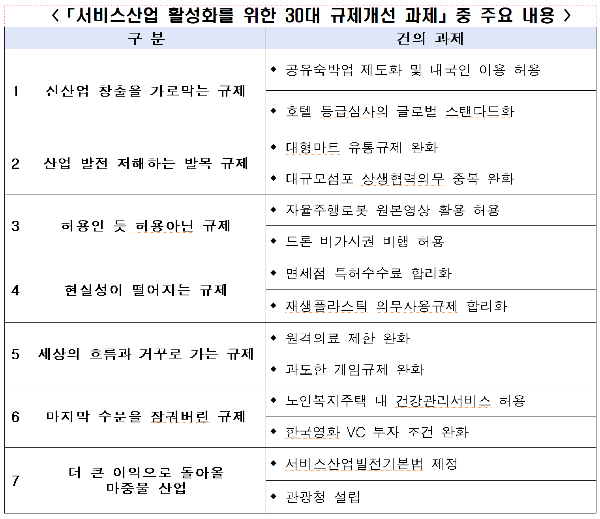
The Korea Economic Association pointed out that the competitiveness of Korea's service industry is significantly lagging behind major advanced countries. They stated that the share of Korea's service industry in gross domestic product (GDP) is markedly lower compared to advanced countries such as the United States, Japan, and France, and that labor productivity is only about half. They further expressed the need to enact the Service Industry Development Basic Act amid the lack of legal and institutional foundations for the development of the service industry.
Lee Sang-ho, head of the Economic and Industrial Headquarters at the Korea Economic Association, emphasized, "The lack of competitiveness in our service industry is due to excessive regulations and insufficient policy support," adding, "We must improve discriminatory support and regulatory barriers compared to manufacturing to establish a foundation for the advancement of the service industry."
© The Asia Business Daily(www.asiae.co.kr). All rights reserved.


















