The scale of loans through card loans and cash services, perceived as 'emergency cash channels' for vulnerable groups, has reached an all-time high. Concerns are emerging that the repayment burden on ordinary citizens is being pushed to its limit, as the delinquency rate also surpassed 3%.
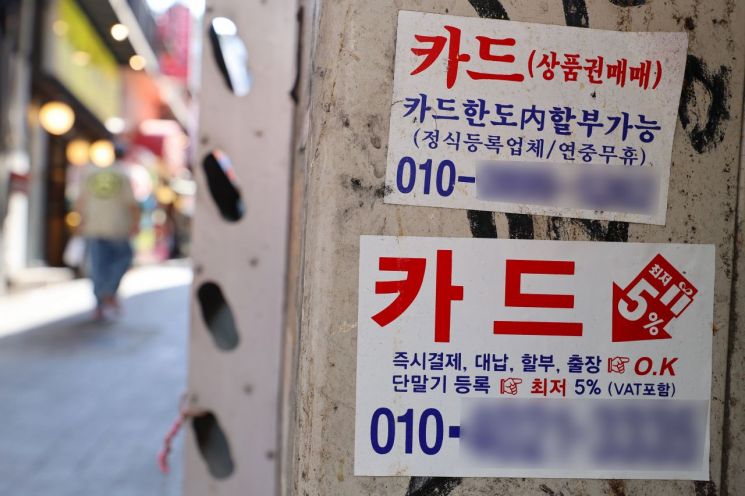
According to the 'Domestic Card Loan and Delinquency Status' submitted by the Financial Supervisory Service to the office of Kang Min-guk, a member of the National Assembly's Political Affairs Committee from the People Power Party, as of the end of last month, the total card loan amount (based on 8 specialized card companies) was 44.665 trillion KRW, with 11.709 million cases. This is the largest scale since the Financial Supervisory Service began estimating related statistics in 2003.
The long-term card loans, known as card loans, amounted to 38.788 trillion KRW (6.482 million cases), and short-term card loans, known as cash services, totaled 5.876 trillion KRW (5.227 million cases), respectively.
This is interpreted as an effect of the increasing use of small emergency loans by vulnerable groups due to the worsening economy for ordinary citizens caused by high interest rates and high inflation.
The delinquency rate has also been steadily rising. As of the end of last month, the card loan delinquency rate (loans overdue by more than one month) was 3.1%. The card loan delinquency rate has been increasing from 1.9% at the end of 2021, 2.2% at the end of 2022, to 2.4% at the end of last year.
The amount of delinquent card loans surged from 718 billion KRW (200,000 cases) in 2021, 860 billion KRW (249,000 cases) in 2022, 983 billion KRW (265,000 cases) in 2023, to 1.372 trillion KRW (312,000 cases) as of the end of August this year. This is the largest scale since the so-called 'card crisis' in 2004 (1.988 trillion KRW).
There are concerns that the repayment burden on vulnerable groups and self-employed individuals is reaching its limit, which could potentially spread the impact of non-performing loans throughout the financial sector.
Representative Kang pointed out, "Financial authorities need to continuously monitor trends in card loan delinquency rates and strengthen risk management of card loan assets by card companies. It is necessary to manage this balance to ensure that the role of supplying funds to ordinary citizens continues."
© The Asia Business Daily(www.asiae.co.kr). All rights reserved.
![User Who Sold Erroneously Deposited Bitcoins to Repay Debt and Fund Entertainment... What Did the Supreme Court Decide in 2021? [Legal Issue Check]](https://cwcontent.asiae.co.kr/asiaresize/183/2026020910431234020_1770601391.png)















