"Israel's Highly Sophisticated Technology... Undetectable in Advance"
Recent explosions of wireless communication devices (pagers) across Lebanon have been analyzed to have been triggered by explosives implanted inside the batteries. Israel applied a 'highly sophisticated technology' to conceal the explosives.
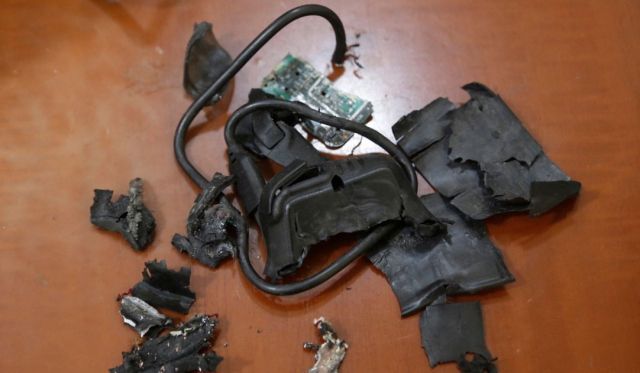 Debris of wireless communication devices that exploded simultaneously across Lebanon on the 17th (local time).
 [Image source=AFP Yonhap News]
On the 27th (local time), multiple Lebanese senior officials reportedly shared the results of detonation tests conducted on pager devices that avoided explosion because their power was off at the time of the attack, according to US CNN and others. A source from Lebanese security authorities told CNN, "The method Israel used to hide explosives inside the pager batteries was so sophisticated that detecting them in advance was virtually impossible." Another senior source said that after personally examining a pager device modified by Israel and observing the detonation test, "The explosives were tied inside the pager’s lithium battery, making prior detection practically impossible."
Sean Moorhouse, a former British Army officer and explosives disposal expert, stated that if a small explosive device such as an electronic detonator is implanted inside the metal casing of a pager battery, it could be impossible to detect it through X-ray imaging. Several experts investigating the incident also inferred that the explosive device was hidden inside the pager, suggesting the possibility of a sophisticated supply chain attack conducted at a national level.
Hezbollah and Iran immediately pointed to Israel as the mastermind behind the attack, and Lebanese authorities reportedly concluded in their initial investigation that Israel installed the explosives before the pagers were imported into Lebanon. However, no detailed announcement has been made regarding where and how thousands of these 'pager bombs' were manufactured and delivered to Hezbollah. Meanwhile, Hezbollah vowed retaliation for the pager explosions and announced the formation of an internal investigative committee to examine the reality of the bomb supply chain.
Hassan Nasrallah, the leader of Hezbollah, emphasized in a speech the day before, "We have reached a nearly certain conclusion regarding the explosions, but it will take some time to confirm it," adding, "From the company that sold the devices to manufacturing, transportation, importation into Lebanon, and distribution, every process up to the moment of the explosion is subject to thorough investigation and review."
The pager’s contract manufacturer, which caused simultaneous explosions across Lebanon on the 17th resulting in about 4,000 casualties according to Lebanese health authorities, is also suspected to be a 'shell company' created and operated by Israel years ago. The pagers used by Hezbollah militants bore the trademark of the Taiwanese company 'Gold Apollo.' However, Gold Apollo stated shortly after the terror incident, "Our brand was attached through an Original Equipment Manufacturer (OEM) method by a European affiliate company, and we are not related to this incident."
The factory where the problematic pagers were manufactured is known as 'BAC,' located in Budapest, Hungary, and it is reported that the entity operating this factory is Israel. Foreign media reported that BAC normally accepted orders and produced regular products like any other company, but when Hezbollah placed orders, the surface of the pager batteries was coated with PETN, a powerful explosive. Furthermore, Hezbollah had previously advised using pagers instead of mobile phones, claiming that mobile phones are easily tracked by Israel, and there are claims that Israel itself may have spread this 'rumor.'
© The Asia Business Daily(www.asiae.co.kr). All rights reserved.
![Clutching a Stolen Dior Bag, Saying "I Hate Being Poor but Real"... The Grotesque Con of a "Human Knockoff" [Slate]](https://cwcontent.asiae.co.kr/asiaresize/183/2026021902243444107_1771435474.jpg)











