Netanyahu's UN Speech Followed by Heavy Bombardment of Hezbollah Headquarters
Iran Immediately Condemns Israel
US Orders 'Posture Adjustment' for Troops Stationed in Middle East
The Middle East situation is shaking as Hassan Nasrallah, the leader of Hezbollah, a pro-Iran armed faction in Lebanon, is reported missing and presumed dead following a large-scale airstrike by the Israeli military.
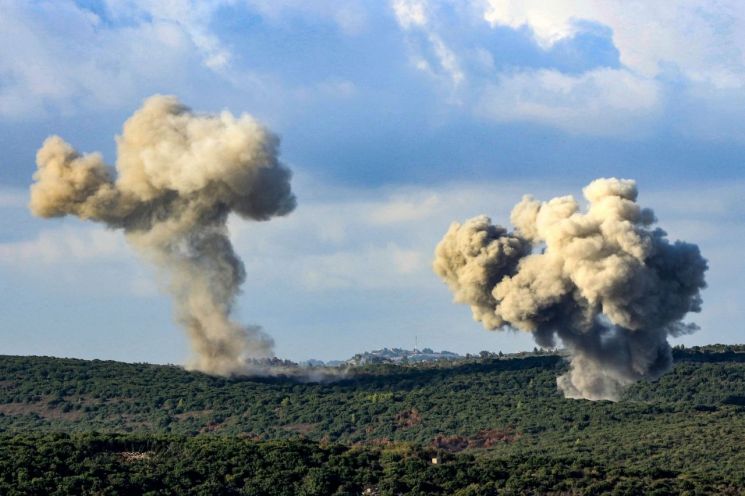 Smoke is rising from an airstrike by the Israeli military in Jibqin, southern Lebanon.
 [Image source=Yonhap News]
On the 27th (local time), the Israeli military announced that it carried out a precision airstrike on Hezbollah's command headquarters located beneath a residential building in Dahieh, a southern suburb of Beirut, the capital of Lebanon.
Lebanese media reported that six high-rise apartment buildings in an area predominantly inhabited by Shia Muslim residents were completely destroyed, turning into rubble, and that the explosion was so powerful that windows shook even more than 30 km away.
Although the apartments are within Hezbollah's security zone, major foreign media reported that the attack was carried out without public knowledge that Hezbollah's headquarters were located beneath. The Lebanese Ministry of Health confirmed at least six deaths and 91 injuries, but the casualty count is expected to rise.
The attack occurred just hours after Israeli Prime Minister Benjamin Netanyahu delivered a tough speech at the United Nations General Assembly, declaring his intention to continue attacks against Hezbollah and rejecting calls for a ceasefire from the United States and the international community.
Foreign media reported that immediately after Netanyahu's UN speech, while he was holding a press briefing, news of the airstrike was delivered. Upon receiving a whispered message from a military advisor, Netanyahu abruptly ended the briefing and cut short his schedule to return home. Sources familiar with the situation said that the Israeli military's goal was to eliminate Hezbollah leader Nasrallah.
On the 28th, the Israeli military issued a statement announcing that it had eliminated Muhammad Ali Ismail, the commander of Hezbollah's missile unit, during the bombing in southern Lebanon. However, it has not been confirmed whether Nasrallah was inside Hezbollah's headquarters on that day. It is reported that contact with Hezbollah's senior leadership has been cut off.
Hezbollah has not made any announcement regarding Nasrallah's status even hours after the bombing.
Concerns are growing that a full-scale war between Hezbollah and Israel is becoming more visible, and with Iran, Hezbollah's "backer," also reportedly unable to remain passive after this attack, the possibility of escalation in the Middle East has deepened. In fact, Hezbollah, which was heavily bombarded by Israel, immediately retaliated. Hezbollah launched rockets targeting the Israeli city of Safed, claiming this was "to protect Lebanon and its people and to respond to Israel's barbaric violations against cities, towns, and civilians."
Meanwhile, in the early hours of the 28th, the Israeli military conducted additional bombings targeting the southern suburbs of Beirut. The Israeli military stated, "We are currently carrying out airstrikes targeting weapons owned by the Hezbollah terrorist organization stored beneath civilian (residential) buildings."
Iran, holding the key to escalation in the Middle East, immediately condemned Israel's airstrikes. Iranian President Masoud Pezeshkian described Israel's airstrikes as "blatant war crimes," stating, "This once again revealed the terrorist nature of the Israeli regime," according to Iran's state-run Press TV. Iranian Foreign Ministry spokesperson Nasser Kanaani claimed that not only Israel but also the United States bears responsibility. As Hezbollah, a core player in the pro-Iran armed coalition in the Middle East known as the "Axis of Resistance," finds itself cornered, Iran, which has supported Hezbollah, is also assessed to be in a difficult position where it can no longer remain a bystander.
As the Middle East situation takes a serious turn, U.S. President Joe Biden received multiple briefings from the national security team on the Middle East situation and instructed the Department of Defense to "assess and adjust the posture of U.S. forces in the region as necessary to strengthen deterrence, protect U.S. forces, and support U.S. strategic objectives," the White House said. Currently, about 40,000 U.S. troops, including one aircraft carrier strike group, are stationed in the Middle East. President Biden also ordered the administration to ensure that U.S. embassies in the region take all appropriate protective measures. However, he told reporters that he "did not know about or involve himself in" the recent Israeli airstrikes. Senior officials such as Secretary of State Antony Blinken and Secretary of Defense Lloyd Austin also urged Israel and Hezbollah to cease hostilities to prevent escalation into a full-scale war.
© The Asia Business Daily(www.asiae.co.kr). All rights reserved.

















