Bitten by a 90cm Shark While Checking Catch
Frequent Shark Sightings Recently Along Busan Coast
An accident occurred where a fishing boat carrying sea fishing passengers was bitten by a blue shark, involving the fishing boat's steward.
On the 27th, Yonhap News reported that around 3:30 a.m., a 60-year-old fishing boat steward was bitten by a blue shark measuring 90 cm in length on a 9.77-ton fishing boat near Saengdo, Yeongdo-gu, Busan. The steward was attacked by the shark while checking the catch caught by fishing passengers. The steward was bitten on the instep and fingers by the blue shark and was taken to the hospital for treatment, with no serious injuries reported. The boat was carrying two crew members and 16 fishing passengers. The blue shark is a fast-moving and highly aggressive shark.
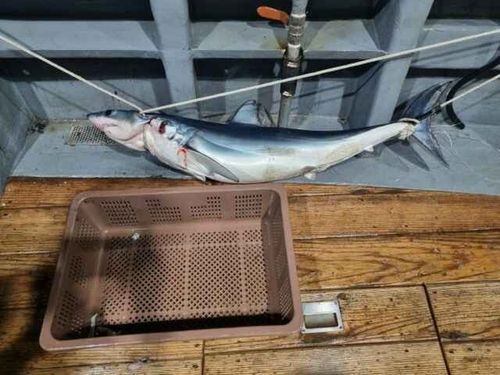
Recently, sharks have been frequently appearing along the coast of Busan. On the 15th at around 2:30 p.m., the carcass of a blue shark approximately 2 meters in length was recovered from the sea in front of the Jagalchi Cruise Pier in Busan. The blue shark is classified as a dangerous lamniform shark that can attack people or boats. The discovered shark carcass showed no signs of harpoon or capture marks and was in a severely decomposed state.
Earlier, in the waters off Busan, two carcasses of the less aggressive sevengill shark were found twice in July near Taejongdae and Saengdo. On July 4th, a fishing boat operating near Taejongdae caught a sevengill shark carcass. Then, on the 12th of the same month, a sevengill shark was caught in the net of a fishing vessel during operations. The average body length of the sevengill shark is 2 meters, weighing 150 to 180 kg, and it has low aggression.
Experts believe that due to the recent rise in water temperature, the number of warm current fish species has increased, causing sharks chasing prey to approach the coastal areas.
Sharks have been frequently appearing in Korean waters since last year. Especially along the East Coast (from Goseong, Gangwon to Pohang, Gyeongbuk), large sharks have appeared in various locations. Last year, there were 29 reports of large sharks being caught or found along the East Coast. This is an explosive increase compared to only one report in 2022. Additionally, up to early last month this year, there have been a total of 14 cases of sharks caught as bycatch during fishing operations.
Considering the locations where sharks have been found so far, the probability of ordinary people encountering sharks while swimming is very low. Sharks are generally found along the paths where their prey travel, so one must travel at least 30 to 40 minutes by boat from the coast to see sharks. However, if you encounter a shark in the sea, you must never provoke it. A National Institute of Fisheries Science official advised, "If you spot a shark when the seawater is knee-deep, you should immediately get out of the water on the spot," and "If the water is up to the chest, you should remain as still as possible to avoid being perceived as prey by the shark." The Busan Coast Guard has urged swimmers and marine leisure participants to be cautious and prepare for shark appearances near the coast.
© The Asia Business Daily(www.asiae.co.kr). All rights reserved.

















