3rd HanEun-SangSang Seminar... "Increase Productivity with AI and Overcome Low Birthrate"
Economic circles, the Bank of Korea, and experts unanimously agreed that bold financial support for corporate investment, infrastructure expansion, and talent development should be leveraged as opportunities to create new growth engines amid AI (Artificial Intelligence) competition risks. They advised actively utilizing AI in the process of increasing productivity and overcoming low birth rates.
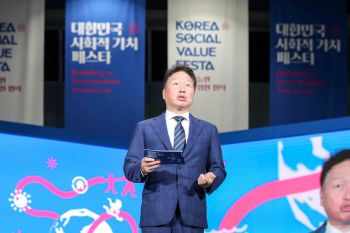 Choi Tae-won, Chairman of the Korea Chamber of Commerce and Industry, is delivering a greeting at the opening ceremony of the "KCCI, 1st Social Value Festa" held on the 12th at COEX in Gangnam-gu, Seoul. Photo by Kang Jin-hyung aymsdream@
The Korea Chamber of Commerce and Industry (KCCI) announced on the 27th that it held the 3rd Bank of Korea-KCCI seminar at the Bank of Korea in Jung-gu, Seoul. The seminar's theme was "Global Supply Chain Restructuring and the AI Era: Challenges and Tasks." Since last year, the two organizations have been holding seminars together on national agendas for sustainable growth. About 200 key figures from corporations, academia, and households attended this seminar, including Chey Tae-won, Chairman of KCCI, Lee Chang-yong, Governor of the Bank of Korea, and Ahn Deok-geun, Minister of Trade, Industry and Energy.
Advice was given that responses are needed as many companies are striving to establish supply chain bases outside of China. Richard Baldwin, professor at the International Institute for Management Development (IMD) in Switzerland, said in his keynote speech, "The global value chain is rapidly being reorganized due to the shift from a US-led unipolar system to an economic multipolar system, China emerging as the world's sole manufacturing powerhouse, and the arrival of a 'G-zero' disorderly world."
Professor Baldwin added, "Many companies are adopting a 'China+1' strategy or promoting nearshoring (relocating production bases to neighboring countries) to diversify supply chains, and major countries are actively pursuing industrial policies to bring manufacturing back home. Governments and companies must find a new balance between economic security and efficiency considering these changes."
There was also an opinion that efforts should be made to find effective ways to utilize AI technology as much as to develop AI technology itself. Min Kyung-hee, a research fellow at KCCI's Sustainable Growth Initiative (SGI), said in her presentation that unlike about ten years ago when interest was focused on AI technology itself, recent discussions have become active regarding AI technology utilization and economic and industrial outcomes. She claimed that applying AI to companies could increase the annual average total added value by 0.8 to 2 percentage points through productivity improvements. She also said that AI application could prevent the decline in growth potential caused by low birth rates.
Researcher Min emphasized the urgency of policy support. He said, "We should actively consider expanding tax credits and establishing a tax credit trading market for AI-related companies and investments, as well as providing semiconductor subsidies. We must ensure access to infrastructure such as supercomputers, graphics processing units (GPUs), and data for universities, research institutes, and small and medium-sized enterprises that lack abundant resources, and build research environments and education systems to nurture and attract domestic AI talent."
Lee Chang-yong, Governor of the Bank of Korea, directly participated in the discussion after his keynote speech. Questions from attendees followed regarding changes and prospects in the trade environment after the US presidential election in November, ways to enhance the status of Korean companies within the global value chain, and strategies for securing global competitiveness for companies in the AI era. Governor Lee led the Q&A session.
Famoushee Yoo, visiting professor at Seoul National University Graduate School of International Studies and former head of the Trade Negotiations Department at the Ministry of Trade, Industry and Energy, moderated the comprehensive discussion session. The topic was "Industrial Strategy in the Era of AI and Supply Chain Transformation." Participants included Ha Jung-woo, head of Naver AI Lab; Yoo Min-sang, Chief Strategy Officer (CSO) of Autonomous A2Z; Kwon Gu-hoon, senior economist for Asia at Goldman Sachs; and Kang Gam-chan, director of industrial policy at the Ministry of Trade, Industry and Energy. The discussion covered industrial applications of AI technology, Korean companies' response strategies to supply chain restructuring, and government industrial policy directions.
Park Yang-su, head of KCCI's SGI, said, "The AI utilization strategies and insights on global supply chain restructuring derived from the seminar will serve as a practical roadmap to elevate the international competitiveness of Korean companies to the next level. KCCI and the Bank of Korea will cooperate more closely to conduct regular joint research and prepare actionable policy alternatives for the sustainable growth of the Korean economy amid the rapidly changing global economic environment."
© The Asia Business Daily(www.asiae.co.kr). All rights reserved.

















