The Economist's Perfect Storm Scenario
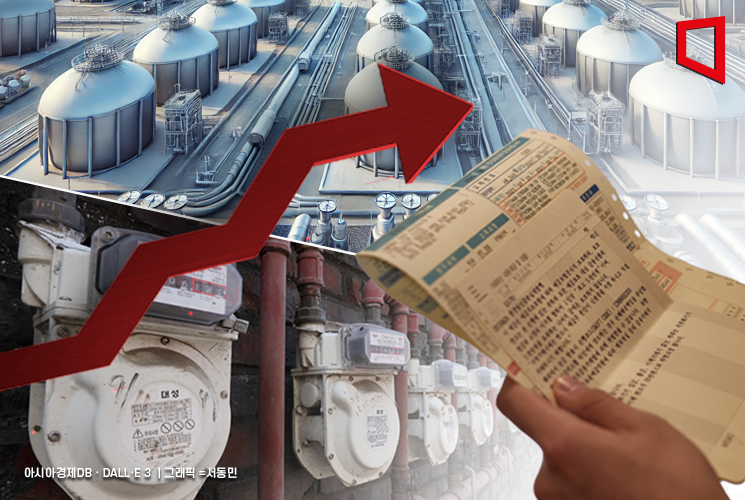
This winter, there are concerns that a gas supply crisis could occur in Europe and Asia, causing liquefied natural gas (LNG) prices to soar.
On the 26th (local time), the British weekly magazine The Economist reported, "Since the start of the Ukraine war, the global LNG market may soon face its first true test," adding, "(With various factors) demand is expected to increase, and if supply is not delivered on time, a new gas competition could arise."
First, this winter is expected to bring cold waves to many parts of the world due to abnormal weather. Rystad Energy forecasted that if severe cold occurs in Europe and Asia, additional gas demand would be 21 billion cubic meters and 15 billion cubic meters respectively. This corresponds to 4-8% of last year's import volume in those regions.
The gas supply issue remains blocked. First, European imports of Russian gas are expected to decrease. Ukraine has announced it will not extend the gas pipeline usage agreement made with Russia's Gazprom in December 2019, which expires at the end of this year. This means Russian gas will no longer be able to pass through Ukrainian territory. As of last year, 1.5 billion cubic meters of gas were transported to Europe through this route.
According to the European Union (EU), Russian gas accounted for 18% of the EU's total gas imports, significantly down from 45% before the war in 2021, but dependency remains high. The Economist stated, "Europe is discussing solutions with Ukraine. A realistic alternative is to relabel Russian gas entering through Ukraine as Azerbaijani gas, but due to various variables, gas supply will be much more insufficient than before."
Accordingly, new gas demand must be met through LNG. Europe has reached the limit of gas pipeline imports, and most Asian countries except China import gas via maritime trade. The Economist analyzed that in this case, LNG demand equivalent to 26 million tons, or 7% of the global gas traded last year, will arise.
However, LNG supply is also expected to be severely insufficient. Russia's major Arctic LNG 2 terminal cannot export up to 13 million tons of LNG annually until next year due to U.S. sanctions. In Egypt's largest gas production site, Zohr, which had emerged as a stable LNG supply source for Europe, production is naturally declining.
Meanwhile, the U.S. Biden administration is actively regulating LNG export facilities. The lead contractor for the Golden Pass Project, a large U.S. LNG terminal in Texas scheduled to operate next year, has gone bankrupt. This means that of the terminal's potential production capacity of 25-30 MTPA (1 MTPA = 1 million tons per year) next year, only 15 MTPA can be produced.
As a result, Europe will compete with Asian countries for LNG cargoes, which is expected to drive up spot prices. Anne-Sophie Corbeau of Columbia University estimated that LNG prices could reach $16 per million BTU early next year.
The global benchmark Asian LNG price currently exceeds $13 per million BTU. This level is higher than most periods except for the energy crisis triggered by the outbreak of the Ukraine war in 2022.
© The Asia Business Daily(www.asiae.co.kr). All rights reserved.
![From Hostess to Organ Seller to High Society... The Grotesque Scam of a "Human Counterfeit" Shaking the Korean Psyche [Slate]](https://cwcontent.asiae.co.kr/asiaresize/183/2026021902243444107_1771435474.jpg)
















