Held in Paris, France on the 25th-26th
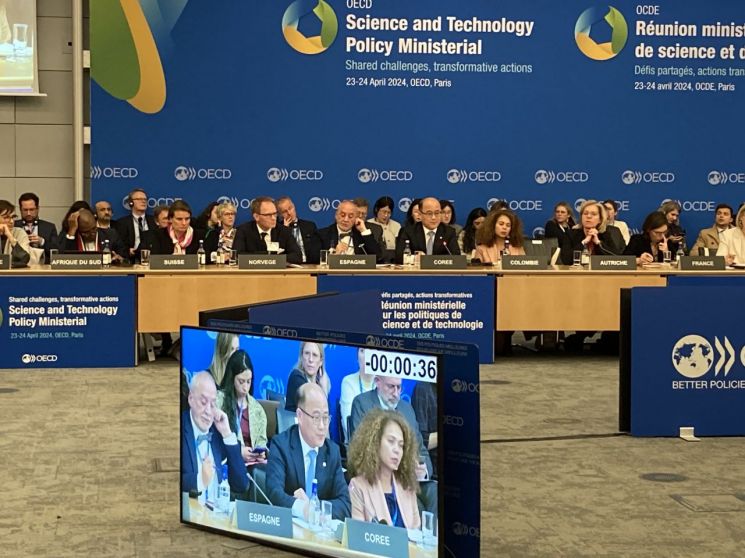
The Ministry of Economy and Finance announced on the 27th that the "12th Korea-OECD International Fiscal Forum," attended by fiscal authorities from Korea and OECD member countries, was held at the OECD headquarters in Paris, France, on the 25th and 26th.
At this forum, under the theme of "Dynamic Economy and Fiscal Sustainability," discussions were held on ways to enhance the efficiency of fiscal expenditure, the role of fiscal policy in strengthening growth engines and social mobility, and dynamic economies and fiscal rules.
Yu Byung-seo, Director General of Budget Review at the Ministry of Economy and Finance, stated in his opening remarks, "Korea is striving to restore the inherent dynamism of our economy and upgrade it through the realization of a dynamic economy," adding, "We are pushing forward with large-scale structural reforms centered on 10 major tasks in three key areas: fostering an innovation ecosystem, ensuring fair opportunities, and improving social mobility."
Director Yu further emphasized, "To this end, we are concentrating necessary resources through expenditure restructuring and continuing efforts to enhance fiscal sustainability, including the legislation of fiscal rules."
Choi Sang-dae, Ambassador to the OECD, mentioned in his welcoming remarks, "To address challenges faced by Korean society such as low birth rates and aging, it is necessary to expand fiscal capacity through the legislation of fiscal rules, and alongside this, focused support in areas such as research and development (R&D) and social mobility is required to enhance economic dynamism."
The OECD highlighted the importance of regularly restructuring expenditures to expand fiscal capacity amid resource shortages caused by increased economic uncertainty and tax revenue shortfalls. It evaluated as encouraging that 97% of OECD member countries, including Korea, are enhancing fiscal sustainability through expenditure restructuring.
Furthermore, the OECD noted that many member countries are experiencing demographic changes such as aging populations and improvements in quality of life, which demand corresponding improvements in healthcare quality and expenditure efficiency. It suggested that comprehensive decision-making is necessary, considering improvements in supply-side incentive structures and appropriate control of healthcare spending.
© The Asia Business Daily(www.asiae.co.kr). All rights reserved.

















