Ruling LDP Leadership Election
Top 2 Likely to Proceed to Runoff Vote
The successor to Japanese Prime Minister Fumio Kishida will be decided on the afternoon of the 27th. With a record nine candidates running in the ruling Liberal Democratic Party (LDP) leadership election, a fierce three-way race continues until the final stages. As expected, if the first round of voting does not conclude the election and a runoff is required, the new LDP leader, the 'post-Kishida,' is estimated to be confirmed around 3:40 p.m. that day.
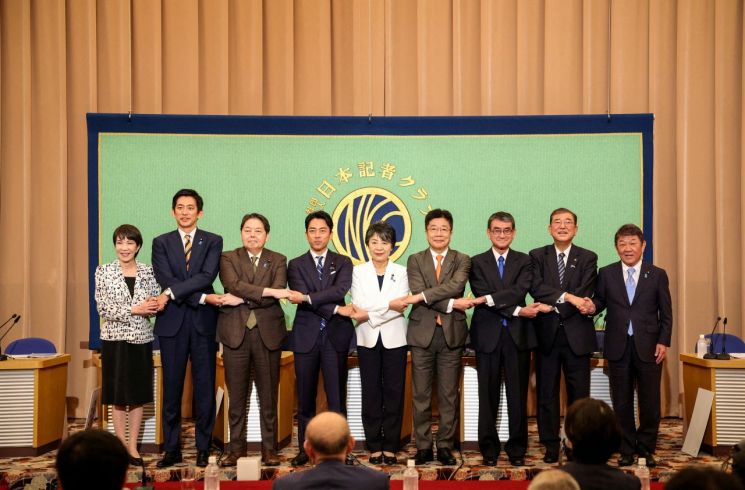
According to the Nihon Keizai Shimbun and others, the LDP leadership election will be conducted by combining the votes of Diet members (368 votes), who start voting at 1 p.m. that day, and the party members and supporters' votes (368 votes), which closed the previous day. Counting is expected to begin at 2:20 p.m. If no candidate secures a majority in the first round, a runoff will be held between the top two candidates by adding 368 Diet member votes and 47 local organization votes.
With a record number of candidates and no clear frontrunner in this election, it is widely expected that a runoff will be necessary. In this case, the announcement of the new leader is estimated to be around 3:40 p.m., the newspaper reported. The new leader is scheduled to hold a press conference at 6 p.m. that day. Subsequently, they will be nominated as Prime Minister at the extraordinary Diet session starting on the 1st of next month. In Japan’s parliamentary system, the leader of the ruling party, which holds the majority, serves as Prime Minister. A new cabinet is also expected to be announced on the same day.
Based on the public opinion polls released so far, it is certain that among the nine candidates, Shigeru Ishiba (67), former LDP Secretary-General; Sanae Takaichi (63), Minister in charge of Economic Security; and Shinjiro Koizumi (43), former Environment Minister, form the 'big three' competing for the leadership position. While Ishiba leads among party members nationwide, Koizumi is ahead in the Diet member votes. Takaichi, who has recently surged in the polls, is also a strong contender.
Since a runoff is likely, the key issue is where the Diet members’ votes will go in the second round, influenced by last-minute alliances and negotiations. This is why candidates have been making their final efforts to persuade Diet members until the previous day. In the runoff, the weight of Diet members’ votes increases. Also, the votes of candidates who placed third or fourth in the first round will be decisive in determining the winner.
Former Secretary-General Ishiba, who enjoys strong support from party members, is making his fifth attempt. Having served twice as Secretary-General, he is a 12-term veteran politician and policy expert, but is considered to have relatively weak factional support within the party. In the 2012 election, although he ranked first in the first party member vote, he lost to former Prime Minister Shinzo Abe, who united the factions. Well-versed in defense issues, Ishiba has shown a 'dovish' historical perspective, differing from the right-wing faction within the LDP.
Shinjiro Koizumi, aiming to become the youngest-ever prime minister in his 40s, is the second son of former Prime Minister Junichiro Koizumi. He enjoys full support from former Prime Minister Yoshihide Suga and currently leads in Diet member votes, but his lack of cabinet experience is seen as a weakness. Recently, his proposal to introduce a ‘couple separate surname system,’ where married couples can keep different surnames, has caused his support among the party’s conservative base to waver. However, as a young politician in his early 40s, he is expected to contribute to renewing the LDP’s image, which has been tarnished by corruption scandals involving slush funds.
There is also a possibility that Japan’s first female prime minister will emerge from this election. The candidate is Sanae Takaichi, a right-wing politician known as the ‘female Abe.’ Initially, the election was expected to be a two-horse race between Ishiba and Koizumi, but Takaichi, who had been third in the polls, surged by absorbing support from the right-wing conservative base, reshaping the race into a three-way contest. Born in 1961, she has held key positions such as Minister of Finance, Foreign Affairs, and Economy, Trade and Industry, which previous prime ministers have commonly held, earning her positive evaluations. If she becomes prime minister, she plans to continue the economic, diplomatic, and security policies of former Prime Minister Abe, including Abenomics.
© The Asia Business Daily(www.asiae.co.kr). All rights reserved.

















