Expectations for Foreign Exchange Market Stability and Yield Improvement
Monthly Increase from $1 Billion to Up to $3 Billion
Introduction of 'Dialogue with Companies' Targeting Overseas Firms
The National Pension Service (NPS) has decided to increase the limit for advance foreign currency procurement. This move is expected to achieve the 'two birds with one stone' goals of stabilizing the foreign exchange market and improving fund returns.
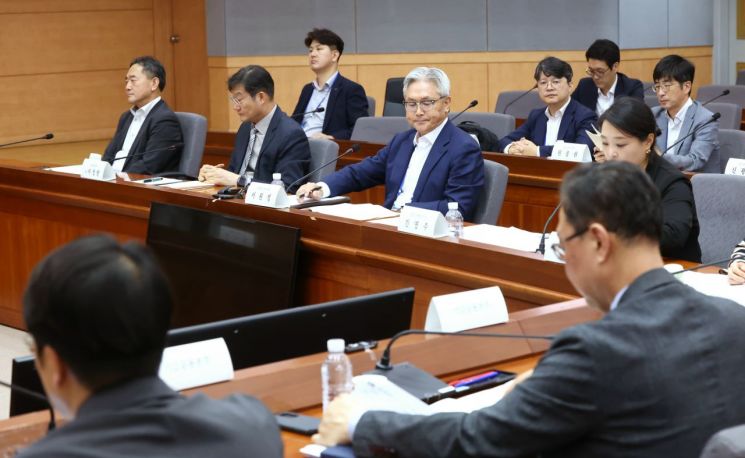
The NPS Fund Management Committee held its 6th meeting on the 26th and received a report on raising the foreign currency advance procurement limit from the current monthly cap of $1 billion to a quarterly cap of $6 billion (monthly $3 billion, daily $150 million). Advance procurement refers to the practice of purchasing foreign currency in installments when making overseas investments. The expanded advance procurement limit is scheduled to take effect from October.
The NPS's advance procurement limit has been capped at $1 billion since September 2022. There have been ongoing concerns that this limit is low compared to the increasing scale of overseas investments. As of June, the NPS's overseas equities, overseas bonds, and alternative investment assets totaled KRW 655.403 trillion, accounting for 57.1% of total assets (KRW 1,146.079 trillion). After recent discussions between the Ministry of Economy and Finance and the Ministry of Health and Welfare, it was decided to increase the advance procurement scale to an average of $6 billion quarterly, allowing up to $3 billion monthly.
The expansion of the advance procurement scale is expected to contribute to stabilizing the foreign exchange market. The government assessed that the NPS's previous inability to advance procure foreign currency led to downward pressure on the Korean won's value as it had to purchase foreign currency in the spot market. Additionally, securing foreign currency 'ammunition' more easily will accelerate efforts to improve returns through overseas investments. An NPS official stated, "If we buy dollars in advance when the exchange rate is low and hold them, we can actively invest when the 'low-price buying' opportunity arises. Previously, even when such opportunities came, if the advance procurement limit was reached, we had to reluctantly buy dollars no matter how expensive they were."
On the same day, the Fund Management Committee also deliberated and approved the 'introduction of dialogue with companies regarding overseas stocks.' This involves applying 'dialogue with companies,' one of the shareholder activities aimed at enhancing long-term fund returns, to overseas companies as well. 'Dialogue with companies' is a continuous engagement with investee companies on issues closely related to corporate value, such as dividend policy, climate change, and industrial safety, to encourage voluntary improvements. This has been implemented for domestic companies since January 2019 and is planned to be applied to overseas companies starting next year.
© The Asia Business Daily(www.asiae.co.kr). All rights reserved.

![Clutching a Stolen Dior Bag, Saying "I Hate Being Poor but Real"... The Grotesque Con of a "Human Knockoff" [Slate]](https://cwcontent.asiae.co.kr/asiaresize/183/2026021902243444107_1771435474.jpg)














