Hyundai Motor Company and Kia have embarked on the development of a new LFP (Lithium Iron Phosphate) battery cathode material technology. By adopting the new process, the production process of cathode materials can be shortened, reducing production costs while also minimizing environmental pollution.
On the 26th, Hyundai Motor Company and Kia announced that they have started a project to develop LFP battery cathode material technology in collaboration with Hyundai Steel and EcoPro BM. This cooperation is part of the 'LFP Battery Technology Development' project supported by the Ministry of Trade, Industry and Energy and will proceed over a total of four years.
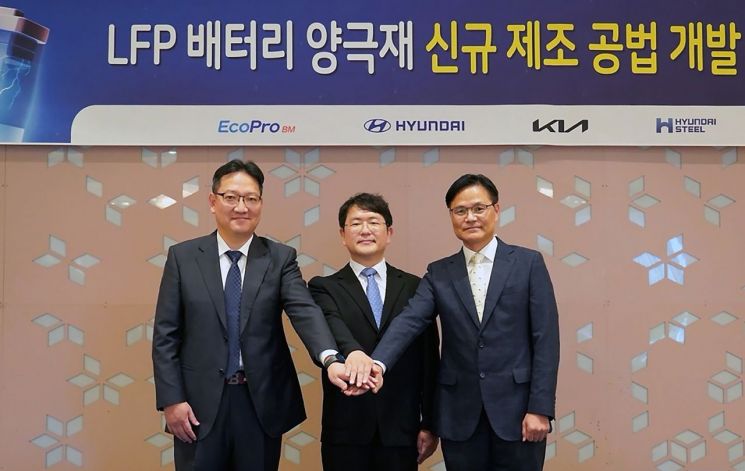 Hyundai Motor Company and Kia announced that they will begin a project to develop LFP (Lithium Iron Phosphate) battery cathode material technology in collaboration with Hyundai Steel and EcoPro BM. At an event held on the 25th at the Sunshine Hotel in Dong-gu, Daejeon, Jung Soon-jun, Executive Director of Electrification Drive Material Development at Hyundai Motor Company and Kia (right in the photo), Lim Hee-jung, Executive Director of Advanced Development at Hyundai Steel (left in the photo), and Seo Jun-won, Executive Director of Research Planning at EcoPro BM, posed for a commemorative photo.
 [Photo by Hyundai Motor Company and Kia]
The goal of this project is to develop a technology that synthesizes materials directly without using precursors during the manufacturing of LFP battery cathode materials. Precursors are substances used in the stage before the final synthesis of cathode materials. Typically, LFP battery cathode materials are produced by adding lithium to precursors synthesized from phosphate and ferrous sulfate.
The direct synthesis method being developed by Hyundai Motor Company and Kia is a technology that combines phosphate, iron powder, and lithium simultaneously to produce cathode materials without creating separate precursors. Since there is no need to produce the basic precursor, harmful emissions generated during the process can be minimized, and production costs can be reduced.
In adopting the new process, securing raw materials with no impurities and uniform particle size is crucial. To this end, Hyundai Motor Company and Kia are developing a high-purity fine iron powder processing technology using domestically recycled iron in collaboration with Hyundai Steel. EcoPro BM will utilize this to develop directly synthesized LFP cathode materials.
Moreover, LFP cathode materials produced using this method exhibit excellent charge and discharge performance at low temperatures, and Hyundai Motor Company and Kia aim to develop the technology to enable rapid charging capabilities. A Hyundai Motor Company and Kia official stated, "If this project is successfully completed, it will be possible to manufacture LFP batteries at more competitive prices," adding, "We expect to reduce dependence on overseas imports of cathode material precursors, internalize the necessary technology, and enhance the technological competitiveness of both the nation and Hyundai Motor Group."
© The Asia Business Daily(www.asiae.co.kr). All rights reserved.

















