Press Conference in Seoul for the Launch of Next-Generation Accelerator and Processor
Intel, which is experiencing management difficulties, has challenged the AI market by launching next-generation artificial intelligence (AI) accelerators and high-performance processors. Intel, which has announced competition with Nvidia, a leading AI semiconductor company, aims to regain competitiveness in the data center and AI infrastructure sectors through these new products.
Intel Korea held a press briefing on the 26th at the FKI Tower (formerly the Federation of Korean Industries building) in Yeongdeungpo-gu, Seoul, introducing the newly launched CPU-based AI accelerator ‘Gaudi3’ and ‘Xeon 6 with Performance-cores’ technology.
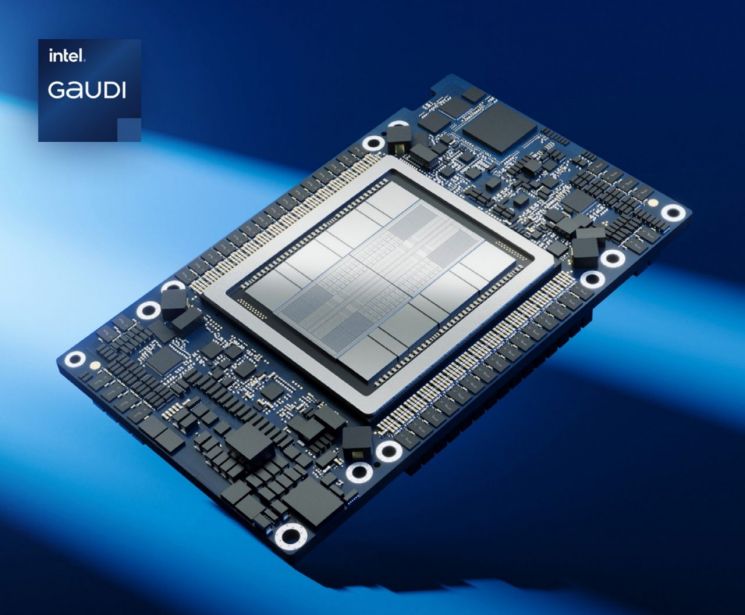
Gaudi3 is a semiconductor optimized for large-scale AI computations. It supports faster and more efficient processing when AI learns or predicts vast amounts of data. It is mass-produced using TSMC’s 5㎚ (nanometer, one billionth of a meter) process. Compared to the previous model, its speed is up to 4 times faster, and the HBM has been increased by 1.5 times. Equipped with four tensor processor cores and 128GB of HBM2e memory, it can handle large AI models without any issues.
This product is compatible with major AI frameworks such as PyTorch for deep learning and Hugging Face for natural language processing (NLP, language analysis), and it is expected to be offered as a service on IBM Cloud. Intel will compete with Nvidia and AMD in the AI chip market through Gaudi3. Nvidia currently holds more than 70% of the global server CPU market, with AMD and Intel chasing.
Intel’s new CPU, Xeon 6 with Performance-cores, features six cores capable of handling ‘high-performance’ tasks. It enables faster and more efficient data processing, server operations, and high-speed computations. Its performance has doubled compared to the previous model. It is optimized for AI performance in edge environments (processing data near the collection site or on the device itself, such as autonomous vehicles), data centers, and cloud environments. Conversely, the ‘E-core (Efficient core)’ focuses on energy efficiency and is used for background tasks or situations requiring low power consumption. Earlier, Intel released the Xeon 6 based on E-cores in June.
Despite management difficulties such as layoffs and deficits, Intel launched new products. Intel recorded losses of $381 million in Q1 and $1.61 billion in Q2 this year, facing financial challenges. Particularly, the foundry division accumulated losses of $5.3 billion in the first half of the year. The stock price has dropped by about 60%, and the market capitalization is below $100 billion. Intel plans to cut 15% of its total workforce, about 15,000 employees, and there have been recent reports that Qualcomm has considered acquiring Intel.
Intel intends to strengthen its position in the AI market through the new product launches. Na Seung-ju, General Manager of Intel Korea’s Data Center and AI Business Division, said at the briefing, "Major OEMs will soon launch servers equipped with Intel products released today in Korea," adding, "We will provide domestic customers with a wide range of options for building AI infrastructure."
Intel is collaborating with major OEM partners such as Dell Technologies and Supermicro to jointly design AI deployment systems tailored to specific customer needs. Dell Technologies is currently co-designing a retrieval-augmented generation (RAG)-based solution using Gaudi3 and Xeon 6.
© The Asia Business Daily(www.asiae.co.kr). All rights reserved.
![Clutching a Stolen Dior Bag, Saying "I Hate Being Poor but Real"... The Grotesque Con of a "Human Knockoff" [Slate]](https://cwcontent.asiae.co.kr/asiaresize/183/2026021902243444107_1771435474.jpg)
















