KG Selection Accuracy 95%
Artificial intelligence (AI) technology has made it possible to identify hens that do not lay eggs or lay fewer eggs. This is expected to help farm management by reducing feed costs.
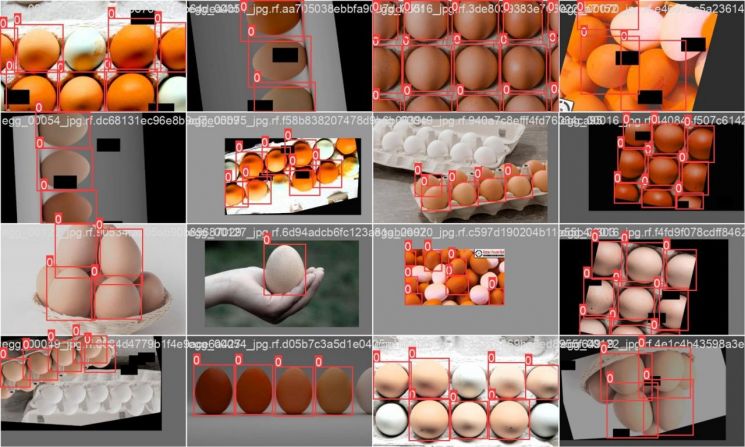 AI Model Training and Evaluation Images for Egg Tracking in Videos / [Image provided by Rural Development Administration]
The Rural Development Administration announced on the 25th that it has developed a technology that automatically recognizes eggs moving on an egg collection conveyor belt using AI, analyzes the number of eggs collected per cage, and distinguishes between non-laying hens (0% laying rate) and low-laying hens (less than 50% laying rate).
This research was jointly conducted by the National Institute of Animal Science, Jeonbuk National University, LG Uplus (LGU+), and Emcopia, supported by the Smart Farm R&D Project Group's "Smart Farm Multi-Ministry Package Innovation Technology Development Project." The Smart Farm R&D Project Group is a joint initiative planned by the Ministry of Agriculture, Food and Rural Affairs, the Ministry of Science and ICT, and the Rural Development Administration.
Generally, about 3% of a flock are hens that do not lay eggs or lay fewer eggs. According to the Rural Development Administration, these abnormal individuals cause an annual feed cost loss of 38.9 billion KRW based on the total number of laying hens raised. Although experts can identify and remove abnormal hens by checking the pelvic bone area of each hen, this process inevitably requires significant time and cost.
The joint research team from the National Institute of Animal Science's Poultry Research Center trained an AI model to accurately recognize eggs in various poultry house environments to improve the accuracy of identifying cages with abnormal hens. As a result, the technology was implemented to be unaffected by factors such as the color, material, and operating speed of the egg collection conveyor, as well as the color and orientation of the eggs.
Additionally, a web-based information collection (monitoring) system was developed that allows easy viewing of cages with abnormal hens and the average number of eggs laid per cage on computers or tablets. Evaluation of the system at farms showed a cage selection accuracy of 95%.
Moon Byung-yeon, CEO of Iseong Farm in Gimje-si, Jeonbuk, who participated in the field demonstration, expressed expectations, saying, "If this system is introduced, it will be easy to select problematic hens, which will help farm management by reducing feed costs."
Lim Ki-soon, Director of the National Institute of Animal Science at the Rural Development Administration, stated, "We will promote commercialization through the joint research companies involved in technology development and transfer the AI model and related patents to companies that wish to use the technology. We will do our best to support farmers." He added, "We will also disclose the AI training data secured during the research and development process to contribute to the spread of smart farm technology."
© The Asia Business Daily(www.asiae.co.kr). All rights reserved.

















