Professor Jeong Hoonui's Team Develops Ultra-Strong Adhesive Patch with Crack Prevention Technology
No Skin Irritation... Expected Application in Wearables and Healthcare Devices
A hybrid patch technology has emerged that maintains strong adhesion and prevents cracks without the use of glue.
It is expected to bring various innovations when applied to wearable devices, VR equipment, and the healthcare industry.
A research team led by Professor Jung Hoonui from the Department of Mechanical Engineering at UNIST (President Park Jongrae) has developed a "programmable meta patch" technology that prevents cracks from the micro to macro scale. This technology maximizes adhesion while allowing attachment in a controlled, desired direction.
 [Researchers] From the right: Professor Jeong Hoonui, Researcher Lee Donghyuk, Researcher Park Sungjin, Researcher Kang Donggwan.
The hybrid patch applies a hexagonal pillar and tip structure, as well as a nonlinear cutting structure, achieving adhesion 70 times stronger than conventional adhesives. Since it does not use chemical adhesives, it does not irritate the skin and can be reused. It is effective in preventing cracks from micro-sized fine areas to macro-sized large surfaces.
This adhesive patch combines an adhesive structure inspired by nature with a kirigami meta-structure. The adhesion strength and attachment direction can be adjusted as needed. Although the adhesive strength varies depending on the direction, it can only attach in the desired direction, making it highly efficient.
Professor Jung Hoonui explained, "Existing skin adhesion technologies for bio-healthcare and wearable devices used chemical adhesives, which irritated the skin and were difficult to reuse. We developed an adhesive technology that maintains strong adhesion, applies directional adhesion, reduces skin irritation, and is reusable."
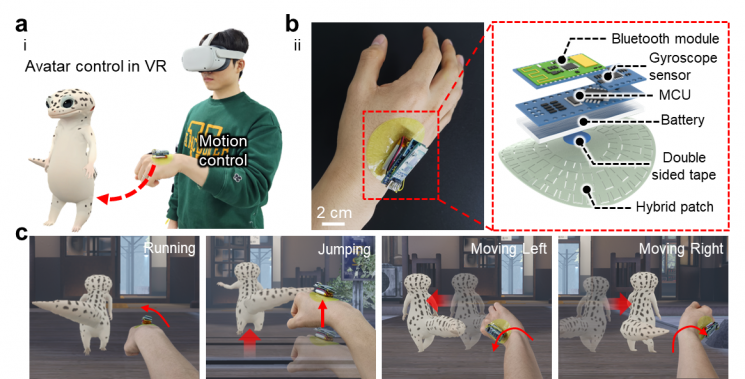
Wearable VR devices made with this patch adhere strongly in all directions while causing almost no skin irritation. Its excellent breathability maximizes user convenience. This achievement, which overcomes the limitations of skin adhesion technology, is also attracting attention in the bio-healthcare field.
The research results were published in the world-renowned journal Science Advances on September 13, and the research was supported by the Ministry of Science and ICT, the National Research Foundation of Korea, and the US National Science Foundation.
© The Asia Business Daily(www.asiae.co.kr). All rights reserved.
!["The Woman Who Threw Herself into the Water Clutching a Stolen Dior Bag"...A Grotesque Success Story That Shakes the Korean Psyche [Slate]](https://cwcontent.asiae.co.kr/asiaresize/183/2026021902243444107_1771435474.jpg)

















