Four Major Convenience Store Chains Launch Sodium-Reduced Lunchboxes
Industry: "Regular Lunchboxes Contain Less Sodium Than Dining-Out Menus"
The convenience store industry is continuously introducing low-sodium lunch boxes. As debates over the sodium content in convenience store lunch boxes persist, the industry is working to dispel misunderstandings by offering less salty and healthier meals.
According to the distribution industry on the 1st, convenience stores have been participating in the "Pilot Project for Sodium Reduction" promoted by the Ministry of Food and Drug Safety (MFDS) since 2012. As a result, they are steadily launching food products, including lunch boxes, with reduced sodium content supported by MFDS technology.
CU, operated by BGF Retail, launched the 'The Geongang Sikdan' (The Healthy Meal Plan) series, which is one of the sodium-reduced foods developed with support from MFDS. The sodium content of The Geongang Sikdan rice balls and gimbap are 480 mg and 740 mg respectively, significantly lower than the WHO's recommended daily sodium intake.
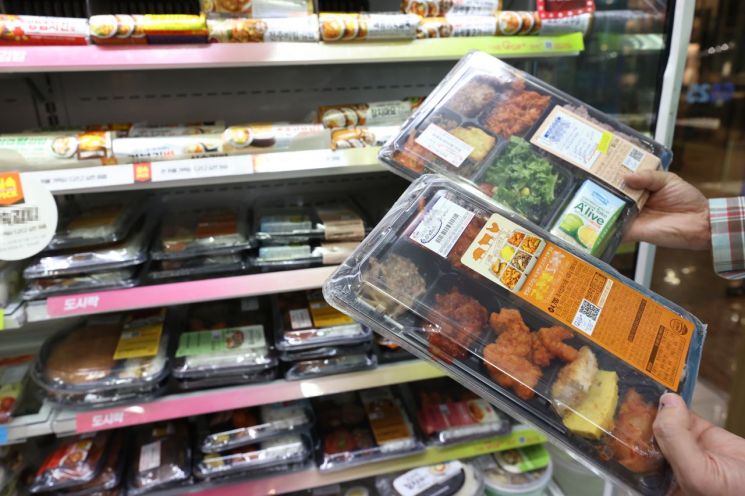
GS25, operated by GS Retail, recently reduced sodium content by replacing the gochujang seasoning in its popular menu item 'Jeongseong Gadeuk Dosirak' with a low-sodium gochujang seasoning, cutting sodium by about 30%. Jeongseong Gadeuk Bibimbap is composed of pork stir-fry, seasoned bean sprouts, fried egg, and a low-sodium gochujang sauce with sesame oil, containing a total sodium content of 1,010 mg. It is characterized by allowing consumers to adjust sodium intake between 483 mg and 1,010 mg depending on the amount of gochujang added.
Seven Eleven also recently introduced a sodium-reduced gimbap with MFDS technical support. They used a sodium-reduced version of 'Spam,' a gimbap filling ingredient, lowering the sodium content to 280.5 mg per 100g. Seven Eleven's self-developed 'The Keojin Spam Corn Mayo Triangle Gimbap' uses Spam Light, which has reduced sodium compared to regular Spam, resulting in only 346 mg of sodium per 100g.
Emart24 also recently launched a low-sodium lunch box product called 'Pujimhan Jeyuk & Bulgogi Dosirak' (sodium content 781 mg). An industry insider said, "As demand for diet management continues to rise, the industry is strengthening low-sodium healthy convenience meals. In this era of high prices, convenience store lunch boxes, which are cost-effective and recognized for hygienic safety, raise questions about whether they actually contain sodium levels harmful to the human body."
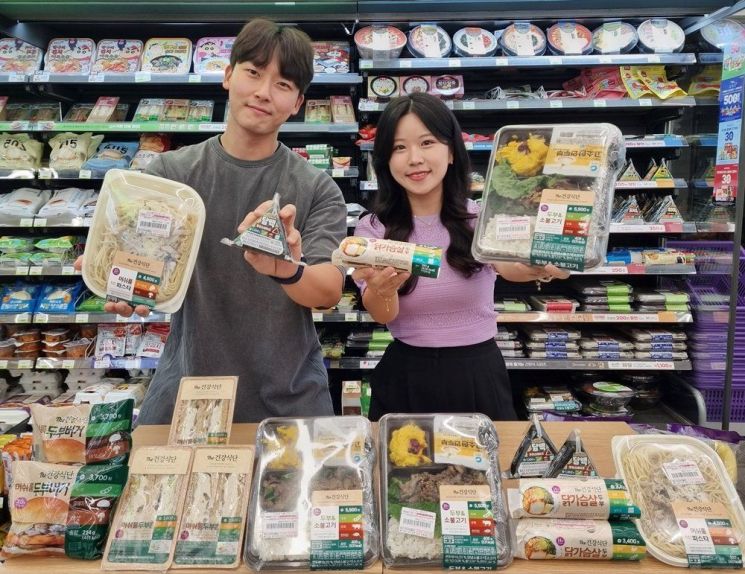 CU releases the 'The Healthy Meal' series every year, focusing on balanced nutrition and healthy cooking methods, including sodium-reduced meals.
 [Photo by BGF Retail]
Are Convenience Store Lunch Boxes Sodium Bombs?
Controversies over the sodium content in convenience store lunch boxes arise repeatedly with new survey results. The domestic food nutrition community has consistently pointed out that the sodium content in convenience store lunch boxes is excessively high. The average sodium content in convenience store lunch boxes is around 1,400 to 1,500 mg, exceeding 70% of the WHO's recommended daily limit (2,000 mg), which is the basis for these claims.
For example, a research team led by Professor Hyun Tae-seon from the Department of Food and Nutrition at Chungbuk National University reported in a 2020 paper that the average sodium content in convenience store lunch boxes was about two-thirds of the daily recommended intake. Their study analyzed the nutrient content of 93 lunch box products sold at the top five domestic franchise convenience stores by store count as of September 2019.
The research team analyzed the nutritional components of lunch boxes categorized as set meals (consisting of rice and side dishes) and single-dish meals (such as fried rice, rice bowls, and bibimbap) from each franchise. They found that 97.2% of the relatively more expensive set meal lunch boxes (average price 4,455 KRW) and 90.9% of single-dish lunch boxes (3,696 KRW) contained more than one-third of the daily recommended sodium intake.
Another domestic study also highlighted the high sodium content in convenience store lunch boxes. A research team from Seoul National University's Department of Food and Nutrition compared the nutritional quality of 71 lunch box products from the top five convenience store companies by price range and confirmed that sodium content exceeded 60% of the daily recommended intake limit. Lunch boxes containing fried rice instead of plain rice had particularly high sodium levels. The team urged manufacturers in their paper to "make efforts to reduce the sodium content in seasonings or condiments used in fried rice in their products."
Convenience Store Industry: "Sodium Content Lower Than Dining Out Menus"
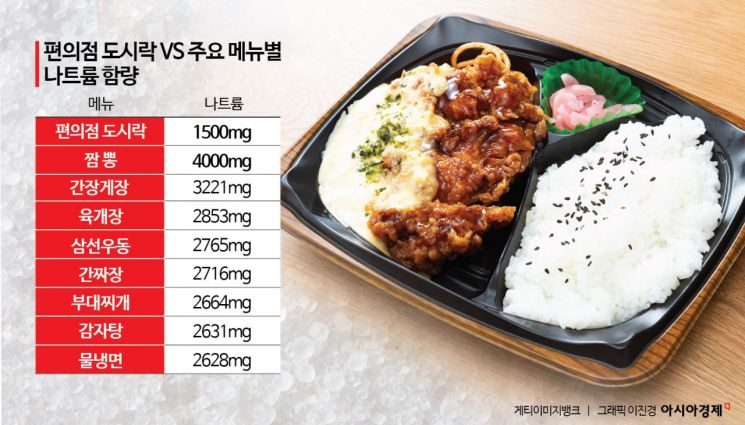
However, the convenience store industry insists that these criticisms are unfair. They argue that the sodium content in convenience store lunch boxes is lower compared to dining-out menus. In fact, the average sodium content in convenience store lunch boxes is lower than that of a single pack of ramen (1,800 mg). Additionally, popular lunch menus for office workers such as jajangmyeon and udon exceed the WHO's daily recommended sodium intake, and jjamppong contains twice the amount.
An industry insider said, "A bowl of jjamppong contains 4,000 mg of sodium, the highest among single dishes," adding, "At some point, jjamppong has been praised for its 'spicy and refreshing broth,' while convenience store lunch boxes have been stigmatized as 'sodium bombs' by some food nutrition experts," expressing bitterness.
The distribution industry also argues that adhering to the WHO's daily recommended sodium intake, which forms the basis of academic claims that "convenience store lunch boxes are sodium bombs," is practically difficult considering Korean dietary habits. According to the National Health and Nutrition Survey data from the Ministry of Food and Drug Safety, the average daily sodium intake of Koreans decreased from 3,247 mg in 2018 to 3,074 mg in 2022, but it still remains more than 1.5 times higher than the WHO's recommended limit of 2,000 mg per day.
Another industry insider said, "Commonly consumed side dishes such as kimchi, soups, stews, pickled foods, and salted seafood have high sodium content," adding, "Due to the spicy and savory nature of Korean cuisine, it is practically difficult to comply with the WHO's recommended sodium intake to preserve the flavor of the food."
© The Asia Business Daily(www.asiae.co.kr). All rights reserved.
![Clutching a Stolen Dior Bag, Saying "I Hate Being Poor but Real"... The Grotesque Con of a "Human Knockoff" [Slate]](https://cwcontent.asiae.co.kr/asiaresize/183/2026021902243444107_1771435474.jpg)


















