April 24 National Assembly Science and ICT Committee AI Basic Act Public Hearing
Professor Choi Kyung-jin "AI Innovation Requires Special Provisions"
Experts Emphasize Regulation Despite Promotion-Focused Legislation
At the National Assembly public hearing on the Basic AI Act, Professor Choi Kyung-jin of Gachon University (President of the Korean Artificial Intelligence Law Association) suggested that special exceptions are necessary to accelerate AI innovation in Korea and establish a trust-based AI ecosystem.
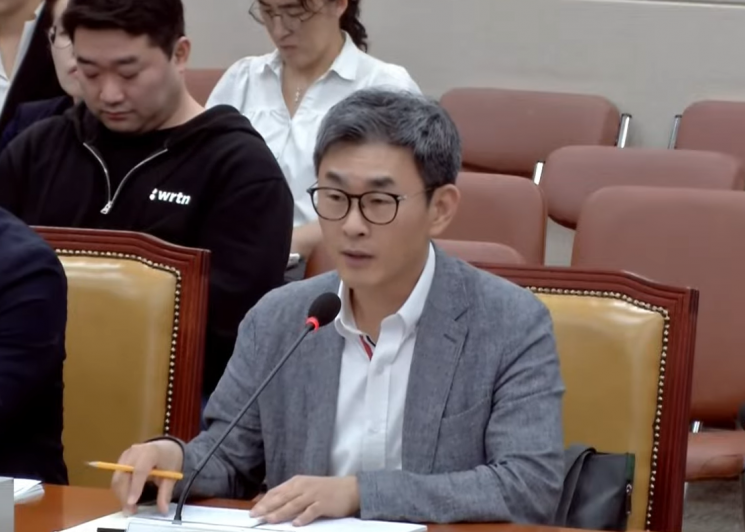 On the 24th, Professor Choi Kyung-jin of Gachon University is expressing his opinion at the public hearing on artificial intelligence and digital inclusion-related bills held at the National Assembly Science, ICT, Broadcasting and Communications Committee. Photo by National Assembly Internet Broadcasting System Capture
At the public hearing on AI and digital inclusion-related legislation held on the 24th by the National Assembly's Science, Technology, Information and Broadcasting and Communications Committee, Professor Choi emphasized the need for three special exceptions, including a personal information regulation sandbox, stating the following.
First, Professor Choi said a personal information regulation sandbox is necessary. He explained, "Although there is currently a sandbox, it mainly serves as a relaxation system for entry regulations and is not a system that relaxes or exempts laws prohibiting certain acts, so innovation from the perspective of personal information is not progressing well," adding, "It is necessary to use the original personal information itself or enable learning in a secure environment within the scope that harmonizes with the Personal Information Protection Act."
He also argued for the necessity of special exceptions regarding the use of copyrighted works for AI training. Professor Choi said, "It is unclear to whom the data is being trained," and added, "When collecting and using data for AI training, it should be done without consent, but a post-facto, low-cost yet reasonable compensation system needs to be established."
He emphasized special exceptions related to public data as well. Professor Choi stated, "There is a lot of meaningful public data, but one reason it is not open is due to personal information," and said, "A new public data licensing system should be introduced, transferring basic responsibility to the companies conducting the training, allowing them through license evaluation, and if personal information is exposed or generated during the service process, responsibility should be imposed accordingly through the special exceptions."
Baek Kyung-hoon, head of LG AI Research Institute, stressed the need for promotion-centered legislation rather than excessive regulation from the corporate perspective. Baek said, "Many companies are already striving to establish and comply with AI ethical principles," and added, "For example, our company identifies vulnerabilities in AI algorithm models through a red team and is building data governance to review copyright and personal information issues."
He continued, "From a corporate standpoint, adhering to AI ethical principles is directly linked to customer trust and determines the survival of the company," emphasizing, "Companies cannot neglect voluntary efforts to develop trustworthy AI." He added, "AI regulation should focus on preventing misuse rather than the technology itself."
Attorney Ko Hwan-gyeong of the law firm Kwangjang stated that the Basic AI Act should be prepared to be interoperable with overseas regulations. Attorney Ko said, "We need to closely examine the definitions of AI and AI systems," noting, "The EU AI Act and the US AI Executive Order also have separate definition clauses." He added, "We also need sufficient review of reasonable definitions to avoid excessively expanding the scope of regulation."
Research Professor Yoo Seung-ik of Handong University said that while AI industry promotion is important, the proposed bills lack content on regulation. He stated, "It is necessary to specifically define who the subjects required to comply with the law are," and added, "It should be clear what obligations are imposed on the subjects in detail and where those affected can file complaints when asserting their rights."
Regarding AI governance, Professor Yoo said, "The National Human Rights Commission has recommended establishing an independent and effective supervisory system," and pointed out, "Although the National AI Committee has been launched, it cannot be said that any regulatory or supervisory system has been established."
© The Asia Business Daily(www.asiae.co.kr). All rights reserved.
![Clutching a Stolen Dior Bag, Saying "I Hate Being Poor but Real"... The Grotesque Con of a "Human Knockoff" [Slate]](https://cwcontent.asiae.co.kr/asiaresize/183/2026021902243444107_1771435474.jpg)
















