As hundreds have died in Israel's airstrikes on Lebanon, escalating tensions in the Middle East, U.S. President Joe Biden is set to deliver a speech at the United Nations (UN) General Assembly at the UN headquarters in New York on the 24th (local time). With only about four months left in his term, this is expected to be Biden's final UN General Assembly speech.
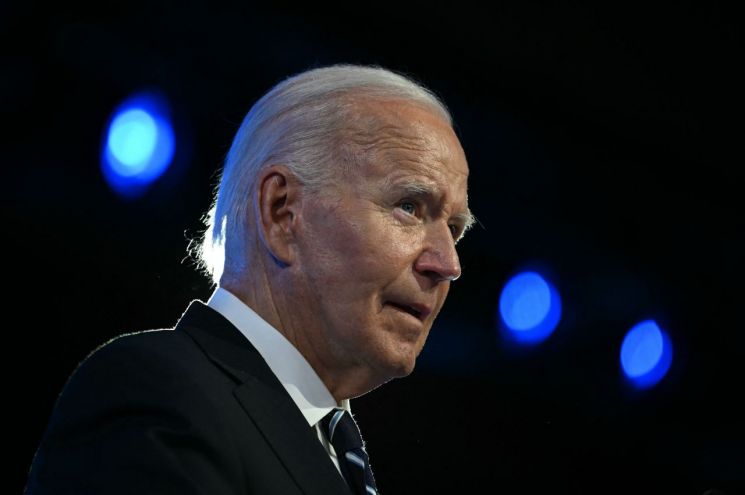
According to the New York Times (NYT) and others on the 23rd, President Biden will take the podium as the second speaker during the general debate on the morning of the following day, coinciding with the high-level week of the UN General Assembly. This will be late at night Korean time on the 24th. The speech is expected to focus on reaffirming U.S. leadership and presenting a vision for how the world should unite to address urgent global issues. Biden’s team has indicated that his speech will be filled with declarations about the future.
In particular, Biden’s speech draws attention amid ongoing uncertainties surrounding the prolonged Ukraine war and the U.S.-China hegemonic rivalry, as well as the recent escalation risk originating from the Middle East. The NYT noted, "President Biden is delivering his UN General Assembly speech at a time of deep uncertainty about America’s global role," adding, "As multiple global crises collide with U.S. politics, America’s approach to these challenges may also change."
So far, President Biden has repeatedly emphasized the need to reach a ceasefire agreement to end the war in the Gaza Strip. He has also stated that the U.S. will do everything possible to prevent further escalation amid intensifying clashes between Israel and the Lebanese Shiite militant group Hezbollah in Lebanon. Additionally, Biden faces several decisions, including whether to authorize the use of long-range weapons in response to Russia in the protracted Ukraine war.
John Kirby, White House National Security Council (NSC) National Security Communications Coordinator, described Biden’s upcoming UN General Assembly speech as "an explanation of his vision for how the world should solve these major problems and uphold fundamental principles such as the UN Charter."
President Biden is also scheduled to attend a United Nations Security Council meeting on the same day, which Ukrainian President Volodymyr Zelensky is expected to attend as well.
However, the NYT pointed out that with Biden’s term nearing its end, there is uncertainty about the long-term direction of U.S. policy. While Democratic presidential candidate Vice President Kamala Harris generally accepts Biden’s stance on the importance of strategic alliances, her specific policy views may differ. In contrast, former President Donald Trump, the Republican presidential candidate, advocates a "America First" policy, so if he wins the election, a significant shift in U.S. foreign policy is inevitable.
Accordingly, it has been observed that world leaders visiting New York for the UN General Assembly are striving to meet not only President Biden but also Vice President Harris and former President Trump. John Alterman, head of the Middle East program at the Center for Strategic and International Studies, said, "Currently, wars are ongoing in Ukraine and the Gaza Strip, and there is a possibility of war breaking out in Lebanon as well," adding, "What stance the U.S. takes is very important, but it has largely slipped beyond their control." He further noted that for other world leaders, understanding where the U.S. will head after the November election has become the most crucial part of their strategic calculations.
© The Asia Business Daily(www.asiae.co.kr). All rights reserved.
![Clutching a Stolen Dior Bag, Saying "I Hate Being Poor but Real"... The Grotesque Con of a "Human Knockoff" [Slate]](https://cwcontent.asiae.co.kr/asiaresize/183/2026021902243444107_1771435474.jpg)
















