Reverse repo rate down 0.2%P... Existing mortgage down 0.5%P
Unprecedented joint press conference by heads of 3 financial authorities
China, experiencing an economic downturn and a slowdown in consumption, announced on the 24th that it will soon cut the bank reserve requirement ratio (RRR) by 0.5 percentage points to inject liquidity worth 1 trillion yuan (approximately 189 trillion won) into the market.
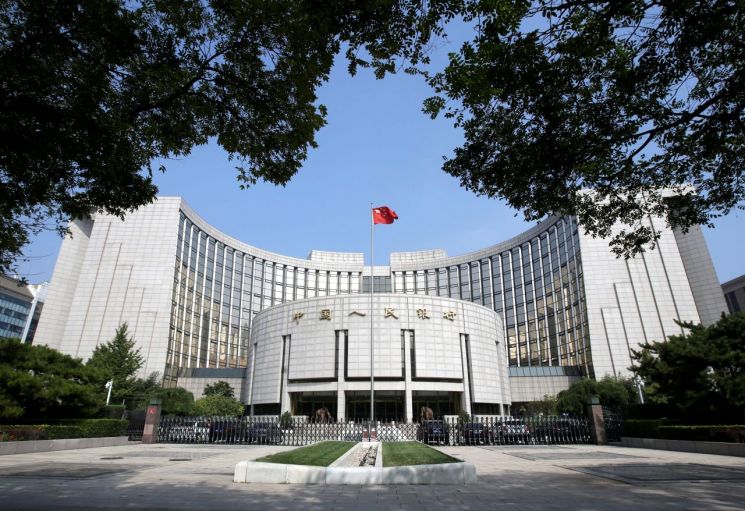
Pan Gongsheng, Governor of the People's Bank of China, the country's central bank, stated at a joint press conference held by the State Council Information Office in Beijing, "We will soon lower the RRR by 0.5 percentage points to provide long-term liquidity of 1 trillion yuan to the financial market," adding, "Depending on the market liquidity situation within this year, we may choose the timing to further reduce the RRR."
The RRR is the proportion of deposits that banks are required to hold with the central bank. Lowering the RRR supplies liquidity to the market. Amid growing concerns about deflation (price declines during economic downturn) in China, the People's Bank of China reduced the RRR by 0.25 percentage points in March and September last year, and by 0.5 percentage points ahead of the Lunar New Year holiday in February this year. Recently, the People's Bank indicated that there is sufficient room to cut the RRR further. With consecutive RRR cuts, the weighted average RRR in China's financial sector currently stands at about 6.9%.
In addition, the policy rate for the 7-day reverse repurchase agreements (reverse repos) will be lowered by 0.2 percentage points from the current 1.7% to 1.5%. Governor Pan said, "This will induce a simultaneous decline in the quoted interest rates in the money market and deposit rates, while maintaining the stability of commercial banks' net interest margins."
Targeting the real estate sector, a core area of China's economic downturn, the interest rates on outstanding mortgage loans have also been reduced. The plan is to guide existing mortgage rates down to the level of new loans, with an expected average reduction of about 0.5 percentage points. At the national level, the minimum down payment ratio for second-home loans will be lowered from the current 25% to 15%, aligning it with the down payment ratio for first homes.
A new monetary policy tool will also be created to support the stable development of the stock market. Facilities will be established to facilitate swaps for securities firms, funds, and insurance companies, allowing qualified securities firms, funds, and insurance companies to secure liquidity from the central bank through asset collateral. This will enhance institutions' ability to secure funds and hold stocks. Additionally, a special re-lending facility will be created to enable banks to provide loans to listed companies and major shareholders, supporting stock repurchases and holdings.
The press conference was also attended by Li Yunze, Director of the National Financial Regulatory Administration, and Wu Qing, Chairman of the China Securities Regulatory Commission.
The unusual joint press conference held by the heads of the three financial authorities was aimed at emphasizing the determination to stimulate the economy amid recent weak economic indicators in China. Despite several stimulus measures, concerns are growing that the economic growth target of around 5% for this year will be difficult to achieve. China's economy grew by only 4.7% in the second quarter. Retail sales and industrial production in August increased by 2.1% and 4.5% year-on-year, respectively, falling short of market expectations of 2.5% and 4.8%. Despite various stimulus measures such as consumption promotion policies previously announced by the Chinese government, domestic demand appears to remain sluggish.
Global financial institutions have recently lowered their economic growth forecasts for China this year to below 5%. Although forecasts vary by institution, growth projections compiled by Goldman Sachs, Bank of America (BoA), UBS, JP Morgan, and Nomura Holdings range from 4.5% to 4.9%.
Earlier, following the U.S. Federal Reserve's "big cut" (a 0.5 percentage point reduction in the benchmark interest rate) on the 18th, which created room for monetary easing, China kept its loan prime rate (LPR), which functions as a de facto benchmark interest rate, unchanged for two consecutive months on the 20th. However, on the previous day, ahead of the National Day holiday, the People's Bank of China lowered the 14-day reverse repo rate from 1.95% to 1.85% and injected liquidity worth 234.6 billion yuan (approximately 44.3441 trillion won) into the banking system through the reverse repo market to meet liquidity demand.
Becky Liu, Head of China Macro Strategy at Standard Chartered, said, "The monetary easing was bolder than expected as the interest rate cut and RRR cut were announced simultaneously," adding, "Following the Fed's large-scale rate cut, there is likely room for bolder easing in the coming quarters."
© The Asia Business Daily(www.asiae.co.kr). All rights reserved.

















