It is analyzed that the opening of customs trade data is leading to the creation of economic effects. Customs trade data is a comprehensive concept that includes basic data used for compiling statistics such as export/import cargo, arrival and departure of trade vessels and trade aircraft, import item tariffs, and data produced, processed, and analyzed based on these.
On the 24th, the Korea Customs Service announced that last year, it provided 30.1 billion cases of customs trade data annually to about 1.15 million users including government, public institutions, import/export companies, and the public, generating an economic effect worth a total of 4.8 trillion KRW in added value such as reduced working hours and decreased administrative costs (Openness Index = Number of data uses * Reduced working hours * Average hourly wage of workers).
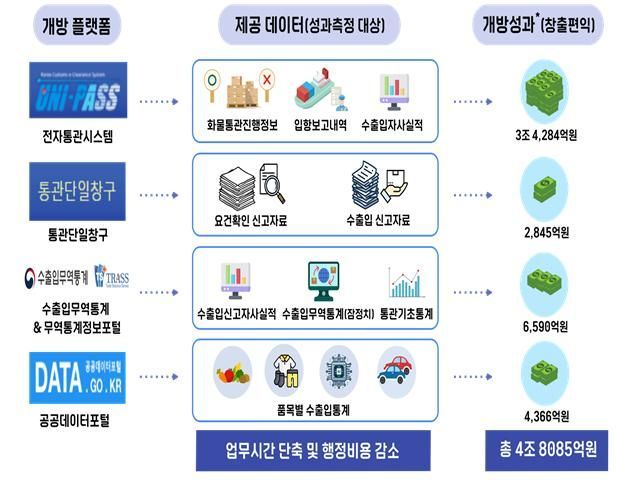 Openness (Created Benefits) = Number of Data Uses x Work Time Reduction x Average Hourly Wage of Workers (14,456.7 KRW, 2023). Provided by Korea Customs Service
This result was derived through a research service measuring the performance of opening customs trade data.
Customs trade data is opened through electronic customs clearance systems (UNI-PASS), import/export trade statistics, the Korea Trade Statistics Information Portal, and the Public Data Portal.
Among the opening channels, the electronic customs clearance system showed the largest economic effect at 3.4 trillion KRW. Additionally, the Korea Customs Service’s import/export trade statistics homepage and the Korea Trade Statistics Information Portal recorded an economic effect of 600 billion KRW.
The Korea Customs Service provides customs trade data through methods such as screen queries, open APIs (Application Programming Interface), and file data to enhance users’ convenience in processing and utilizing data.
In particular, starting this year, the scope of data opening will be expanded to promote private sector utilization of customs trade data and to create new business opportunities.
Furthermore, to provide practical assistance in establishing logistics strategies for import/export companies, the national and monthly data on ‘maritime export/import and air import transportation costs’ will be opened, and the existing ‘city/province-level’ import/export performance data will be expanded to the ‘city/county/district-level’ to allow for more detailed understanding of economic trends by administrative district.
Lee Jin-hee, Director of Information Data Policy at the Korea Customs Service, said, “The Korea Customs Service plans to actively discover additional demands for data opening and continuously advance data opening services to increase the economic added value derived from utilizing customs trade data.”
© The Asia Business Daily(www.asiae.co.kr). All rights reserved.
![From Hostess to Organ Seller to High Society... The Grotesque Scam of a "Human Counterfeit" Shaking the Korean Psyche [Slate]](https://cwcontent.asiae.co.kr/asiaresize/183/2026021902243444107_1771435474.jpg)
















