Shin Won-sik "If Kim Jong-un Decides, It Can Happen Anytime"
Flood Damage at Nuclear Test Site, Physical Conditions Difficult
Small-scale Test Expected... "Proof of Small Nuclear Warhead"
Predictions about the possibility of North Korea's 7th nuclear test are divided. The government is assessing the likelihood of it being carried out around the November U.S. presidential election, but experts generally believe it is not feasible timing-wise.
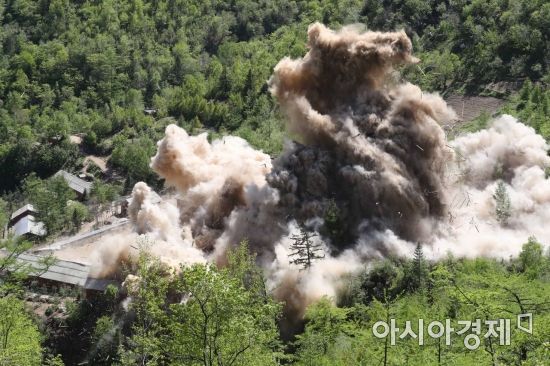 2018 North Korea Punggye-ri Tunnel Explosion Scene
 On the 23rd, Shin Won-sik, Director of the National Security Office, appeared on Yonhap News TV and said, "North Korea maintains a state where it can conduct a nuclear test anytime if Kim Jong-un decides to do so," adding, "The question of 'when to conduct it' will be decided by North Korea based on strategic advantages and disadvantages, and the timing around the U.S. presidential election is included in that consideration." Earlier, the U.S. State Department also stated that North Korea has completed preparations for a nuclear test and only a political decision remains.
However, experts predict it is physically impossible. The Punggye-ri nuclear test site, where the nuclear test would take place, suffered severe flood damage this summer. The U.S.-based North Korea specialist media 38 North analyzed satellite images of the Punggye-ri area earlier this month and diagnosed that the ground at Punggye-ri weakened due to large-scale flooding caused by the Yalu River overflow at the end of July, and some bridges on the access road to the test site were washed away. Experts analyze that it would take at least 3 to 6 months to restore the site enough to carry out a nuclear test, making it difficult before the U.S. presidential election.
Hong Min, Senior Research Fellow at the Korea Institute for National Unification, said, "To conduct a nuclear test, climatic conditions and tactical necessities must be considered, and it is still difficult to say the rainy season has completely ended," adding, "Even if the rain stops completely, the ground must stabilize and roads near the test site must be repaired, so the conditions are not right."
Political factors also play a role. Since there is no call for denuclearization in the U.S., North Korea has no reason to force a nuclear test. Especially, as North Korea has established a 'new diplomatic strategy' this year and is expanding its diplomatic activities in the 'anti-U.S. coalition,' there is speculation that it will not disrupt this with a nuclear test. China and Russia, which have played the role of North Korea's 'backers,' may also change their stance toward such an extreme measure as a nuclear test.
 From the left in the photo: Hong Min, Senior Research Fellow at the Korea Institute for National Unification; Park Won-gon, Professor of North Korean Studies at Ewha Womans University; Yang Wook, Research Fellow at the Asan Institute for Policy Studies.
Park Won-gon, Professor of North Korean Studies at Ewha Womans University, analyzed, "Currently, the U.S. political sphere is not mentioning 'denuclearization,' and if North Korea carries out a high-intensity nuclear test, it will become a U.S. issue again," adding, "It is not beneficial from North Korea's perspective either."
Senior Research Fellow Hong Min also pointed out, "If a nuclear test is carried out around the U.S. presidential election, it will attract global attention, but whether its impact is positive for North Korea is another matter," adding, "In a situation where sanctions resolutions against North Korea are not properly enforced, conducting an additional nuclear test would remove China and Russia's justification to oppose sanctions."
However, there are also predictions that North Korea may conduct a small-scale nuclear test. It is said that North Korea only needs to demonstrate the power of the small nuclear warheads that can be mounted on missiles it has revealed so far. North Korea has already unveiled the actual tactical nuclear warhead named 'Hwasan-31.' It has been promoted as being mountable on more than 10 types of weapons, including the 600mm super-large multiple rocket launcher (KN-25), unmanned underwater attack vehicle Haeyil, Hwasal-1 and -2 cruise missiles, KN-24 (ATACMS), and mini submarine-launched ballistic missiles (SLBM). Military authorities estimate the power of Hwasan-31 to be 10kt (1kt equals the explosive power of 1,000 tons of TNT). When the 3rd nuclear test was conducted in 2009, it showed an explosive power of 5kt.
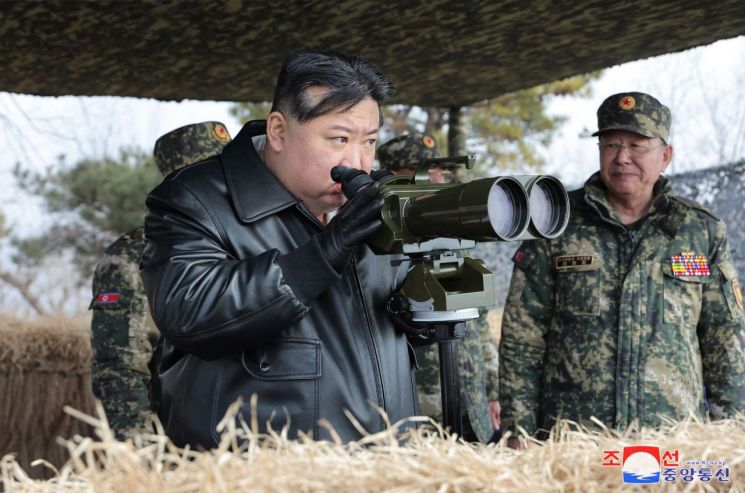
Yang Wook, Research Fellow at the Asan Institute for Policy Studies, evaluated, "Even if the Punggye-ri test site is not fully restored, a small tactical nuclear test can be conducted," adding, "To prove the small nuclear warhead, North Korea will carry out the 7th nuclear test."
© The Asia Business Daily(www.asiae.co.kr). All rights reserved.


















