Optimization of AI Function Support in Vehicles
256GB SSD Sample Provided to Customers
2TB Product Launch Planned for Early Next Year
Samsung Electronics has developed a new vehicle SSD (NAND flash-based data storage device) optimized for autonomous driving cars.
On the 24th, Samsung Electronics announced that it has completed the development of the industry's first PCIe 4.0 vehicle SSD ‘AM9C1’ applying 8th generation V-NAND. This product is suitable for autonomous vehicles as it can quickly store and retrieve data. Samsung Electronics plans to expand the market in earnest by providing samples of the industry's fastest 256GB (gigabyte) to major customers.
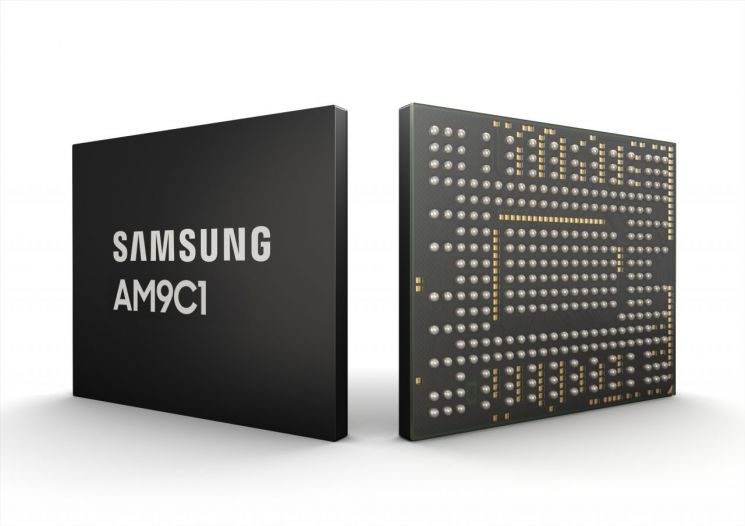
Samsung Electronics' 256GB product offers a sequential read speed of 4400MB/s and a sequential write speed of 400MB/s, with about 50% improved power efficiency compared to its predecessor (AM991). This performance is optimized to support on-device artificial intelligence (AI) functions within vehicles. Autonomous vehicles analyze and process road condition data collected in real-time through cameras, radars, sensors, etc., and in this process, the SSD plays a key role with its fast data processing speed.
Equipped with a 5nm-based controller to enhance performance and efficiency, it also improves product stability and durability through strengthened board-level reliability evaluation (inspection for damage due to temperature changes). It supports SLC mode (Single-Level Cell mode, storing 1 bit of data per cell). When needed, switching the SSD from TLC (Triple-Level Cell, storing 3 bits of data per cell) to SLC mode further increases sequential read/write speeds, enabling rapid access to large files within the vehicle. This product meets the AEC-Q100 Grade 2 standard for automotive semiconductor quality, guaranteeing stable performance across a wide temperature range from -40°C to 105°C.
Hyunduk Cho, Executive Director of Product Planning Team at Samsung Electronics Memory Business Division, said, "We expect to meet the demand for high-capacity, high-performance vehicle SSDs through collaboration with global autonomous driving companies," adding, "We will continue to lead the physical AI memory technology and related markets such as autonomous driving and robotics."
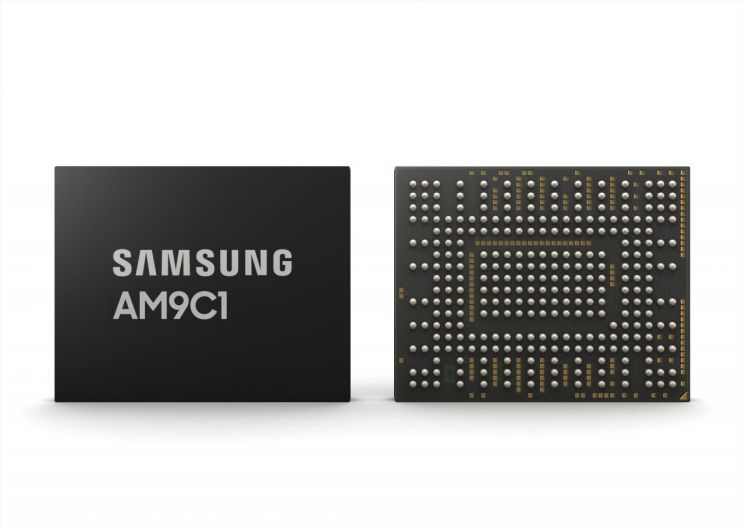
Samsung Electronics plans to mass-produce the 256GB AM9C1 product within this year and will introduce products of various capacities in response to increasing customer demand for high-capacity vehicle SSDs. Based on 8th generation V-NAND, it is developing the industry's highest capacity 2TB (terabyte) solution, aiming for mass production early next year.
To verify the high reliability required in the automotive semiconductor market, Samsung Electronics is implementing various vehicle development and management process certifications. It has obtained the CSMS certification, a vehicle cybersecurity management system based on the international automotive cybersecurity engineering standard (ISO/SAE 21434), and in March this year, received the German ASPICE CL3 certification for its UFS 3.1 product.
Hwasuk Oh, Vice President of Samsung Electronics Memory Business Division, said, "The ASPICE and ISO/SAE 21434 certifications are important milestones that externally recognize the reliability and stability of our technology," adding, "We will continue to improve safety and quality to provide the best solutions to our customers."
© The Asia Business Daily(www.asiae.co.kr). All rights reserved.
![Clutching a Stolen Dior Bag, Saying "I Hate Being Poor but Real"... The Grotesque Con of a "Human Knockoff" [Slate]](https://cwcontent.asiae.co.kr/asiaresize/183/2026021902243444107_1771435474.jpg)

















