Deferral Team: "The Stock Market Is Not Yet Fully Developed"
Implementation Team: "No Tax Cuts for the Wealthy"
A Democratic Party of Korea (DPK) internal forum on the financial investment income tax (FIIT) is just around the corner. The DPK is set to finalize its position on the FIIT roughly two months after party leader Lee Jae-myung mentioned reconsidering a deferral of the tax when announcing his candidacy for party leadership in July. The debate will be divided between a "deferral team," which advocates postponing the FIIT, and an "implementation team," which insists the tax should be enforced as scheduled next year. The deferral team includes lawmakers Hyun-jung Kim, So Young Lee, Yeon-hee Lee, and Sun-won Park, as well as former lawmaker Byung-wook Kim. The implementation team consists of lawmakers Young-hwan Kim, Sung-hwan Kim, Kang-il Lee, Nam-geun Kim, and Kwang-hyun Lim, among others.
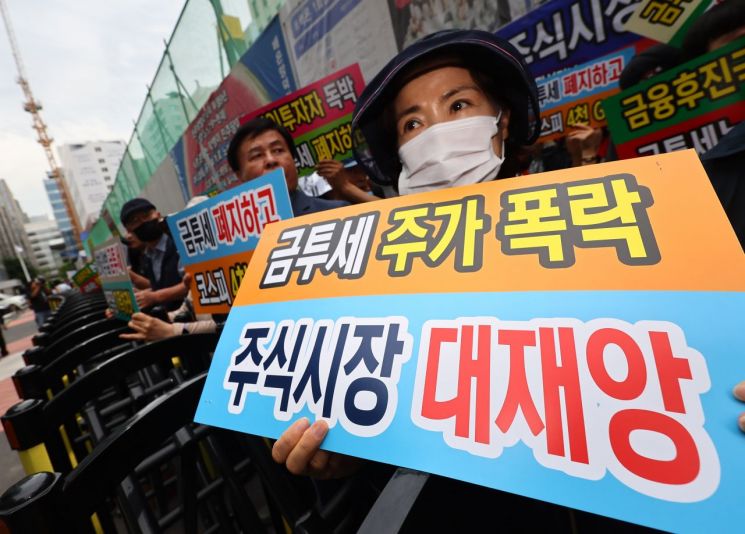 Members of the Korea Stock Investors Association (KOSIA) held a rally on the afternoon of the 30th in front of the Democratic Party headquarters in Yeongdeungpo-gu, Seoul, urging the abolition of the financial investment income tax (FIIT).
 [Image source=Yonhap News]
The key figure on the deferral side is lawmaker So Young Lee. Lee even postponed an overseas business trip to attend the party's internal FIIT forum. Last month, when controversy over the FIIT resurfaced following a shock in the U.S. stock market, she immediately raised the question, "We need to ask whether our stock market has the conditions and resilience to handle such a tax," indicating the need for a deferral. Recently, she compiled and reshared posts from lawmakers advocating for a deferral under the title "Echo," consolidating support for the deferral position.
On August 8, Lee began by arguing that the domestic stock market remains underdeveloped, and within a week, she published three consecutive posts on her personal blog. Each post drew an average of about 800 comments, reflecting strong engagement. She argued that even if only 1% of individual investors end up paying the FIIT, it is difficult to label them as "the wealthy." She also expressed concern that, regardless of whether the FIIT triggers a stock market crash, its implementation could make the market less attractive overall.
The main figure on the implementation side is lawmaker Kwang-hyun Lim. Last month, Lim engaged in a debate on the FIIT with Han Dong-hoon, leader of the People Power Party. When Han argued that implementing the FIIT would destabilize the stock market, Lim countered by asking, "Would the U.S., Japanese, and European stock markets all fall simultaneously because of Korea's FIIT?" and proposed a joint discussion. On September 11, during a parliamentary Q&A session on economic affairs, Lim also asked Deputy Prime Minister for Economic Affairs Choi Sang-mok, "Isn't the FIIT a fair and rational tax system targeting the wealthy?"
In preparation for the forum, Lim has introduced a package of supplementary bills related to the FIIT, including amendments to the Income Tax Act, Local Tax Act, and National Health Protection Act. The amendment to the Income Tax Act, submitted on September 20, proposes raising the FIIT threshold from 50 million won to 100 million won in investment income. The Local Tax Act amendment seeks to unify the current semi-annual withholding system into a single annual filing and payment process.
'Deferral' So Young Lee vs. 'Implementation' Kwang-hyun Lim... Will the DPK Reach a Conclusion After the Forum?
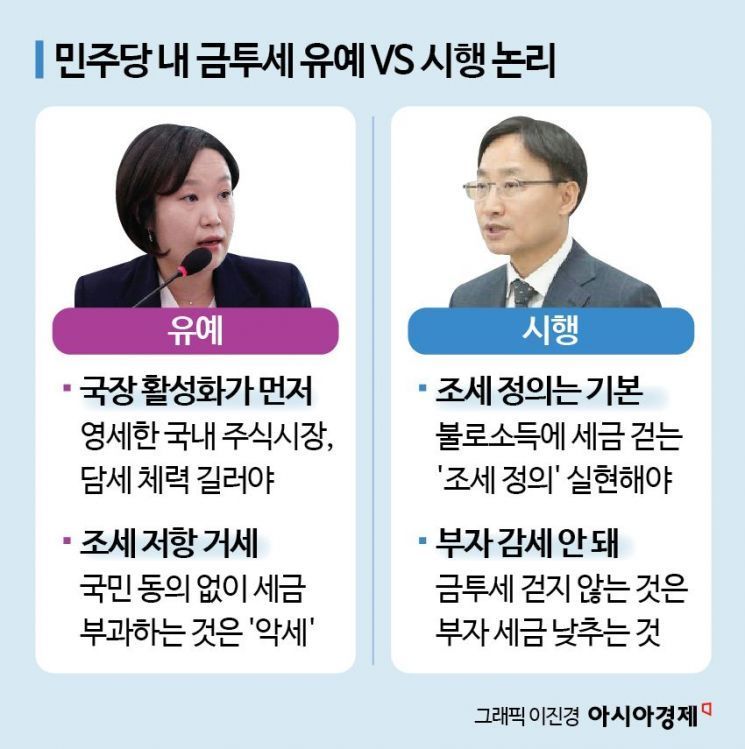
The main argument from the deferral side is that the domestic stock market is not yet sufficiently developed to warrant the implementation of the FIIT. The FIIT was passed in 2020 with the goal of being introduced in 2023, but its enforcement was postponed for two years at the end of 2022, citing the need to "improve investor protection measures." The deferral team argues that the legislative improvements and market revitalization cited at the time have still not been adequately achieved.
Another newly emphasized argument is the strong public resistance to new taxes. Lawmaker Yeon-hee Lee, who will join So Young Lee in the deferral team at the forum, posted on her social media the previous day, "The introduction of a new tax should be based on public consensus, not just theoretical or logical justification." She argued that since new taxes are fundamentally "bad taxes," public consent is essential to minimize resistance when introducing them.
Some also believe that specific targets, such as achieving a KOSPI 4000, should be set. They argue that the FIIT should be further postponed until individual investors can reliably generate financial investment income.
The core argument from the implementation side is tax justice. They maintain that while wage earners are subject to income tax every month, it is no longer acceptable to defer the FIIT, which taxes unearned income. Last year, the government collected 59.1 trillion won in wage income tax, up 2.96% from the previous year. Despite chronic tax revenue shortfalls under the Yoon Suk-yeol administration, wage income tax collections have continued to rise. Furthermore, with the FIIT set to be implemented, the securities transaction tax is on track for abolition, making the FIIT even more necessary in their view.
Preventing tax cuts for the wealthy is another key argument for the implementation side. If individuals earning more than 50 million won annually in financial investment income are not taxed, it amounts to a tax cut for the wealthy. According to data provided by lawmaker Kyoo-geun Cha's office from the Korea Securities Depository, as of the end of last year, there were 140,000 people holding more than 500 million won in listed stocks, accounting for about 1% of all investors (14.07 million). Only a very small number of investors-those who achieve an annual return of 10%-will actually be subject to the FIIT.
Consensus on Amendments to the Commercial Act... Minority Shareholders Call for Investor Protection Measures
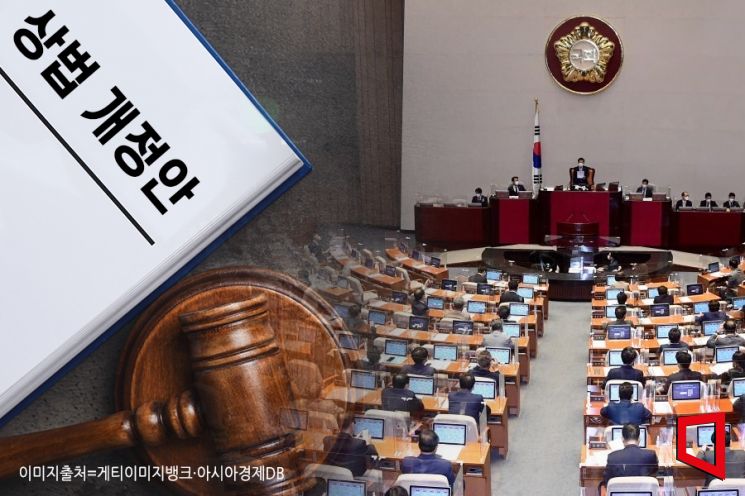
However, both the deferral and implementation sides agree on the need to improve the structure of the stock market, including amendments to the Commercial Act. Last month, So Young Lee stated on her social media, "The reason for the Korea Discount is simple: it is because the unscrupulous behavior of conglomerate major shareholders, who fatten themselves at the expense of individual investors, is left unchecked." Nam-geun Kim, a DPK lawmaker participating in the forum on the implementation side, has introduced the Minority Investor Protection Act (Special Act on the Governance Structure of Listed Companies). The bill aims to extend directors' fiduciary duties to shareholders and mandates cumulative voting for listed companies with total assets exceeding 2 trillion won.
Minority investors, commonly referred to as "ant investors," have stated that they hope the current debate will serve as an opportunity to reform the stock market, rather than focusing solely on whether to implement the FIIT. Hyun Kim, head of the Ewha Group Shareholders' Alliance, said, "It is only natural to discuss the interests of minority shareholders, such as amendments to the Commercial Act, alongside the FIIT debate. There is also a need for practical protection measures for minority shareholders, such as strict penalties for major shareholders who cause trading suspensions through illegal activities, and the immediate suspension of board authority, as in the case of Ewha Group."
© The Asia Business Daily(www.asiae.co.kr). All rights reserved.

![Clutching a Stolen Dior Bag, Saying "I Hate Being Poor but Real"... The Grotesque Con of a "Human Knockoff" [Slate]](https://cwcontent.asiae.co.kr/asiaresize/183/2026021902243444107_1771435474.jpg)
















