Meeting with Research Institute Heads to Discuss Future Financial Policy Directions
Research Institute Heads: "Must Prepare for Unexpected Capital Flow Changes and Potential Debt Increase"
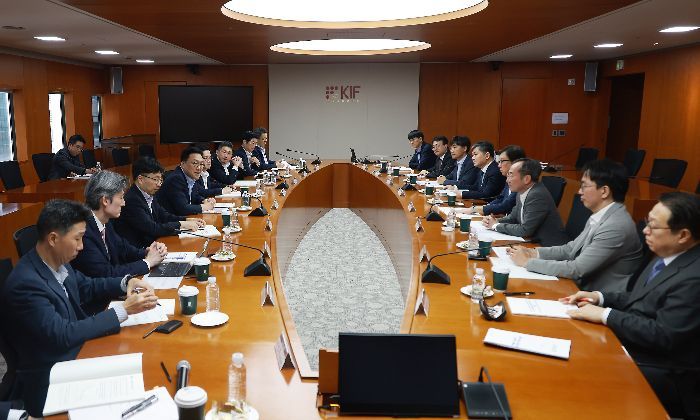
On the 23rd, Kim Byung-hwan, Chairman of the Financial Services Commission, held the 'Meeting with Heads of Economic and Financial Research Institutions' to discuss various financial policy tasks to be promoted, including policy tasks to shift the debt-dependent structure to a capital-centered one.
Attending the meeting were Cho Dong-chul, President of the Korea Development Institute; Lee Hang-yong, President of the Korea Institute of Finance; Shin Jin-young, President of the Korea Capital Market Institute; and Cho Jae-rin, Vice President of the Korea Insurance Research Institute. The Financial Services Commission plans to actively reflect the various discussed tasks in the establishment of next year's FSC work plan after further review and in-depth discussions.
In particular, the participants discussed the global monetary policy shift together with the heads of research institutions, noting that following the European Central Bank (ECB), the U.S. Federal Reserve (Fed) cut the benchmark interest rate by 50 basis points (1bp=0.01%) on the 19th (from 5.25~5.50% to 4.75~5.00%), marking the beginning of a global monetary policy transition.
The heads of research institutions generally expressed that the Fed's rate cut was already anticipated by the market, so its impact on the financial market is limited; however, since this marks a transition from a prolonged high-interest rate environment, preparations should be made for potential unexpected capital flow fluctuations or increases in debt.
Chairman Kim mentioned, "The global monetary policy transition may have positive macroeconomic effects such as easing financial burdens and expanding investment, but depending on the magnitude and speed of the rate cuts and interest rate differentials between countries, market volatility may increase," adding, "We will closely monitor the financial market together with market experts going forward."
He continued, "While maintaining a stable management stance to prepare for the possibility of expanded leverage across the economy due to the rate cuts, we will improve the economic structure, which excessively depends on debt, to a capital-centered one in the mid to long term," and requested continuous policy suggestions from research institutions to identify necessary tasks.
© The Asia Business Daily(www.asiae.co.kr). All rights reserved.

















