China Struggles with Aging Population and Low Birthrate
Hosts 'Joint Wedding Ceremony' to Encourage Marriage
As China's marriage rate declines, the largest-ever joint wedding ceremony was recently held across the country.
On the 23rd, the state-run English newspaper Global Times reported that with the support of Chinese authorities, a total of 5,000 couples held group wedding ceremonies simultaneously on the 22nd in 50 regions nationwide. This joint wedding ceremony was jointly organized by the Ministry of Civil Affairs, the Ministry of Agriculture and Rural Affairs, and the Women's Federation. It is the largest-scale wedding ceremony arranged by the Chinese government since the founding of the People's Republic of China in 1949.
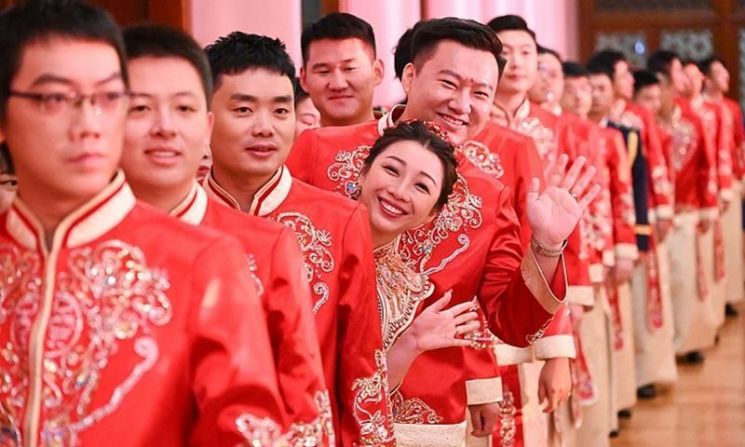
The 5,000 couples wore traditional Chinese wedding attire and recited their marriage vows at 50 wedding venues nationwide, including Beijing, Zhengzhou, Hong Kong, and Macau. The newlyweds pledged to build happy families and promised to simplify wedding procedures and refrain from expensive gifts. This joint wedding ceremony was organized to encourage marriage among young people in China, who tend to avoid marriage and childbirth due to economic burdens amid a low birthrate and aging society.
Demographic expert He Yafu said, "In recent years, China's marriage rate has declined due to the cost of marriage," adding, "This joint wedding ceremony aims to increase the marriage rate by promoting simplified ceremonies to reduce marriage expenses."
In China, there is a custom where the groom's side gives a dowry called 'chaili' to the bride's family upon marriage. Typically, amounts range from 100,000 yuan (approximately 18.95 million KRW) to 200,000 yuan (approximately 37.91 million KRW), but in some cases, it can reach as high as 1 million yuan (approximately 189.5 million KRW).
Meanwhile, the number of newborns in China, once the world's most populous country, fell below 10 million consecutively in 2022 and 2023. Last year, the number of newborns was 9.02 million, the lowest since the founding of China in 1949. China's total population also decreased by 2.08 million from the end of 2022 to 1.40967 billion in 2023, and it is projected to fall below 1.4 billion by 2035. Although the Chinese government changed its policy from conditional two-child allowance in 2013 to full two-child allowance in 2015, the trend of avoiding childbirth remains severe, leading to a declining population.
In response, Chinese authorities are actively implementing various measures to encourage marriage. Local governments in China have even worked extended hours on July 7th (the Qixi Festival, lunar July 7) last month to accept as many marriage registrations as possible, and the Xi'an city government in Shanxi Province launched a campaign giving lottery tickets to newlyweds.
© The Asia Business Daily(www.asiae.co.kr). All rights reserved.
![Clutching a Stolen Dior Bag, Saying "I Hate Being Poor but Real"... The Grotesque Con of a "Human Knockoff" [Slate]](https://cwcontent.asiae.co.kr/asiaresize/183/2026021902243444107_1771435474.jpg)










