Martial Arts 'Survey on Reintroduction of Truck Safety Freight Rate System'
"Concerns Over Weakened Export Competitiveness Due to Increased Logistics Costs"
Three out of four export companies opposed the reintroduction of the Safe Freight Rate System currently under discussion in the National Assembly, citing concerns that it could weaken export competitiveness.
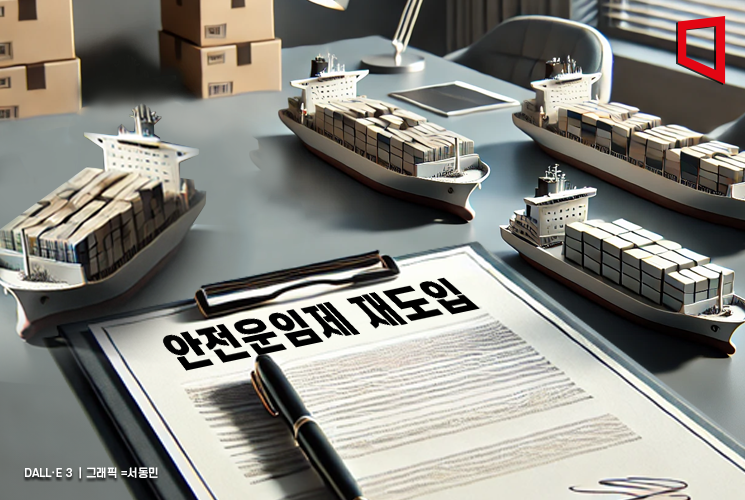
On the 23rd, the Korea International Trade Association (KITA) announced the results of a survey on the reintroduction of the Safe Freight Rate System, conducted with 577 export companies. Amid the submission of bills related to the system’s reintroduction in the National Assembly, 72.5% of the respondent companies opposed the reintroduction.
The Safe Freight Rate System is a rule that legally guarantees appropriate freight rates for export-import container and cement truck drivers. It was temporarily implemented for three years starting in 2020 with the aim of preventing overwork, speeding, and overloading, thereby ensuring traffic safety.
However, the survey results showed that most export companies did not agree with the purpose of the system’s introduction. Regarding the effect on improving traffic safety, 85.1% responded that it was ineffective or they were unsure. Additionally, 72.7% of companies anticipated that the reintroduction of the Safe Freight Rate System would negatively impact export competitiveness.
Companies pointed out issues such as ▲weakening export competitiveness due to increased logistics costs (43.5%) ▲inefficiency caused by excessive market intervention (19.5%) ▲lack of relevance to truck safety (16.4%) ▲and fairness issues among transport companies, truck drivers, and export-import companies (13.8%).
Among the respondents, 91.4% expected freight rates to rise by at least 10% if the Safe Freight Rate System were reintroduced. About 40% of companies anticipated an increase of 20-30%.
Only 7.5% of companies responded that the reintroduction of the Safe Freight Rate System was necessary.
As alternatives to the Safe Freight Rate System, companies suggested strengthening enforcement and penalties for traffic law violations (41.7%) and improving the multi-tiered subcontracting structure in the freight transport market (37.2%).
Many companies (33.2%) also emphasized the need to eradicate the negative effects of the Jiipje system to improve the structure. Jiipje is a system where individual truck drivers operate their trucks under the transport company’s commercial license plate in exchange for paying a lease fee. It is argued that Jiipje causes export companies to bear unfair transportation costs.
Lee In-ho, Vice Chairman of KITA, stated, "The Safe Freight Rate System is a policy that pours cold water on export SMEs that are fighting to secure competitiveness by reducing costs. We hope the National Assembly seriously considers that small and medium-sized enterprises, which account for 97% of export companies, are engaged in fierce price competition in the global market."
© The Asia Business Daily(www.asiae.co.kr). All rights reserved.

















