Not Only Cabbage but Also Radish and Spinach Prices Rise
Major Vegetable Prices Increase by Over 30% Compared to Last Year
As the long heatwave is compounded by summer downpours, the burden on ordinary people's stores is also increasing. Recently, with the price of cabbage exceeding 20,000 won, the expression "cabbage more expensive than meat" has emerged. On the 22nd, an online community post titled "Hanaro Mart Cabbage Price Update" was uploaded. In the photo attached by the author, the price tag shows 22,000 won for domestically produced cabbage.
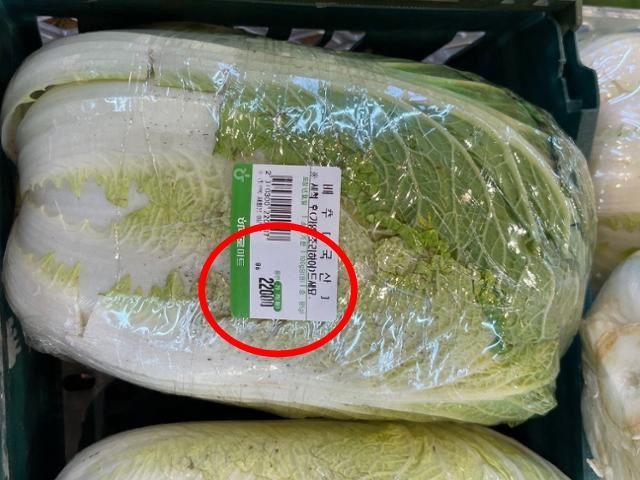 On the 2nd, an online community posted a thread titled "Hanaro Mart Cabbage Price Update." In the photo attached by the author, the price tag shows that domestic cabbage is priced at 22,000 won.
 [Photo by Online Community]
Netizens who saw this commented, "The grocery mart near my house sells two cabbages for 30,000 won," "The cheapest was 16,000 won. All are in the 20,000 won range," "I’m skipping kimchi-making this year," and "We should call it 'goldchi' instead of kimchi." Another netizen said, "I really feel the saying that cabbage is more expensive than beef," and lamented, "I’m afraid to eat kimchi stew."
According to the Korea Agro-Fisheries & Food Trade Corporation's agricultural product distribution information, as of the 21st, the retail price of one cabbage was recorded at 9,337 won. This is an increase of 69.49% compared to a year ago and 32.65% compared to the average year. The rise in cabbage prices is due to continued hot weather in September, which worsened growing conditions. Cabbage is a cool-season vegetable with an optimal growing temperature of 18?20 degrees Celsius. Due to delayed growth and reduced marketability, high-quality cabbage has become scarce, leading to price increases.
In particular, Gangwon, known as a major cabbage production area, also experienced unfavorable climate conditions, with the period of daytime temperatures exceeding 30 degrees Celsius being longer than usual. Additionally, the decreasing cultivation area of cabbage has had an impact. According to data released by the Korea Rural Economic Institute, the cabbage cultivation area this summer decreased by 6.6% and 8.5% compared to the previous year and the average year, respectively. The intended cultivation area for autumn cabbage is also expected to decrease by 2.1% compared to the previous year. The distribution industry expects the price increase to continue until mid-October before the autumn cabbage shipments begin, due to the shortage of summer cabbage supply.
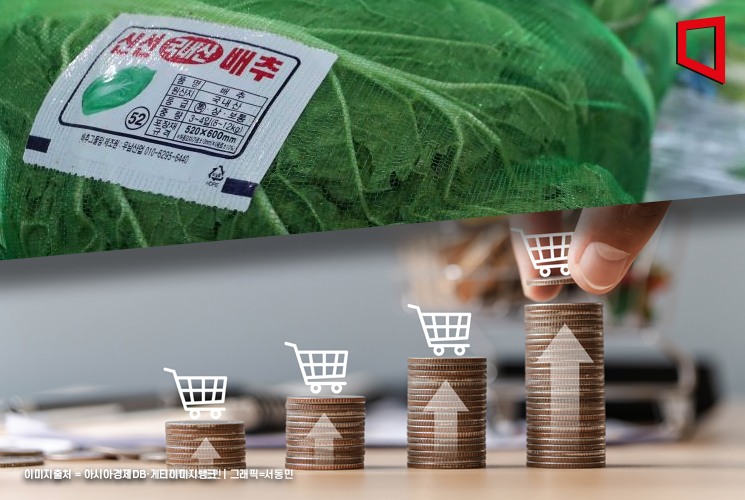 According to the agricultural product distribution information from the Korea Agro-Fisheries & Food Trade Corporation, as of the 21st, the retail price of one head of napa cabbage was recorded at 9,337 won. This represents an increase of 69.49% compared to one year ago and 32.65% compared to the average year.
 [Photo by Dongmin Seo, Asia Economy]
Not only cabbage but also the price of radish rose to 3,909 won per piece, up 23.9% from the previous month (3,156 won) and 69% from the previous year (2,313 won). Besides cabbage and radish, prices of major vegetables such as spinach (100g·3,697 won) and young radish leaves (1kg·5,430 won) increased by about 30?50% compared to the previous year. This is analyzed as a result of poor crop conditions due to the summer heatwave combined with the end of discount support from the government and distributors after the Chuseok peak season. Above all, there are concerns that if cabbage and radish prices continue their high climb ahead of the kimchi-making season, the cost burden for kimchi-making this year will significantly increase.
As the kimchi-making season approaches and consumer concerns grow, a Ministry of Agriculture, Food and Rural Affairs official stated, "We expect the supply and demand situation to improve as the temperature drops and vegetable growth recovers," and added, "We plan to continue discount support after Chuseok for crops like cabbage that have poor growing conditions to reduce the burden on consumers."
© The Asia Business Daily(www.asiae.co.kr). All rights reserved.


















