"Economically Viable" Baseless Rumors Fuel Speculation
Local Governments Concerned Over Land Price Rise → Cost Increase → Decline in Project Feasibility
Concerns are rising that the extension of the Bundang Line from Giheung to Osan, promoted by local governments in the southern Gyeonggi Province, may be distorted into a means of real estate speculation. This is due to promotional materials presenting baseless estimates to induce investment, based on the preliminary feasibility study results expected only by the end of the year. Local governments on the front lines are instead urging consumers to be cautious, warning that such speculative trends could lead to land price increases and higher costs, thereby worsening the project's viability.
What kind of line is it?
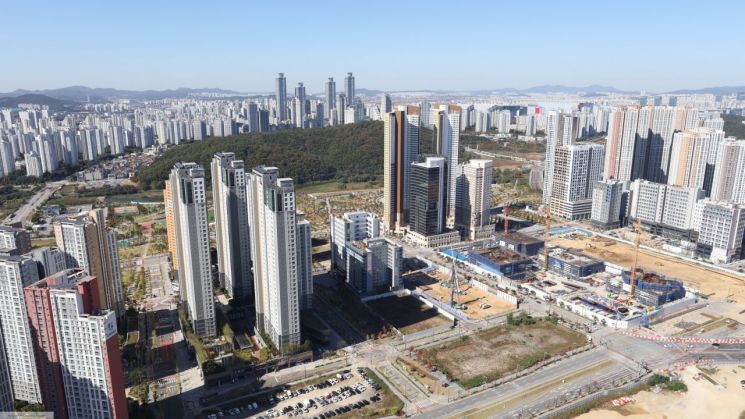 A preliminary feasibility study for the extension of the Bundang Line from Giheung to Osan is currently underway, while speculative activities based on unconfirmed matters are spreading among frontline real estate agencies and online platforms. A panoramic view of Dongtan New Town, Hwaseong.
 [Photo by Hwaseong City]
The Bundang Line extension from Giheung to Osan is a project jointly promoted by Yongin, Hwaseong, and Osan cities. It is a branch line diverging from the existing Suin-Bundang Line at Giheung Station, connecting Hwaseong Dongtan 2 New Town to Osan City. Previously, Yongin and Osan jointly released the results of a preliminary feasibility study in 2020 on three proposed routes, each with 6 to 8 stations and spanning 16.5 to 20.5 km, connecting these areas. At that time, the cost-benefit ratio (B/C) of this line was between 0.61 and 0.71, which meets the national railway network plan's inclusion criteria (0.7 or higher).
The greatest benefit of this line is that it would establish the shortest-distance railway network connecting Seoul's Gangnam area and the southern Gyeonggi region along the Gyeongbu axis. In particular, local governments expect it to maximize synergy by linking key semiconductor infrastructure such as Yongin's Idong and Namsa Advanced System Semiconductor National Industrial Complex, Wonsam Yongin Semiconductor Cluster General Industrial Complex, Dongtan New Town, and Osan City.
However, this is only based on the local governments' own verification results. The Korea Rail Network Authority began a preliminary feasibility study for this line in November 2022. The authority initially planned to complete the study by the end of last year but extended the period once to release results by the end of June this year, and then extended it again by six months, aiming to produce results by the end of this year.
The prolonged preliminary feasibility study indicates that there are many factors to consider regarding whether to establish the line. During the remaining period, figures that can influence the B/C ratio, such as costs (C) including land prices and construction expenses, as well as benefits (B) like mid- to long-term urban growth and housing development, may fluctuate.
Moreover, for the railway line extension, including the Bundang Line extension, to be finally reflected in government policy, it must pass the Ministry of Economy and Finance's preliminary feasibility study after next year. There are still many hurdles to overcome before the project can be realized.
No study results yet... but route maps are displayed to induce investment
According to Yongin City in Gyeonggi Province and local real estate brokerage industries, rumors have recently spread online claiming that "the Bundang Line extension from Giheung to Osan has been confirmed to be feasible."
Especially in the real estate sectors around Dongtan New Town, Osan, and Yongin?areas expected to benefit from the line?there are rumors that positive results will be announced, along with circulating related route maps. In brokerage offices and online cafes in these areas, cases have been observed where route maps extending from Giheung Station to Osan University Station, or to Segyo 2 and 3 districts, Dongtan Station, etc., are displayed to encourage investment. Some even present specific estimated figures from the ongoing feasibility study.
For example, brokerage office A in Yongin introduced an auction property in Giheung District while highlighting the positive impact of the Bundang Line extension. Brokerage office B in Hwaseong predicted that new stations such as Osan University Station, Dongtan Station, and Lake Park Station in Dongtan New Town are likely to be established. The recent halt in the decline and subsequent rise in housing prices in this area is said by local brokers to be influenced by the possibility of the Bundang Line extension. A representative from brokerage office C in Dongtan New Town stated, "The establishment of a new railway connecting to Seoul's Gangnam area naturally affects housing prices."
During this process, posts on real estate cafes and blogs claiming that "a local member of the National Assembly predicted a high B/C ratio" or "a certain lawmaker is leading the installation of specific stations" have been posted, causing confusion.
"Lower B/C ratio could negatively impact the project" - Troubled local governments
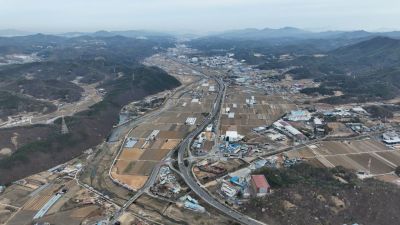 Local governments promoting the extension of the Bundang Line from Giheung to Osan, including Yongin, Hwaseong, and Osan, are making every effort to secure project feasibility. A panoramic view of the planned site for the Advanced System Semiconductor National Industrial Complex to be established in Cheoin-gu, Yongin.
 [Photo by Yongin City]
Local governments involved are in a difficult position amid this atmosphere. If speculative fever causes housing prices to surge, it could negatively affect the project.
The three cities have been pursuing various measures to improve the project's viability. Especially after the Korea Rail Network Authority began the preliminary feasibility study, these local governments have pushed for the inclusion of ▲ Yongin Idong and Namsa-eup Advanced System Semiconductor National Industrial Complex ▲ Yongin Idong New Town with 16,000 households ▲ Osan Segyo 3 District with 31,000 households ▲ Hwaseong Geumgok District with 13,000 households, among others.
Yoo Sang-il, mayor of Yongin, at a presidential-led public discussion on livelihood issues held at Yongin City Hall in March, stated, "This line is already included in the 4th National Railway Network Plan, and citizens are desperately hoping for it," urging the government to expedite the project. In June, the mayor also met with Baek Won-guk, the 2nd Vice Minister of the Ministry of Land, Infrastructure and Transport, requesting swift progress on the line and providing related materials on Idong New Town and Segyo 3 District.
It is said that the Korea Rail Network Authority extended the study period until the end of the year because variables such as the creation of new industrial complexes and large-scale housing developments have increased since the study began.
The problem is that rising real estate prices can act as a negative factor in the study results. As land prices rise, construction costs increase due to higher material and labor costs, and land compensation costs also grow, increasing the denominator of the B/C ratio (costs), which lowers the feasibility value. In fact, the total project cost for this line, which was 1.0243 trillion KRW in the 2019-2020 study, surged by 54% to 1.5772 trillion KRW in the 2021 National Railway Network Plan announcement.
A local government official explained, "To have a new railway line reflected in government policy, economic feasibility must be proven," adding, "For this, sufficient demand evidence must be presented or ways to reduce total project costs must be found." He also warned, "If unverified inaccurate information and figures are conveyed to citizens, it can cause great confusion. Especially if incorrect information is released, there is concern that the project could be delayed or canceled."
© The Asia Business Daily(www.asiae.co.kr). All rights reserved.
![Clutching a Stolen Dior Bag, Saying "I Hate Being Poor but Real"... The Grotesque Con of a "Human Knockoff" [Slate]](https://cwcontent.asiae.co.kr/asiaresize/183/2026021902243444107_1771435474.jpg)

















