Joint Research Team Improves Blue Phosphorescent OLED Power Efficiency by 24% and Stability by 21%
Develops Interlayer That Lowers OLED Driving Voltage, Eases Commercialization Barrier, Published in 'Chem'
A new organic semiconductor material has been developed that can greatly improve the luminous efficiency and stability of blue OLEDs (Organic Light Emitting Diodes).
This breakthrough is expected to accelerate the commercialization of next-generation high-purity, high-efficiency display technologies.
The research team led by Professors Kwon Taehyuk and Choi Wonyoung from the Department of Chemistry at UNIST (President Park Jongrae), in collaboration with Professor Lee Junyeob's team at Sungkyunkwan University, has developed a new interlayer material that solves the biggest challenge of blue phosphorescent OLEDs: the issue of lifespan.
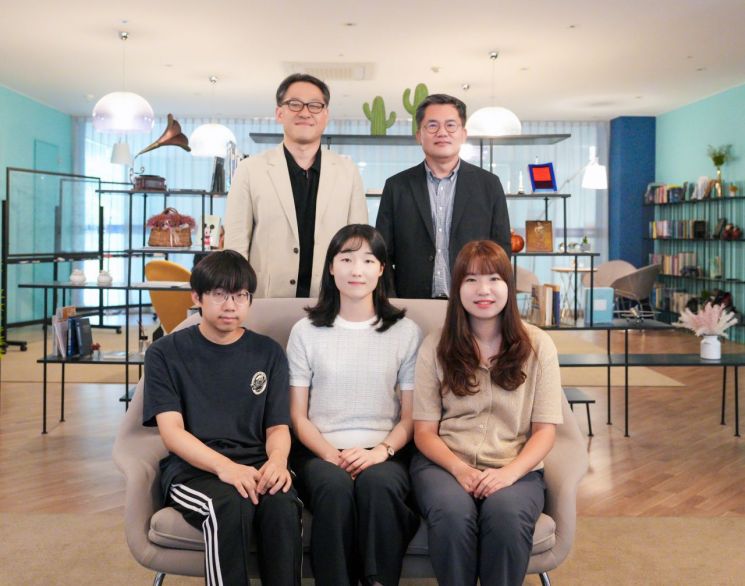 Research team. (From the top left clockwise: Professor Kwon Taehyuk, Professor Choi Wonyoung, Researcher Kim Jiyeon, Researcher Hwang Eunhye (first author), Researcher Kim Minseok)
The developed material significantly reduced the operating voltage of OLEDs compared to existing materials. Power efficiency was improved by 24%, and operational stability by 21%. As an interlayer, it has shown potential for application not only in blue OLEDs but also in next-generation inorganic-based light-emitting devices.
Phosphorescent OLED technology utilizes a light emission mechanism that leverages triplets to emit light more efficiently and for longer periods. While red and green phosphorescent OLEDs have already been commercialized, blue phosphorescent OLEDs have faced challenges in commercialization due to high operating voltage and short lifespan.
The research team developed a new interlayer that lowers the operating voltage of blue OLEDs and reduces light loss. Conventional twisted molecular structures were effective for triplet confinement but had limitations in current flow. The new material overcomes these issues, enhancing stability.
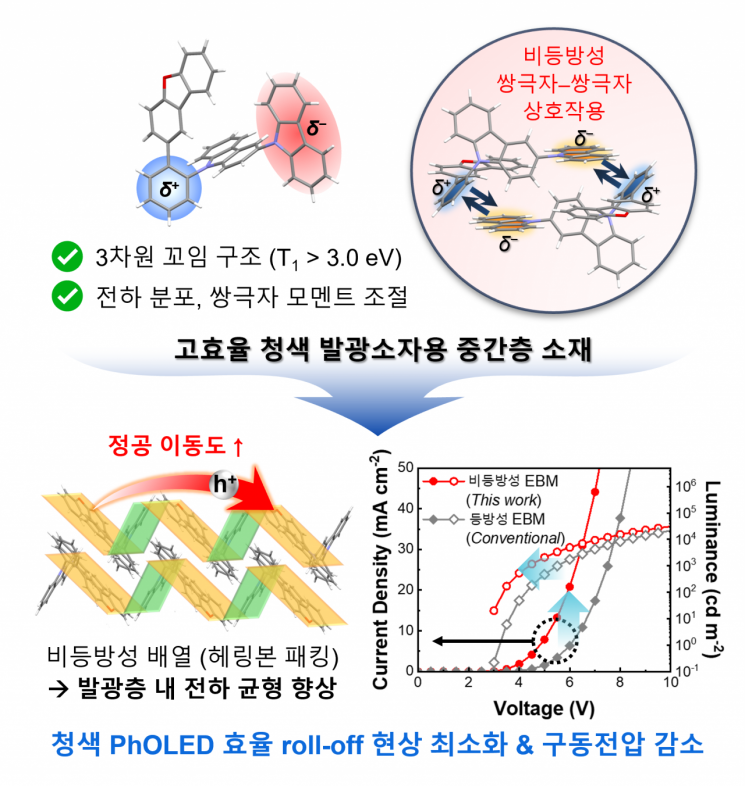
The team created an anisotropic arrangement by controlling how charges move and the properties of the material. This improvement allows for even electrical flow while minimizing light loss.
First author Hwang Eunhye emphasized, "It is extremely rare to implement a herringbone arrangement in a twisted molecular structure," adding, "This will be an important turning point in the development of new organic semiconductor materials."
Professor Kwon Taehyuk stated, "We have proposed a new interlayer material development strategy that independently addresses both triplet confinement and charge balance, separate from the emissive layer," and added, "Based on this, we plan to further advance research on next-generation displays and light-emitting devices."
The research results were published on September 19 in Chem, a sister journal of the world-renowned journal Cell. The study was supported by the National Research Foundation of Korea (NRF), the Korea Institute of Energy Technology Evaluation and Planning (KETEP), and UNIST.
© The Asia Business Daily(www.asiae.co.kr). All rights reserved.


















