[Current Status of Biofuels in the US]⑥
Examining Key Issues by Major Topics
Biofuels have the advantage of being able to partially replace gasoline in the transportation sector immediately and have lower carbon emissions. However, there are concerns about the considerable resources required for processing into fuel, competition with food supplies, and carbon emissions during cultivation. Although recognized as a type of renewable energy under domestic laws, the actual usage of biofuels in Korea is limited. The contentious issues surrounding biofuels are explained in a Q&A format.
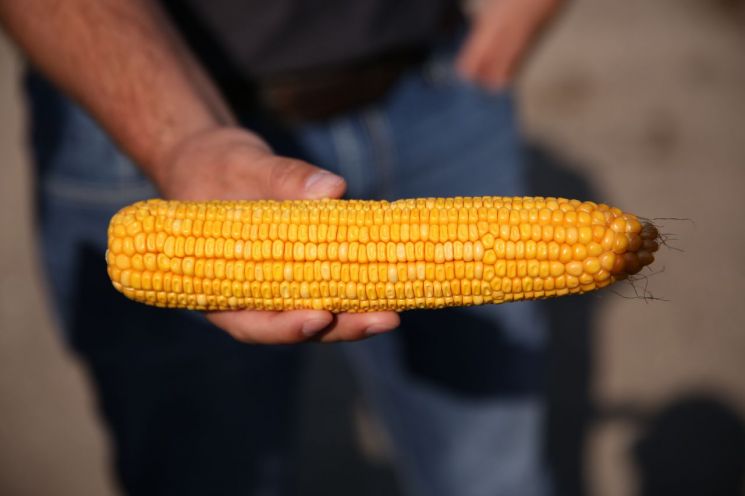 Corn personally grown by Mike Divan, who operates a farm in Nebraska, USA. This variety is intended for ethanol processing.
 [Photo by U.S. Grains Council]
Is it acceptable to use food as fuel amid food security concerns?
About two-thirds of biofuels, specifically bioethanol, are mainly made from corn or sugarcane. There has been ongoing debate about whether it is appropriate to use these food sources as fuel. Recent volatility in food supply due to climate change has further fueled this controversy.
Bioethanol began to be widely used in the United States starting in the 1970s. When the oil crisis exposed vulnerabilities in resource supply, tax credits were provided for bioethanol, and support measures such as loans were introduced to encourage investment in facilities and research and development. U.S. ethanol production, which was about 20 million gallons (75 million liters) in 1979, surged to 750 million gallons in 1986 and reached 3.6 billion gallons by 2004. Currently, about 15 billion gallons are produced and consumed annually.
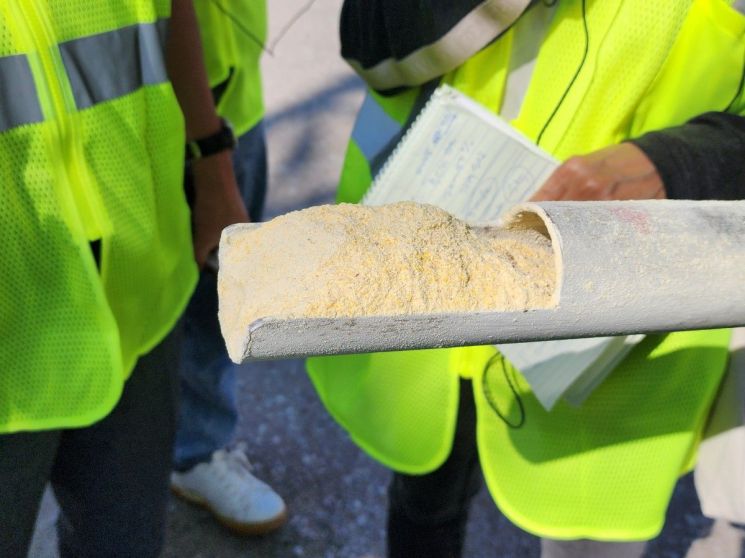 The plant manager of Green Plains, a U.S. ethanol company, is showing the powder produced after grinding corn. Ethanol is produced through several processing steps, including this one.
 [Photo by Korea Automobile Journalists Association, U.S. Grains Council]
Notably, while ethanol production and usage have increased by tens or hundreds of times, the corn cultivation area remains roughly the same at 80 million acres (about 323,000 km²) compared to the 1980s. Advances in agricultural technology, such as automated farming methods and seed improvements, have enabled higher corn yields on the same land area. The industry expects that as methods for processing ethanol from non-food crops or organic waste improve, biofuel adoption will become easier even in countries like the U.S. and Brazil, which are not as rich in food resources.
Edward Hubbard, director of the U.S. Renewable Fuels Association, stated, "In the case of bioethanol, only the starch from corn is processed, while the remaining byproduct, distillers grains, is used as animal feed. Since the byproduct supplies food materials, the claim that 'corn is used as fuel instead of food' is not accurate."
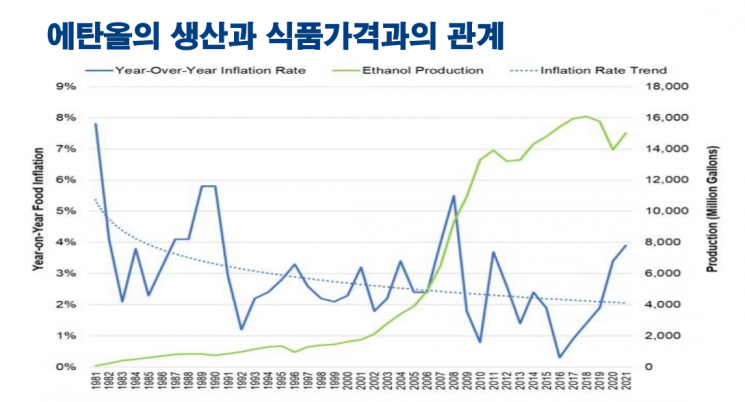 Comparison of ethanol production volume and international food price increase rate. There is little direct correlation. [Data provided by: U.S. Grains Council]
Does blending ethanol with gasoline affect vehicle performance?
In the U.S., blending 10% ethanol with regular gasoline (E10) is mandatory. The U.S. Energy Information Administration explains that using gasoline blended with 10% ethanol can reduce fuel efficiency by about 3%. Considering that driving habits can cause even greater differences in fuel economy, the actual impact on vehicle performance is minimal.
In Nebraska, a state with high ethanol production, there is a proposal at the federal level to introduce E30 fuel, which contains 30% ethanol, exceeding the commonly used E15 (15% ethanol blend) and E10. They reportedly conducted preliminary tests on 50 existing internal combustion engine vehicles, driving about 700,000 miles.
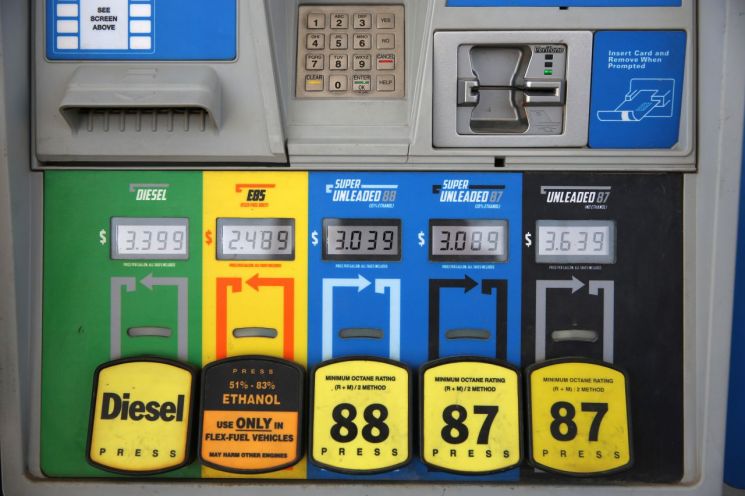 A gas pump at a Boselman Enterprises gas station, the largest gas station chain in Nebraska, USA. The price difference exceeds $1 per gallon depending on the ethanol content. E15 (15% ethanol blend), which can be used in regular vehicles, is said to be the best-selling fuel.
 [Photo by Korea Automobile Journalists Association]
Reed Wagner, director of the Nebraska Ethanol Board, explained, "Even with ethanol content increased to 30%, there was no corrosion or damage to vehicle parts or materials. When considering various factors such as oxygen intake and coolant during engine combustion, it was clear that existing internal combustion engines can effectively utilize E30 fuel."
Fuel with ethanol content ranging from 50% to 85%, known as E85, is also used. However, to use this fuel, specially developed dedicated vehicles or aftermarket conversion kits are required. In the past, automakers focusing on the U.S. and Latin American markets developed such flex-fuel (FF) vehicles, but the shift toward electrification and focus on electric vehicle development has somewhat slowed this trend.

Does Korea have plans to introduce ethanol gasoline?
Korea also introduced the Renewable Fuel Standard (RFS) in 2015 as part of its renewable energy expansion policy. The plan is to gradually increase the biofuel blending ratio, currently mandating a 4.0% biodiesel blend in diesel fuel for diesel vehicles, with a target of 8% by 2030.
The Special Act on Renewable Energy defines various bioenergies, including biodiesel, bioethanol, biogas, and bio-heavy oil, but except for biodiesel, the others are not used. Since the 2000s, various discussions and government-led pilot projects have been conducted mainly by academia and public institutions, but these have not materialized into actual policies.
 A car is running on the track at the National Association for Stock Car Auto Racing (NASCAR) held in Atlanta, USA. This competition uses fuel blended with 15% ethanol as the official fuel. Even without using additional additives, it has a higher octane rating compared to regular gasoline, making it suitable for high-performance vehicles.
 [Photo by Korea Automobile Journalists Association, USA Grain Association]
Most recently, in 2022, there was a plan for a bioethanol pilot project focusing on public institution vehicles, but it was ultimately canceled due to low participation from businesses. The slow adoption of ethanol is reportedly significantly influenced by opposition from the refining industry, which fears revenue losses from replacing existing gasoline demand with ethanol.
In contrast, the trend in the U.S. has changed recently. The acceleration of vehicle electrification has led to rapid electric vehicle adoption over the past two to three years. The industry anticipates that widespread electric vehicle use will reduce gasoline consumption, potentially threatening the existing refining industry itself.
Therefore, the refining industry is now positively considering ethanol blending as a way to reduce carbon emissions and maintain price competitiveness. Dr. Lee Eui-sung of the U.S. Department of Energy’s National Argonne Laboratory explained, "As electric vehicle demand increases and oil demand disappears, biofuels in the U.S. are viewed not as competitors to petroleum but as partners that can help sustain the existing refining industry."
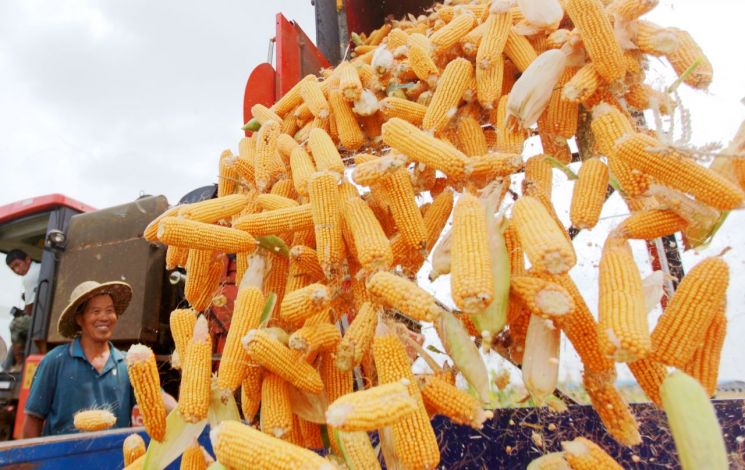 A farmer in Shandong, China, is loading corn onto a truck. China has implemented ethanol blending policies by major regions.
 [Photo by Yonhap News, Xinhua News Agency]
© The Asia Business Daily(www.asiae.co.kr). All rights reserved.
![Clutching a Stolen Dior Bag, Saying "I Hate Being Poor but Real"... The Grotesque Con of a "Human Knockoff" [Slate]](https://cwcontent.asiae.co.kr/asiaresize/183/2026021902243444107_1771435474.jpg)


















