Meituan "74.5 Million Delivery Workers Earn 15 Trillion"
Quality Jobs vs. Need for Improved Treatment
Among the 7.5 million delivery workers employed by Meituan (美團), China's largest delivery app, rumors have spread that 380,000 of them hold a university degree or higher, prompting Meituan to issue a clarification.
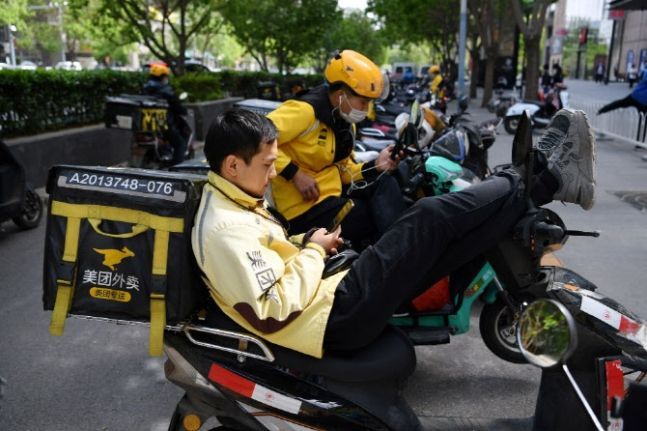 Delivery workers are resting and waiting in front of a shopping mall in Beijing, China.
 [Image source=AFP Yonhap News]
On the 22nd, local media reported that Wang Xing, CEO of Meituan, stated in an internal letter to employees during the recent Mid-Autumn Festival holiday, "In the past three years, we have hired more than 5,000 new employees annually, and plan to hire 6,000 next year." He also added that last year, 7.45 million delivery workers earned income through the Meituan platform. Furthermore, Meituan clarified through its research institute that the rumor claiming "300,000 university graduates and 80,000 graduate degree holders are working as delivery workers" is not true.
Meituan is a representative delivery app in China. The Meituan application (app) currently allows users to check stores sorted by distance and automatically connects customers to delivery riders registered on the Meituan platform when they place an order. Meituan is also considered a symbol of youth unemployment in China. A Meituan delivery worker named A, working in Guangdong Province, told local media, "Among the delivery workers I have met, there were former teachers, civil servants, soldiers, and chefs, but these people came out to deliver because they were on leave or unemployed and needed to earn money immediately." He raised his voice, saying, "The media claims that young people prefer delivery jobs because they don't want to work in factories or because the working hours are flexible, but that is nonsense."
It seems the Chinese government is aware of this issue. In January, the state-run New Employment Forms Research Center reported in the "Blue-Collar Group Employment Research Report" that "last year, the average monthly income of delivery workers was 6,803 yuan (about 1.29 million KRW), exceeding the overall average worker income of 6,043 yuan (about 1.14 million KRW)." According to the report on blue-collar group employment released last year by the China New Employment Forms Research Center, the blue-collar occupations with the highest monthly incomes were postpartum care helpers (8,824 yuan, about 1.67 million KRW), freight truck drivers (7,641 yuan, about 1.45 million KRW), and delivery workers (6,803 yuan, about 1.29 million KRW). While delivery work is described as a relatively good-quality job, local reactions remain cold.
A said, "When I first started working in 2019, the delivery fee was about 5 to 6 yuan (about 1,100 KRW) per order, and for distances over 3 km, about 10 yuan (about 1,900 KRW). But as the number of delivery workers increased, the fee for orders over 3 km has now been halved to 4.5 yuan (about 800 KRW)." He lamented, "The summer heat subsidy has also disappeared." Another netizen pointed out on Baidu, "More than 10 million riders work on the top one or two platforms, including Meituan, but their monthly income does not exceed 3,000 yuan (about 550,000 KRW), and they do not receive protection under social security systems or labor laws."
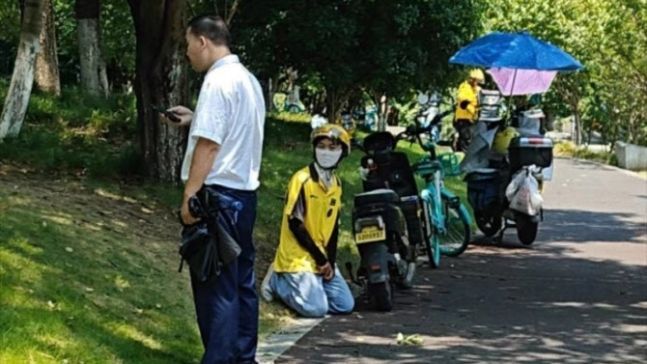 On the 12th of last month, a delivery worker (wearing a yellow jacket) was kneeling and apologizing in front of an apartment in Hangzhou, China. It is reported that he was seeking forgiveness from the security guard for damaging the flower bed. [Image source=Captured from Baidu]
Earlier this month in Hangzhou, a video circulated online showing a delivery worker who was resting while sitting on a motorcycle suddenly falling off and dying. Around the same time, another delivery worker died of a heart attack while lying on a motorcycle. He was known as the delivery king of his neighborhood, delivering an average of 40 orders a day, with a reported monthly income of 10,000 yuan (about 1.9 million KRW). In August, a park security guard severely scolded a young delivery worker who stepped on the park fence while passing by. The delivery worker knelt and apologized to the guard, fearing he might not be able to complete his scheduled deliveries. This incident sparked public outrage in Chinese society. Since then, interest in the treatment of delivery workers in China has increased.
© The Asia Business Daily(www.asiae.co.kr). All rights reserved.
!["I'd Rather Live as a Glamorous Fake Than as a Poor Real Me"...A Grotesque Success Story Shaking the Korean Psyche [Slate]](https://cwcontent.asiae.co.kr/asiaresize/183/2026021902243444107_1771435474.jpg)

















