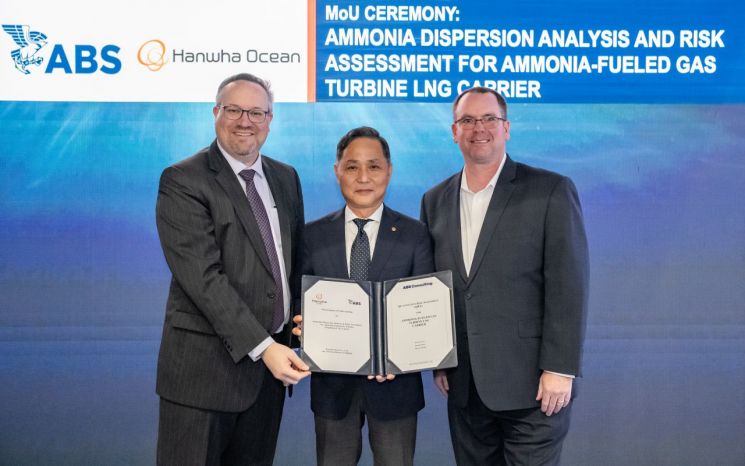
 At Gastech 2024 held in Houston, USA, Patrick Ryan, Chief Technology Officer of ABS, Son Youngchang, Vice President and Head of Product Strategy Technology Institute at Hanwha Ocean, and Joseph Kelly, President of ABS Consulting (from left), are posing for a commemorative photo after completing the certification for 'Ammonia Diffusion Stability Verification.' Photo by Hanwha Ocean
Hanwha Ocean is accelerating the development of decarbonized ships by obtaining multiple certifications for eco-friendly ship technologies from major overseas classification societies.
Hanwha Ocean participated in 'Gastech 2024' held in Houston, USA, and consecutively received approvals related to eco-friendly ship propulsion technologies from the American classification society ABS, Norwegian classification society DNV, Liberia Ship Corporate Registry, and French classification society BV.
First, through collaboration with ABS and conducting a Quantitative Risk Assessment, Hanwha Ocean completed a Safety Evaluation verifying the safety of ammonia diffusion. Hanwha Ocean, in cooperation with ABS, assumed various scenarios of fuel leakage in ammonia gas turbine propulsion ships and conducted quantitative analyses on toxicity and explosiveness. The resulting figures met the requirements set by the International Association of Classification Societies (IACS) established earlier this year, proving safety. This certification is evaluated as having passed the most important gateway for market entry of ammonia propulsion ships developed by Hanwha Ocean.
Ammonia is attracting attention as an eco-friendly ship fuel because it emits no carbon dioxide during combustion. However, it can be harmful to humans if leaked and has explosion risks, requiring careful handling. Last year, Hanwha Ocean signed a memorandum of understanding with ABS for the development of ammonia propulsion ships and has been developing optimal designs that identify potential risks in advance to ensure crew safety. With this review certification, Hanwha Ocean has taken a step ahead in the competition for carbon-free propulsion systems.
Approvals related to Rotor Sail, a next-generation eco-friendly auxiliary propulsion device that uses wind power, have also followed. Hanwha Ocean obtained Type Approval Design Certification (TADC) from DNV for the 'composite material applied Rotor Sail,' the first of its kind in Korea. Type approval is a stage where detailed design reviews are conducted before actual ship application, and through this approval, DNV certified that Hanwha Ocean’s Rotor Sail has no issues for real ship application.
Additionally, Hanwha Ocean, together with the Liberia Ship Corporate Registry and BV, conducted joint research and obtained Approval in Principle (AIP) for a method to eliminate the blind sector caused by the obstruction of navigation lights due to Rotor Sail installation.
The Rotor Sail is a cylindrical device installed on the deck. When the cylindrical column rotates by wind power, it generates propulsion force that can save fuel. Hanwha Ocean has been developing the Rotor Sail independently since 2019, and in April of this year, it broke ground on a Rotor Sail demonstration center where Rotor Sails can be assembled on land and major experiments can be conducted simultaneously. The completion target is 2026. Upon opening two years later, it is expected to be the world’s first Rotor Sail demonstration center.
A Hanwha Ocean official stated, "At this year’s Gastech, being consecutively recognized for eco-friendly ship technologies by the world’s leading classification societies has given strong momentum to Hanwha Ocean’s decarbonization vision," adding, "We will do our best to ensure shipowners can confidently choose Hanwha Ocean’s products."
© The Asia Business Daily(www.asiae.co.kr). All rights reserved.

















