Putin: "Women Have the Ability to Combine Career and Motherhood"
Amid a sharp decline in Russia's birth rate following the Ukraine war, the Russian Minister of Health has sparked controversy by encouraging having children during workplace lunch breaks and other times.
On the 19th (local time), foreign media including the New York Post and Newsweek reported that Yevgeny Shestopalov, the health official of Russia's Primorsky Krai, stated in an interview with local media FederalPress on the 13th that "being very busy at work is not a valid reason but a poor excuse," and added, "You can get pregnant even during breaks." When a reporter asked, "Some people work 12 to 14 hours; when would they make a baby?" Shestopalov emphasized, "During breaks," and argued, "Life passes by too quickly, so there is no reason not to do this."
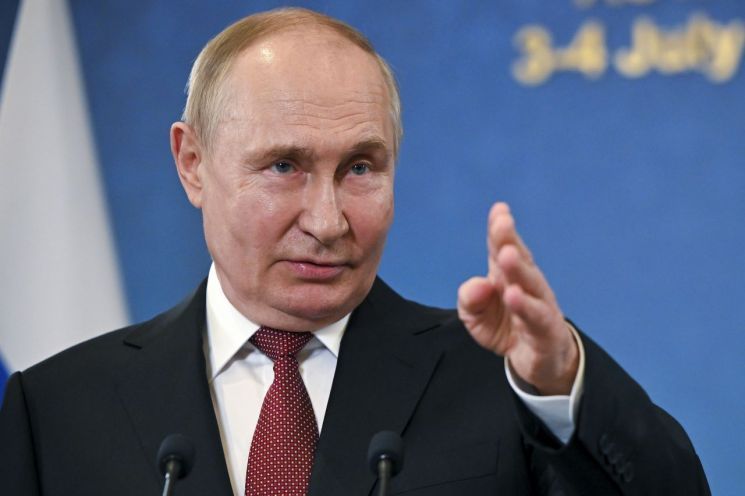
Shortly after this remark, Russian President Vladimir Putin also emphasized the declining birth rate and urged women to have more children. At the Eurasian Women's Forum held in Saint Petersburg on the 18th, President Putin said, "Russia traditionally respects women," and added, "Our national policy follows the state action strategy for the benefit of women." He continued, "Various plans have been proposed to achieve these goals, creating an appropriate environment in Russian society where women can be professionally successful while remaining the central figures of large families and guardians who protect their homes," and added, "Women are beautiful, caring, and attractive, possessing the ability to combine professional careers with motherhood."
Last year, as the number of Russian soldiers losing their lives continued to rise following the invasion of Ukraine, President Putin said, "Our grandmothers' generation generally had 7 or 8 children or even more," and urged, "Let us preserve and revive this wonderful tradition."
Meanwhile, since the outbreak of the Ukraine war in 2022, more than one million Russian residents have emigrated abroad. Additionally, the birth rate among Russian women remains at 1.5 children per woman, falling short of the total fertility rate of 2.1 needed to maintain the current population level. As a result, the population is projected to decrease by more than 14 million, falling below 130 million by 2050.
In Moscow, Russia is struggling to devise measures such as offering free fertility tests for women aged 18 to 40 to assess their reproductive capability. Some regional cities provide incentives of about 15 million Korean won for women under 24 who give birth to their first child. Furthermore, the Russian government is also pursuing policies to make abortion procedures more stringent and increase the costs of divorce.
© The Asia Business Daily(www.asiae.co.kr). All rights reserved.
![User Who Sold Erroneously Deposited Bitcoins to Repay Debt and Fund Entertainment... What Did the Supreme Court Decide in 2021? [Legal Issue Check]](https://cwcontent.asiae.co.kr/asiaresize/183/2026020910431234020_1770601391.png)