"Before additional heavy rain begins, promptly conduct emergency inspections and implement safety measures for low-lying areas, coastal regions, and locations at risk of landslides."
Governor Park Wansu of South Gyeongsang Province gave this directive during an emergency inspection meeting held on the 21st, as heavy rain advisories were in effect across the province.
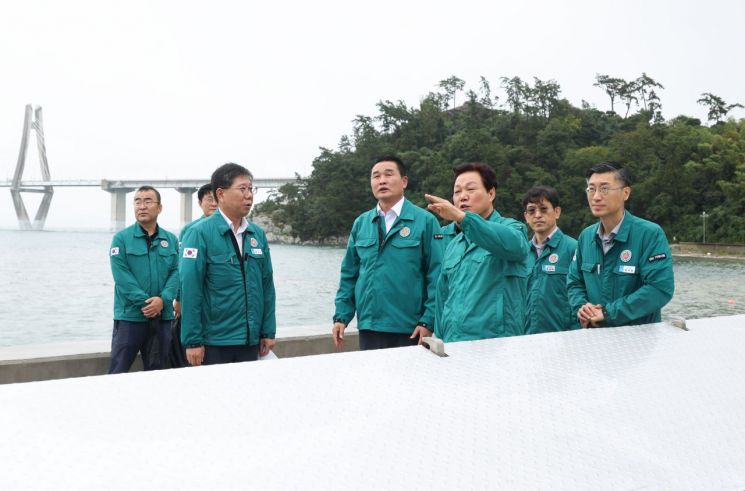 Park Wansu, Governor of Gyeongnam Province (center), is inspecting the heavy rain damage site in the Geoje area.
 [Photo by Gyeongnam Provincial Government]
He also urged, "There have been many reports of flooding due to poor drainage, such as roads being submerged. Thoroughly inspect and maintain drainage facilities such as roadside storm drains, sewers, and manholes to ensure no additional damage occurs."
Governor Park emphasized, "Maintain close cooperation with relevant agencies such as fire and police departments, and have department heads and directors go out to the field to conduct inspections personally."
After the emergency inspection meeting, Governor Park visited the site of soil runoff at Daesang Park in Changwon and the disaster recovery project site for the downstream wave protection wall in Jangmok-myeon, Geoje, to check on the response to the heavy rain.
He stated, "The most effective prevention against natural disasters is preemptive evacuation," and added, "Maintain a system to ensure disaster information is delivered to residents quickly and accurately, and carry out emergency restoration promptly in flooded areas."
The Vice Governor for Administrative Affairs and department heads also visited various sites to inspect underpasses, roads at risk of flooding, landslide-prone areas, steep slopes, disaster-prone zones, and reservoirs.
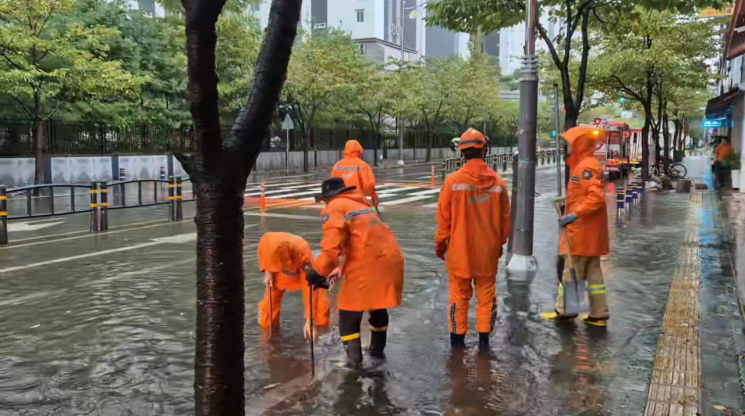 Firefighters are draining water that has risen on a road in Mulgeum-eup, Yangsan-si, Gyeongnam. Photo by Gyeongnam Fire Headquarters
The Gyeongnam region has experienced heavy rainfall since the previous day due to the weakened tropical depression that was formerly Typhoon Pulasan No. 14.
According to the South Gyeongsang Province Disaster and Safety Countermeasures Headquarters, as of 2 p.m. on the 21st, the average rainfall across the province was 175.0mm.
Changwon recorded the highest rainfall at 399.5mm, followed by Gimhae with 339.5mm, Goseong 293.5mm, Yangsan 292.7mm, Sacheon 248.0mm, and Jinju 203.6mm.
Next were Uiryeong with 147.9mm, Hadong 139.0mm, Haman 139.5mm, Namhae 133.2mm, Sancheong 130.6mm, Miryang 126.4mm, Hapcheon 107.7mm, Geoje 99.6mm, Hamyang 95.7mm, Tongyeong 93.1mm, Geochang 92.3mm, and Changnyeong 68.5mm.
Since 11:20 p.m. on the 20th, the provincial government raised its emergency response level to stage 2 and deployed 2,768 public officials to respond to the heavy rain.
Prior to this, access to 308 locations?including national parks, Saewolgyo bridges, riverside trails, riverbed roads and underpasses, road and riverside parking lots, campsites, coastal areas and beaches, valleys, fishing spots, and construction sites?was restricted.
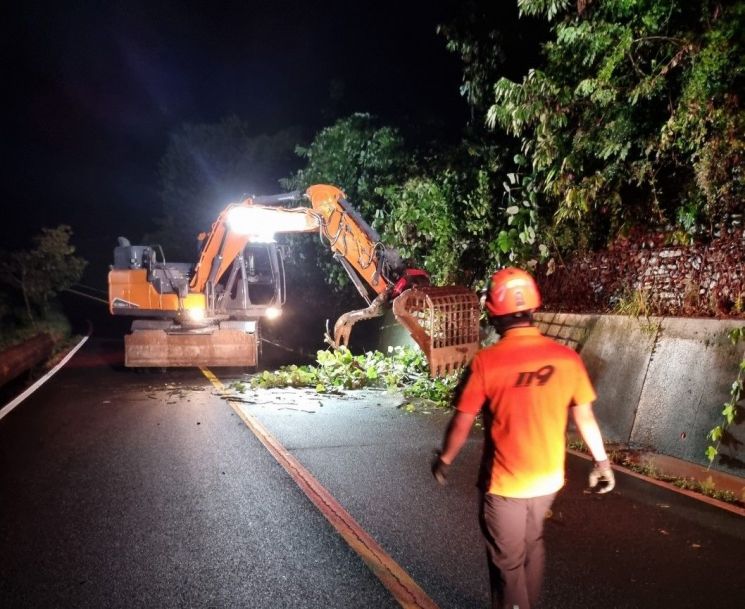 Fire authorities are using heavy equipment to remove a fallen tree on a road in Ibanseong-myeon, Jinju-si, Gyeongnam.
 [Photo by Gyeongnam Fire Headquarters]
According to the Korea Meteorological Administration, 30 to 100mm of rain was forecast across Gyeongnam from 6 p.m. to midnight, with more than 180mm expected along the southern coast.
On the 22nd, it is expected to remain mostly cloudy, with 5 to 20mm of showers likely in the western inland areas of Gyeongnam between noon and 6 p.m.
As of 2 p.m. that day, 184 safety measures had been implemented in the province due to flooding, soil runoff, and fallen trees caused by heavy rain and wind, but no casualties were reported.
© The Asia Business Daily(www.asiae.co.kr). All rights reserved.



















